
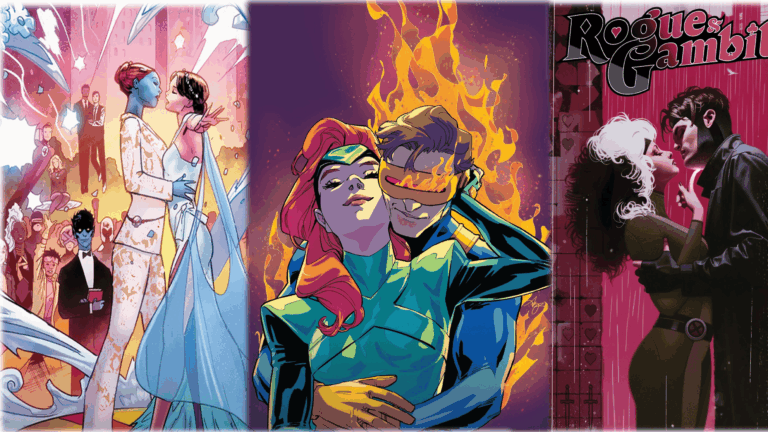
No franchise in Marvel has the kind of complex, emotional, and at times, downright messy romance stories that the X-Men do. The 63-year-old comic line has frequently been called a soap opera, with the emotional, pulpy, and fraught relationships between the characters being a key selling point for the series, particularly as it achieved ever greater fame in the 1980s and 1990s.
With dozens of prominent characters and hundreds of supporting players, the X-Men feature some of the most memorable romances in comic history. But there are a few that are a cut above the rest. Which endure throughout the decades not because of nostalgia or mandate from shadowy editors, but because they are good and well-written. So today, on this day of love, let’s explore these three key X-Men love stories, and what makes these lovebirds work and triumph over the adversity that they face.
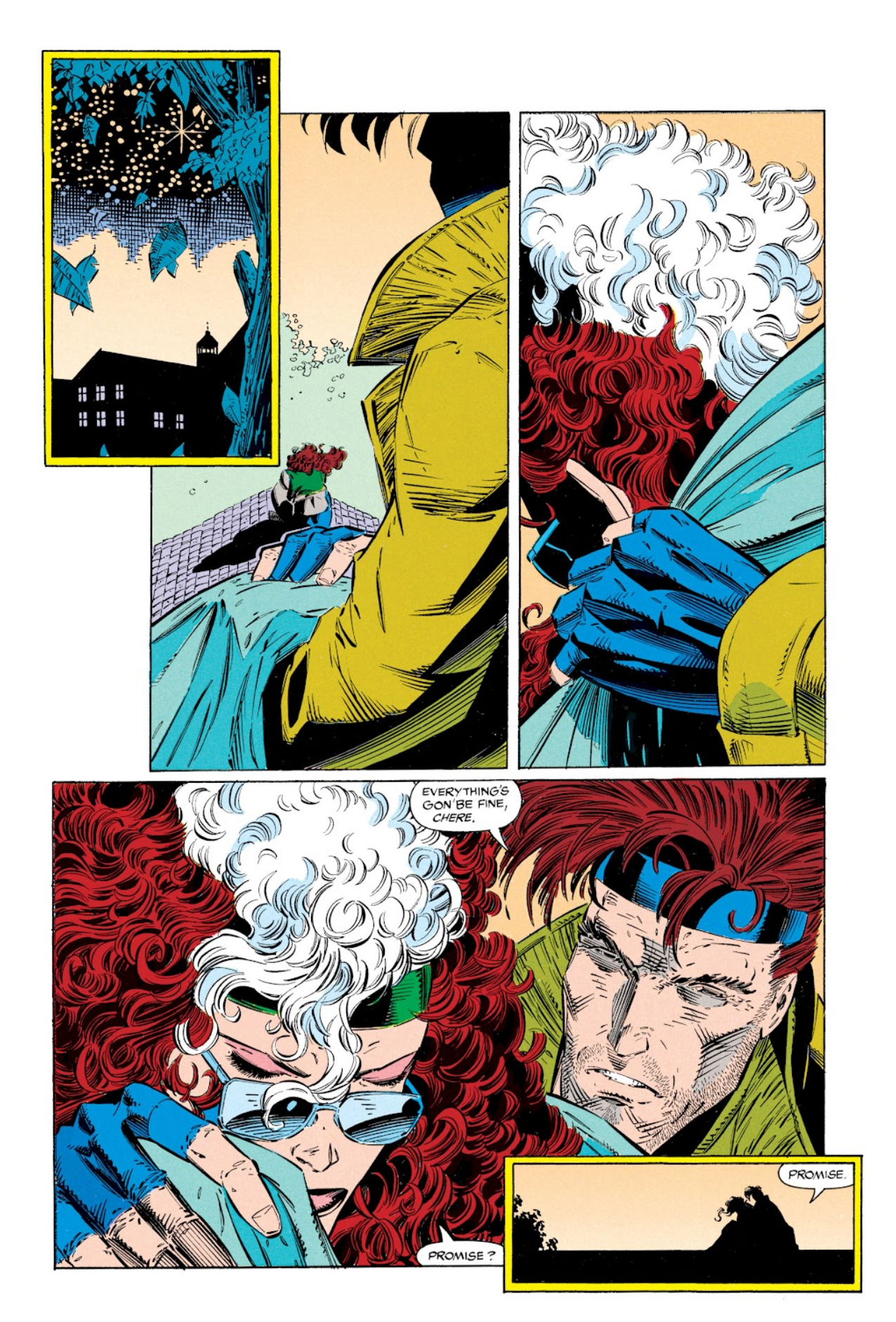
The youngest couple by both age and chronology, Rogue and Gambit, have taken the world by storm recently, likely owing to the tragic portrayal of the couple in X-Men ’97. There’s few things romance-minded viewers and readers enjoy more than angst, and Rogue and Gambit have plenty of that. Since the 1990s, these two characters have gravitated toward one another, both as reformed villains who at times faced judgment and skepticism from their fellow X-Men. Gambit’s presentation as a man of danger, an unscrupulous criminal, and a womanizer won him some ire from the other X-Men, though it always seemed to please the ladies. But the truth about Gambit was that he was a much more loyal and true soul than his outward presentation betrayed. And the only woman who captured his eye and heart was Rogue.
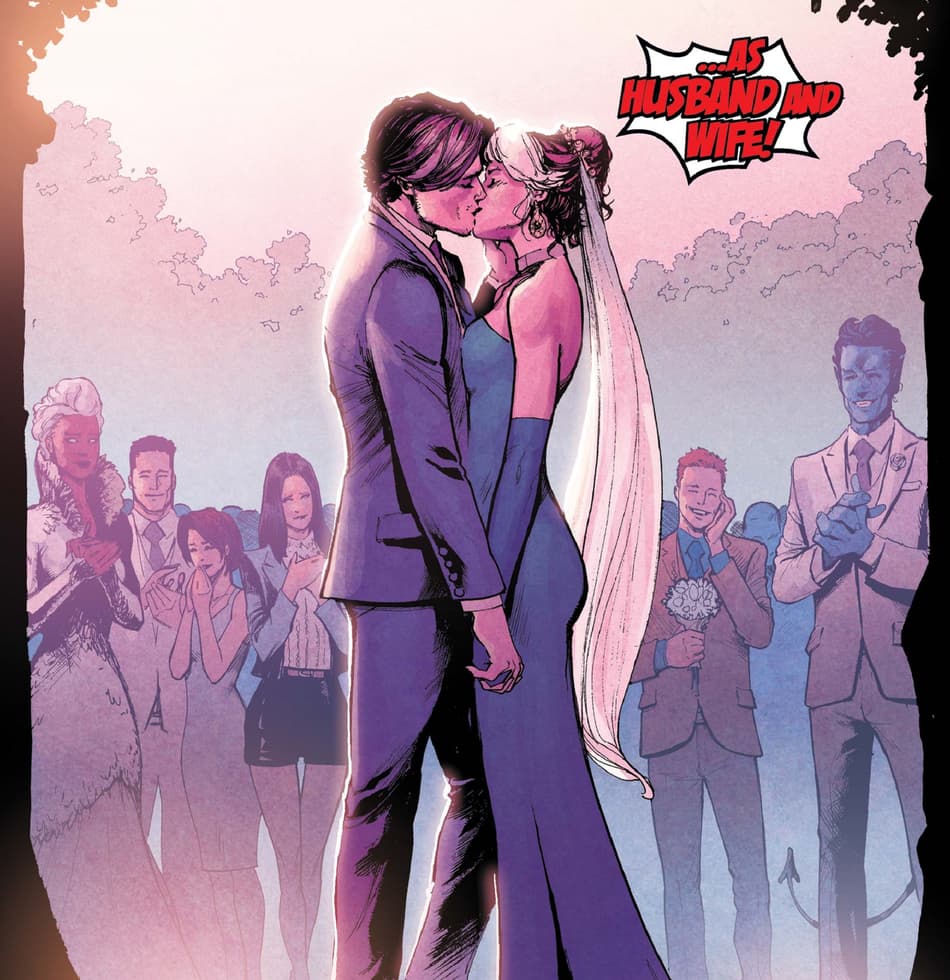
The hook to their relationship, at least initially, was that of two people who loved each other, but couldn’t touch. It’s a stroke of genius, one that Fabian Nicieza and Scott Lobdell deserve credit for. Yearning and pining are staples in great romances across fiction, and that is magnified here with yearning brought on by the inability to even touch the other person.
Gambit’s patience then, and his refusal to take short-cuts or give up on Rogue to satisfy his baser instincts is what makes him such a beloved character, particularly among X-Men women readership. Gambit is one of those rare male characters in comics who does the bulk of the emotional labor in his relationship with Rogue. Gambit is the one who must wait, who must be patient, who must love and endure even when rivals for Rogue’s affection appear, such as Joseph, Deadpool, and even Magneto.
And for Rogue, who has been surrounded by those who are treacherous or false, Gambit is a constant presence of enduring love. Even when it’s most difficult, or when he is angry at her, Gambit’s feelings for her are true.
This is showcased particularly effective in Uncanny X-Men #297, Song’s End, which showcases that early tension in their relationship; one of both skepticism but also yearning. Gambit understands Rogue and takes on a role that is refreshing for male action heroes in superhero comics: that of the one who is the shoulder to cry on. Rogue, more often than not, tends to be the focus and the main star and attraction of X-Men narratives focusing on the duo, and part of what helps Rogue and Gambit succeed is how traditional gender roles are subverted to an extent.
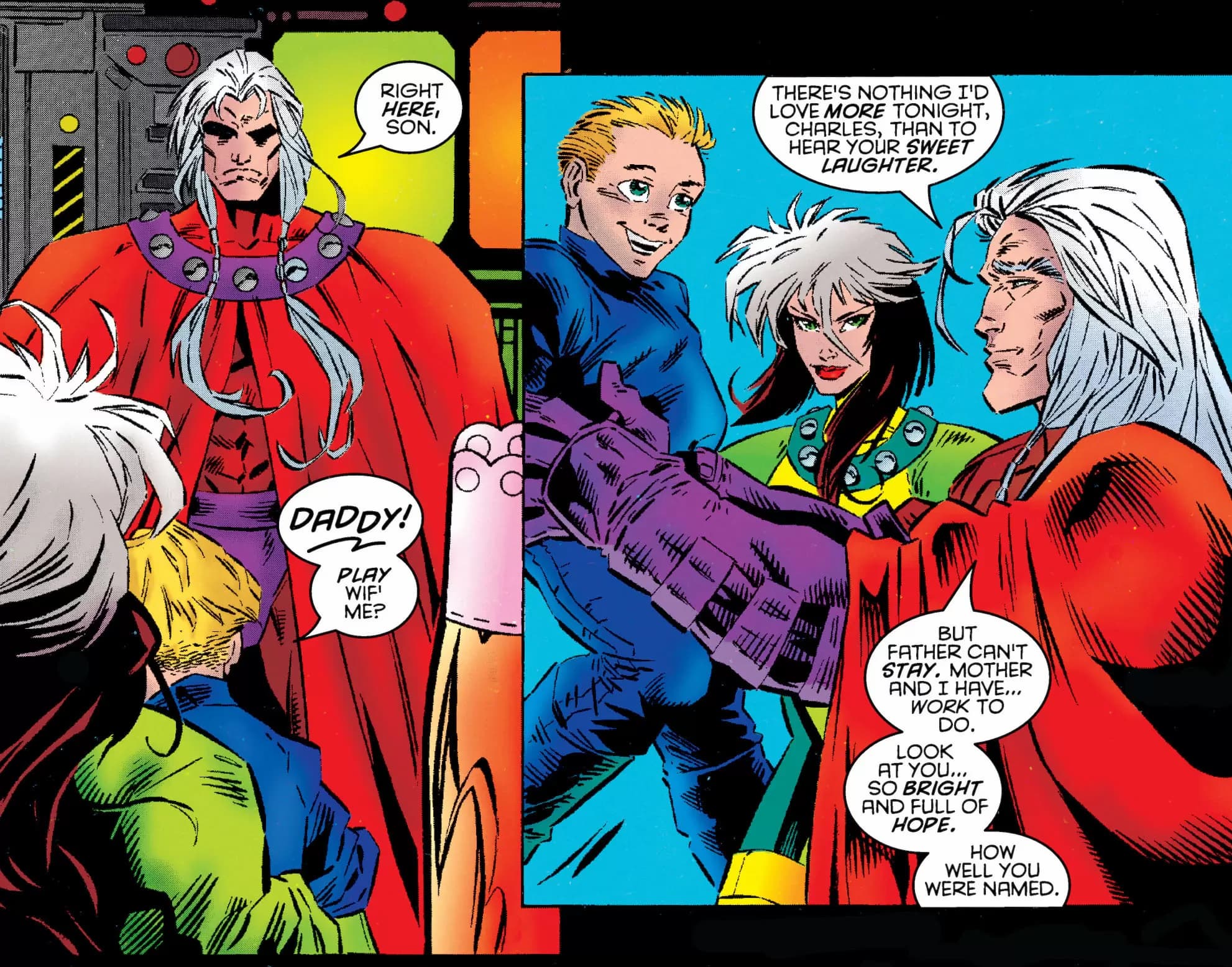
Gambit’s romantic history is considerably more narrow than Rogue’s, and when it comes to competitors and rivals in this romance, they more frequently involve romances between Rogue and other men. It’s easy to dismiss most of these, however, if only because they feel so shallow. Rogue’s romantic entanglements with other men primarily revolve around her ability to touch those men, usually thanks to power-related reasons. Joseph and Deadpool feel more like pairings of convenience than actual love matches; there’s so little there that feels genuine rather than just purely physical.
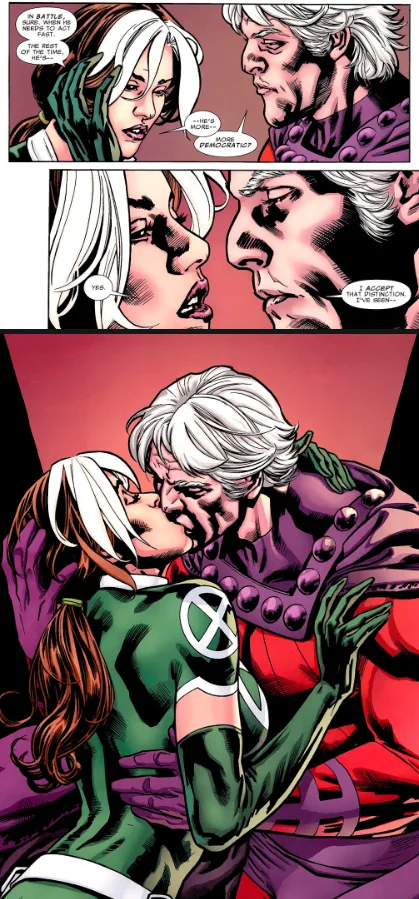
The only serious rival to Gambit is Magneto, who had a relationship with Rogue in Mike Carey’s X-Men Legacy, as well as a marriage to her in the Age of Apocalypse. Magneto and Rogue’s romantic history is a complicated one. Once again, it is premised on their ability to touch one another, but X-Men Legacy does show the chemistry between them.
Their relationship lasts some time, and even survives a long-distance gulf driven the schism within the X-Men. Magneto is accepting of Rogue’s darkness, and she brings out a tenderness in him that’s rare. But the differences between the two are too striking and too narratively tenuous. Magneto’s interest in Rogue is hard to divorce from her relative youth and vulnerability, and Magneto’s appeal is attached to Rogue’s ability to touch him. There isn’t a sense that this is a romance meant to last; just one that both characters perhaps needed at the time but then grew out of.
It is Gambit who can make Rogue reckon with her own flaws, while bringing out her better nature. Though the two aren’t perfect together (certainly, sometimes Rogue is a bit too permissive of her mother’s disrespect to him) nor in storytelling (Gambit’s history and individualism tend to seep away when he is with Rogue), they have a bond that is striking, lasting, and more deeply romantic than any of the alternatives.
Is there any couple in X-Men that are even half as iconic? Like Reed Richards and Sue Storm, or Peter Parker and Mary Jane Watson, Scott Summers and Jean Grey are part of that trinity of Marvel couples who have been the backbone of stories across the decades. More so than any other pairing in Marvel, Cyclops and Jean Grey are defined by tragedy and revival.
With origins in the Silver Age, few characters are so tightly wed to one another’s growth and development as these two. In the very first issue of X-Men an attraction develops, and one that plays out across the 1960s. With Cyclops torn between his longing and his fear of harming other due to his ocular powers, Jean Grey played the part of the tender-hearted romantic who desired the angsty hero, but didn’t act for fear of uncertainty. It’s an old-fashioned, but charming dynamic, one that Stan Lee and Jack Kirby, Roy Thomas and Werner Roth, and then Neal Adams all play with and advance, rapidly making the two a couple across those initial 65 issues of the Silver Age.
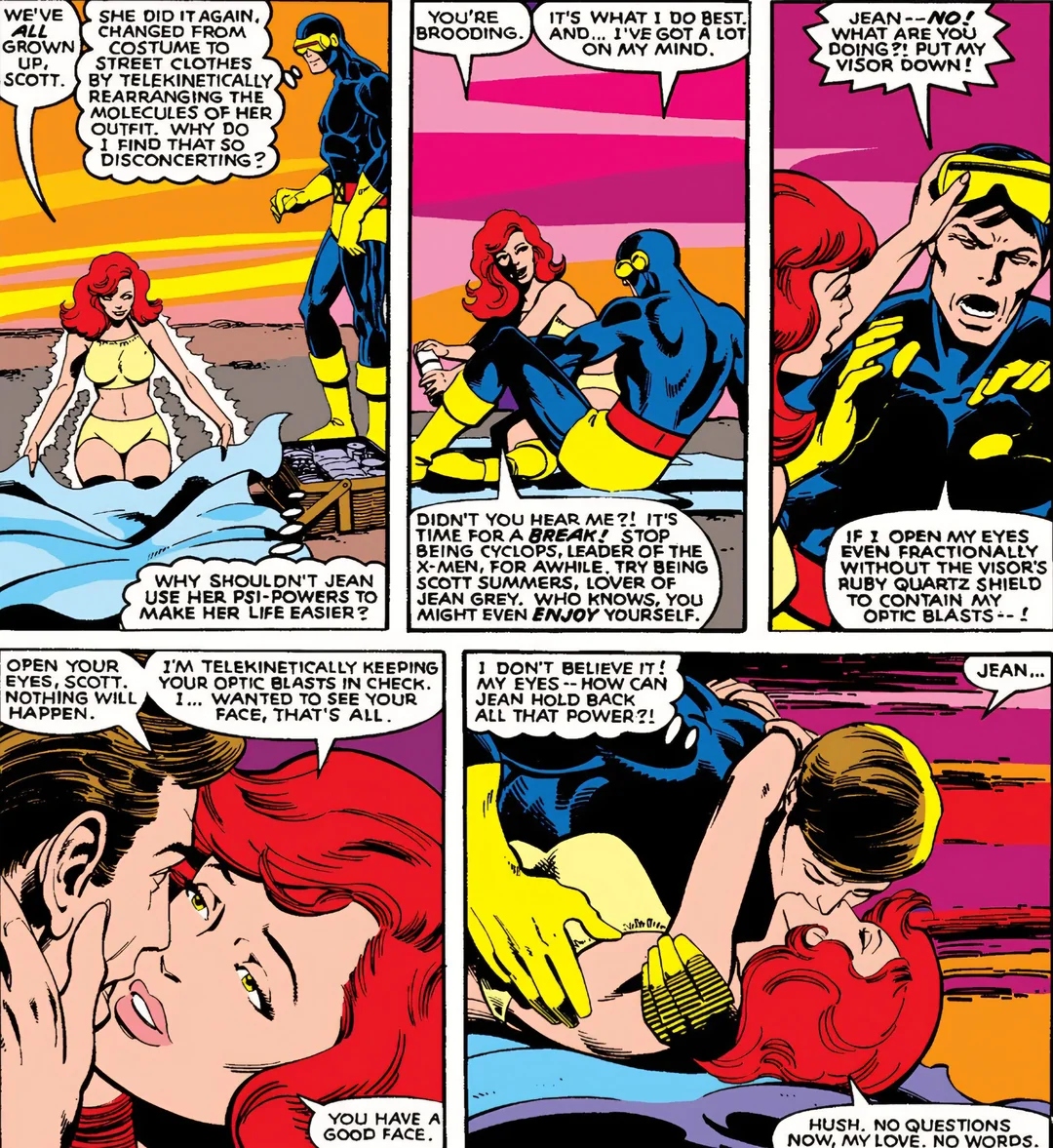
It is Chris Claremont however, who transforms the pair. When Jean Grey becomes Phoenix, one of X-Men’s greatest story arcs begins. Across the pages of the Dark Phoenix Saga, Cyclops sees Jean Grey transform, both physically and emotionally. Their love becomes more mature, with Jean being more assertive and confident.

The iconic love-making atop the Butte is symbolic of their relationship: Jean Grey can hold back Cyclops’ powers, and make him able to see the world around him without fear of destruction or harm. For a character who had such a complex over this, it’s a profound moment, one that echoes in the character’s history for decades. Jean makes Cyclops feel safe, and their connection births a psychic rapport that becomes crucial to their characters.
Jean Grey as Phoenix pushes Cyclops to be more open with her and more emotionally available, and the Dark Phoenix Saga shows his growth as a character; from a sometimes quiet, insular, and stoic figure to a man who can truly let his guard down around the woman he loves and bare his heart to her. Nowhere is this clearer than in Uncanny X-Men #129.
Of course, tragedy defines this pair. More than any other couple in Marvel, Cyclops and Phoenix are a duo that are certainly star-crossed. Tragedy and heartache strike just as they are about to attain happiness. Jean Grey’s death at the end of the Dark Phoenix Saga, the complicated events of her resurrection and the disolution of Cyclops’ marriage to Madelyne Pryor, their son being torn from them and sent to the future for his own safety, the end of their marriage in New X-Men following Cyclops’ affair and Jean’s second death. Even now, Jean Grey’s great cosmic destiny ensures that she’ll far outlive the man she loves.
Cyclops and Jean Grey are certainly not perfect people. Though Cyclops tries to do the right thing for Madelyne eventually, and is encouraged by Jean to do so, there is no mistaking that ultimately, he chose Jean and the life of a superhero over the domestic life he had built. Likewise, Jean Grey and Cyclops are tested more than most couples in temptations from others, namely Wolverine and Emma Frost. Tests that these characters fail. Unlike Reed Richards and Sue Storm, or Peter Parker and Mary Jane, Cyclops and Jean Grey are unique for how they do succumb to these temptations in more definite ways than their counterparts in other Marvel titles.
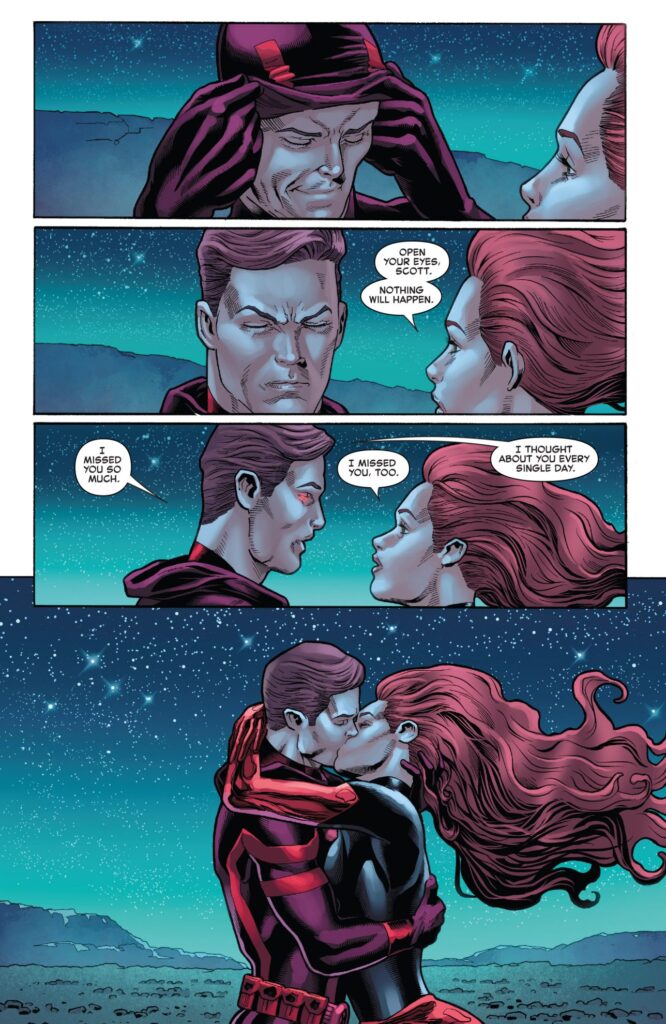
But it is their failing that make them unique, and what makes their relationship so special. Because Cyclops does fail in New X-Men, to be a faithful husband to Jean Grey. And Jean Grey for her part does harbor that attraction to Wolverine that is made so famous by film and television. That they still love each other the most and most deeply however, is what makes Cyclops and Phoenix one of a kind. For no other couple in Marvel survives and persists beyond hardships and heartaches like these.
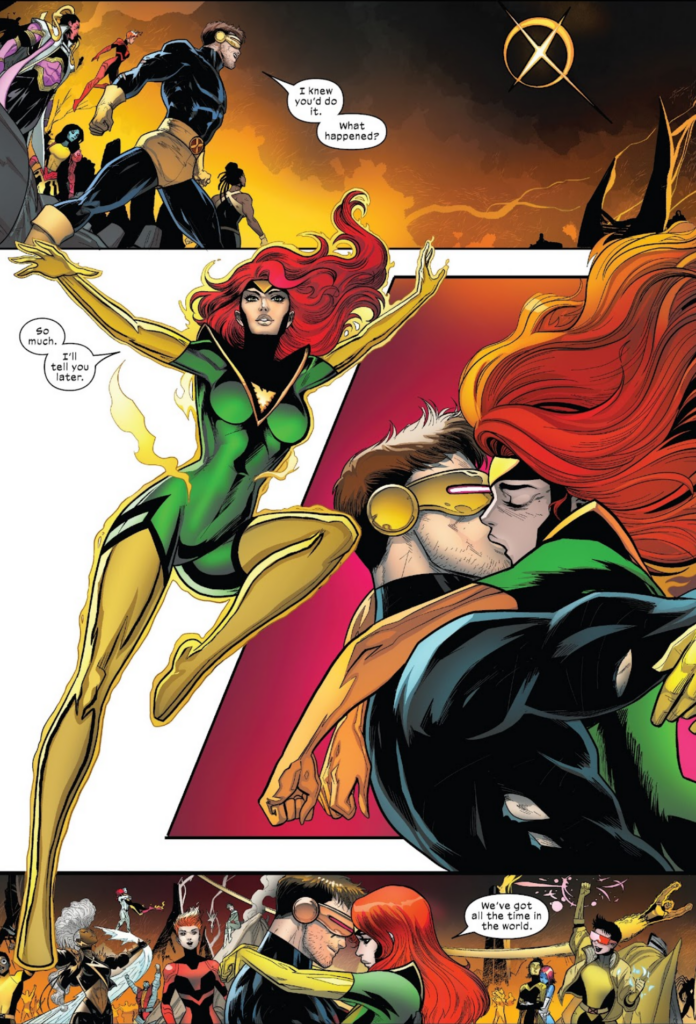
The beauty of their relationship is that they always do find each other again. Jean Grey died at the end of the Dark Phoenix Saga, but she rises again and returns to Cyclops’ arms in X-Factor. They do give up their son to the future in X-Factor #68, but they find him again as a grown man, Cable, and build a bond with him. Their marriage ends in New X-Men, with Cyclops moving on with Emma Frost as Jean ascends to something different, beyond life and death. Their younger selves, brought to the future, are traumatized by the fate that awaits them. Yet even as they try and turn away from each other, they find themselves drawn to each other again, unable to reject each other, wanting to do better than their future selves do. Cyclops ultimately chooses to end things with Emma Frost, and when Jean Grey is resurrected, his true feelings and apology are laid bare. When they meet again, alive and whole once more, they resume their marriage.
Like a phoenix, their love is constantly reborn.
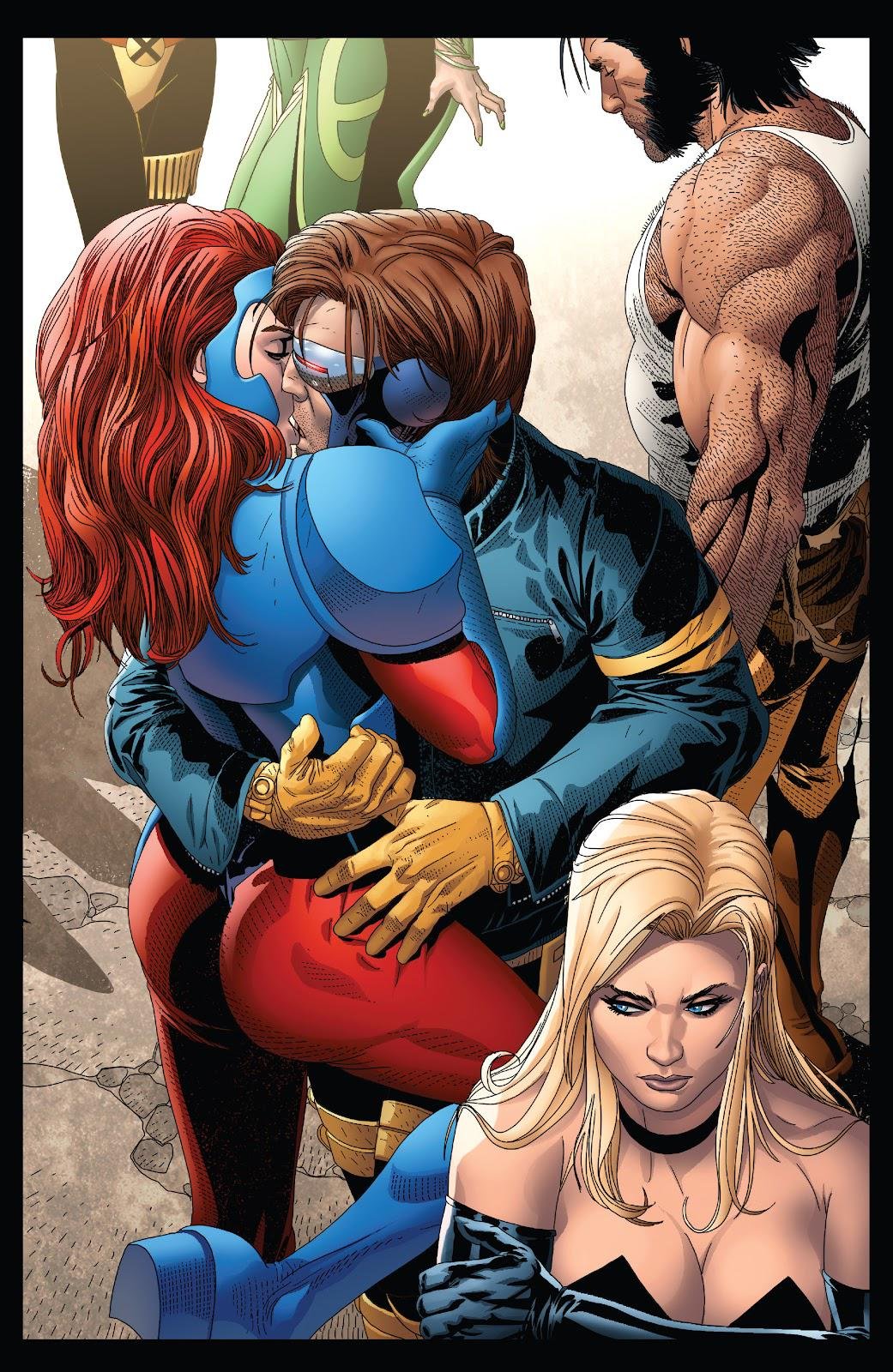
Cyclops’s other main relationship is with Emma Frost, while Jean Grey is famous for her movie-enhanced bond with Wolverine. Both relationships have their fans and their own legacy, but neither have stood the test of time, nor prove to be the most emotionally healthy for the characters involved.
Jean Grey and Wolverine’s relationship is one of temptation and inner desire, but not one that is actively explored by either party. Jean feels an attraction to Wolverine, but both seem to understand nothing can or should come from it; their mutual flames would burn out and Wolverine in particular seems to understand Jean will always look back towards Cyclops before anyone else. Moreover, the initial hints and teases of their romance by Chris Claremont have not aged particularly well. The aggression and forcefulness of Wolverine comes across quite badly in the 21st century, namely their interactions in Classic X-Men and during Inferno. The actual amount of interactions the two share are relatively small; made larger by the movies giving the impression that there was more to their dynamic than the comics truly suggested.
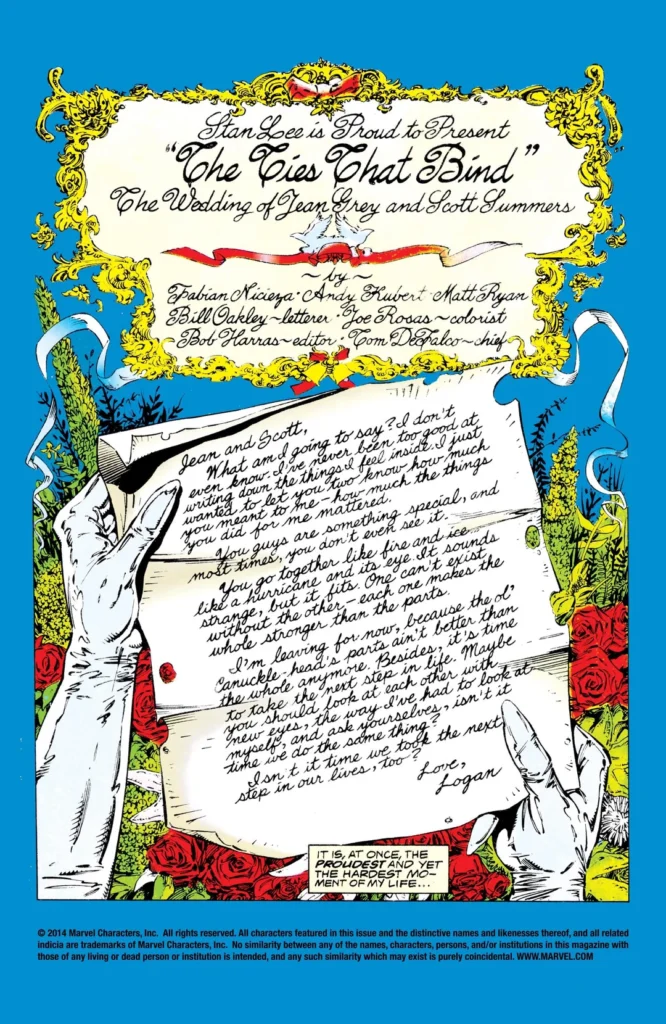
Wolverine for his part has worked best when he works with the couple as a friend and companion, illustrated particularly well by his letter to the couple in X-Men #30.
Cyclops and Emma Frost encounter a different issue. While it’s a frequent refrain that Emma pushed Cyclops to grow and evolve as a person, the same can’t be said for Cyclops with Emma. His star outshone hers, and Emma frequently felt shrunk down to fit around and support Cyclops in the narrative. Throughout New X-Men Volume 2, New Mutants Volume 3, and Uncanny X-Men Volume 2, Emma Frost is frequently portrayed in a more flawed, less-generous light than Cyclops, written to be more petty, vindictive, and spiteful, while other stories have Emma castigate herself while praising Cyclops’ noble morals and brilliance. Her flaws, her insecurities, her sacrifices were put at the forefront, but Cyclops never seemed to reciprocate. If anything, his frequent thoughts of Jean only twisted Emma’s insecurities further and further.
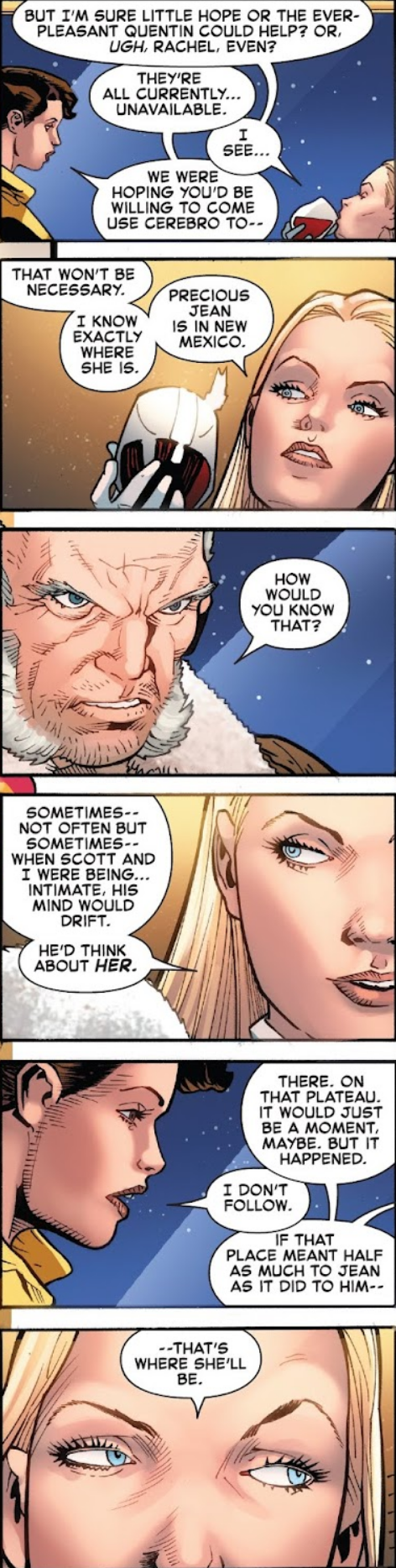
Emma’s insecurities are such that she tries to smother Hope in her sleep for her resemblance to Jean Grey. She later torments a younger Jean Grey in Brian Michael Bendis and Chris Bachalo’s Uncanny X-Men Volume 3, out of jealousy of her older self and the bond she shared with Cyclops. In Dark Reign, Emma’s sexuality and past is cast in a bad light, something Cyclops must forgive, albeit reluctantly, for the sake of the mutant cause. Namor reminds Emma, that Cyclops never quite offers Emma what he takes; her devotion is not rewarded with his. After all, he married the redhead.
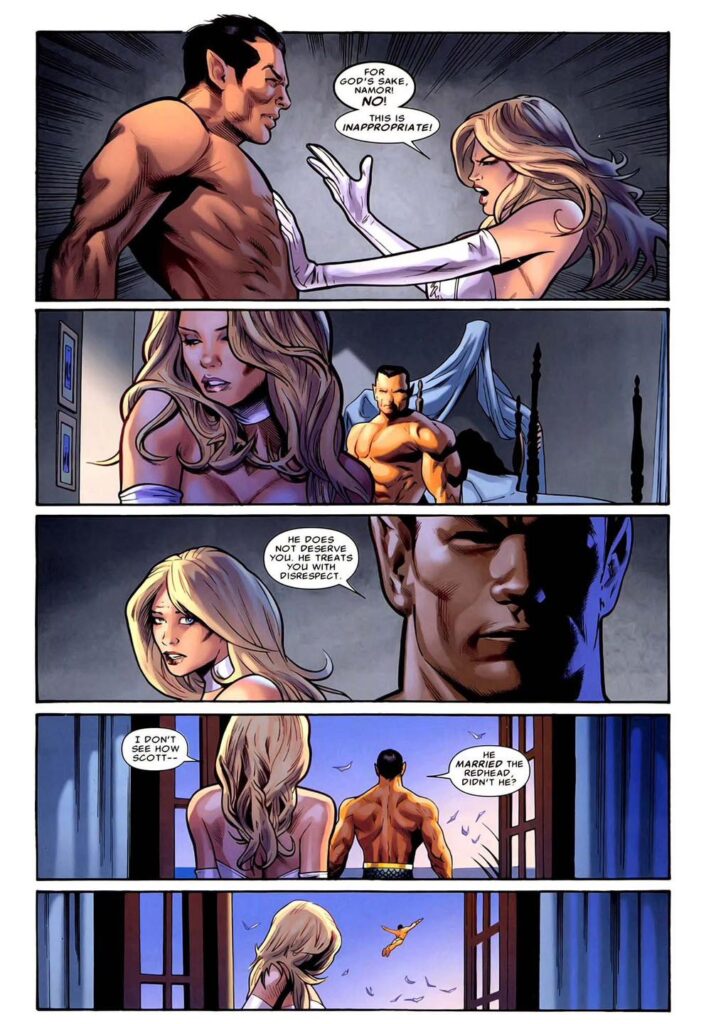
An unfortunate pattern develops: Emma Frost is frequently cast in a worse, more morally dubious light to Cyclops as a result of their relationship. Where he is noble and well loved by their comrades, she is calculating and loathed. Where he is martyred by the story, she is demeaned and made to be jealous or genocidal (as in Inhumans vs X-Men).
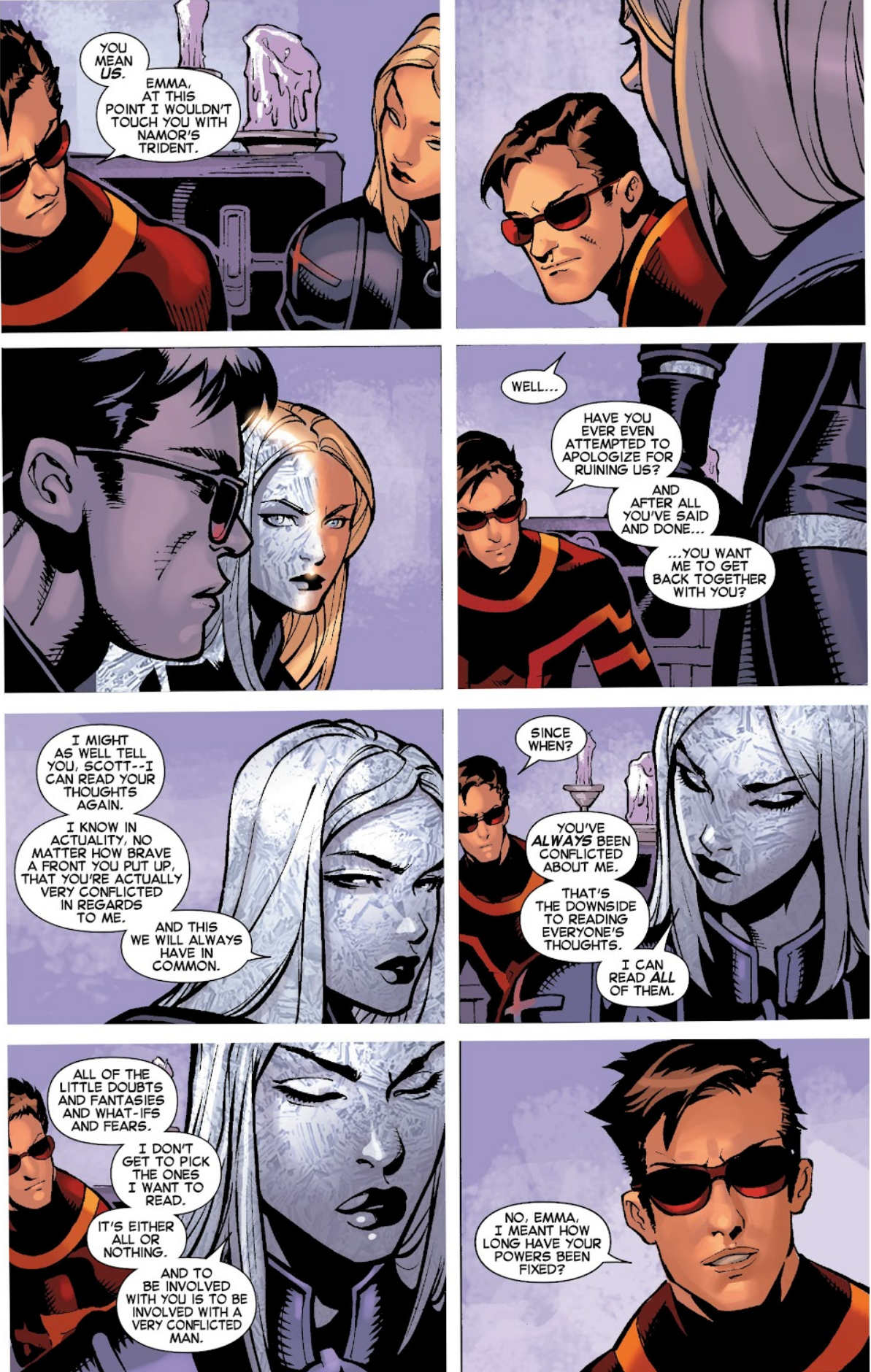
Cyclops is also perhaps too similar to Emma in many ways. Their shared mindset meant that Emma would often reinforce Cyclops’ own views, and when disagreements began to happen, their relationship ended. Cyclops cannot stomach Emma’s indiscretions with Namor, and coldly shuns her attempts to reconcile. Cyclops almost always gets his way where Emma Frost is concerned, the consequences for her character be damned.
Jean and Cyclops in contrast have survived many conflicts and disagreements. And their fundamental differences are perhaps why Jean is able to push Cyclops without pushing him away. Cyclops during his time with Emma became increasingly isolated, cut off from his friends and allies until there was no one left. His brother, Alex, even celebrates when Emma is finally cut out of Scott’s life. Cyclops with Jean in contrast, has a full family, and on Krakoa, is reunited with his friends again, closer than ever. When Jean and Cyclops argue over the Brood, Cyclops backs down and later agrees to her request to leave the X-Men to focus on each other.
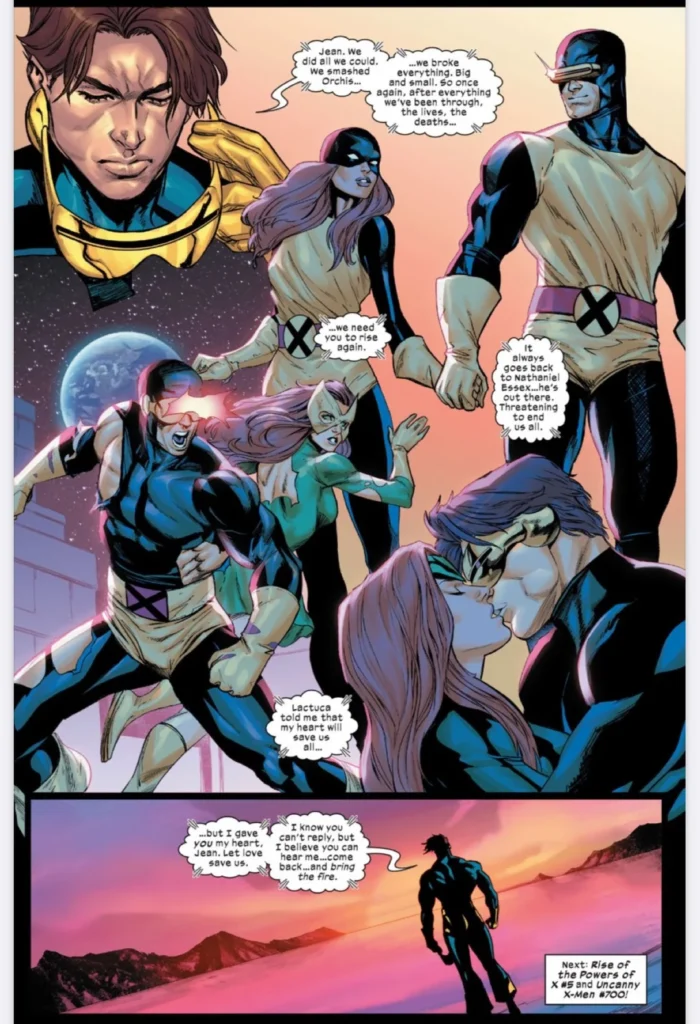
The gender dynamics of Cyclops and Emma Frost relationship tilts firmly in the direction of the traditional male lead. But the scales are reversed with Jean Grey; her gravity as a character as Cyclops in her orbit. There is a more equitable balance in their relationship and how writers treat their respective power. Where Emma is vilified and shamed in contrast to Cyclops, Jean Grey is kept in the light, and lifts Cyclops up into it as well.
It’s probably no surprise that Emma Frost was able to reach new heights as a character once she and Cyclops officially ended things. Krakoa saw Emma become a leader of mutants, independent of Cyclops and his narrative weight, and able to stand tall on her own. She forged a real relationship with her daughters, befriended the women she had once alienated, married an Avenger and achieved broader crossover fame. Like Wolverine, Emma is able to accomplish more as a character on her own.
The most recently married, but the oldest in-canon couple, Mystique and Destiny are one of the most fascinating love stories in Marvel. By all rights, they’re a terrible duo morally. Mystique’s actions throughout X-Men have been frequently reprehensible, and her moments of heroism fleeting and far between.
Destiny, likewise, often served as a sinister figure, with eerie premonitions of the future and a history of allying with evil causes. The pair of lovers have deceived, lied, betrayed, and killed in abundance. And though at times they have fought on the side of the heroes, their penchant for treachery has often put them at odds again with the X-Men.
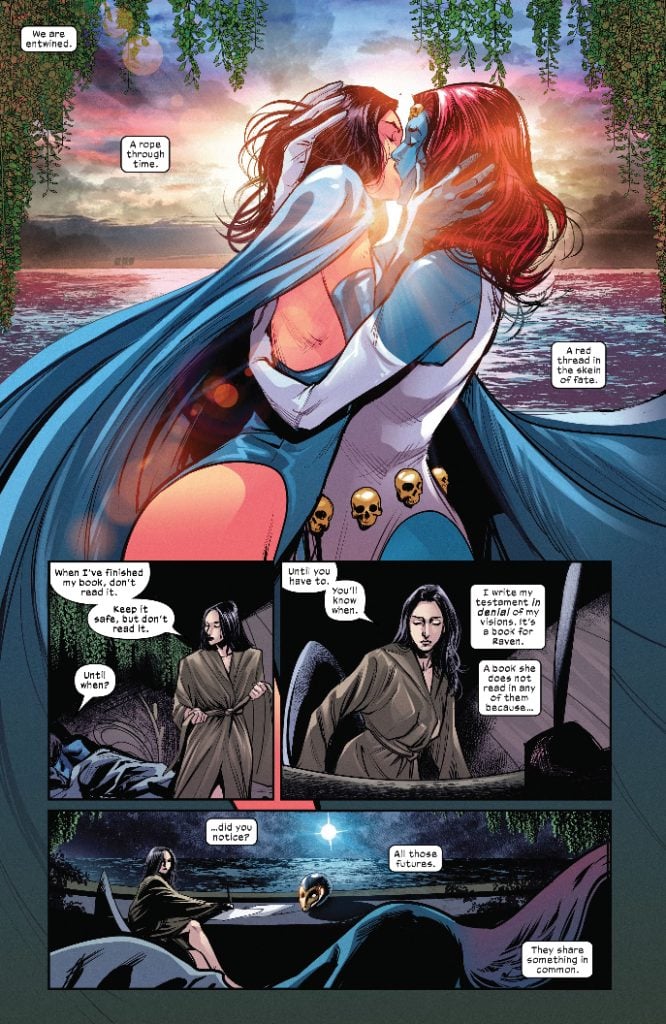
It’s all the more striking then, that two such treacherous characters have such deep, unabashed love for one another. Mystique and Destiny are loyal to no one but each other, and the lengths they will go to for each other are as deep and profound as any pair of heroic lovers.
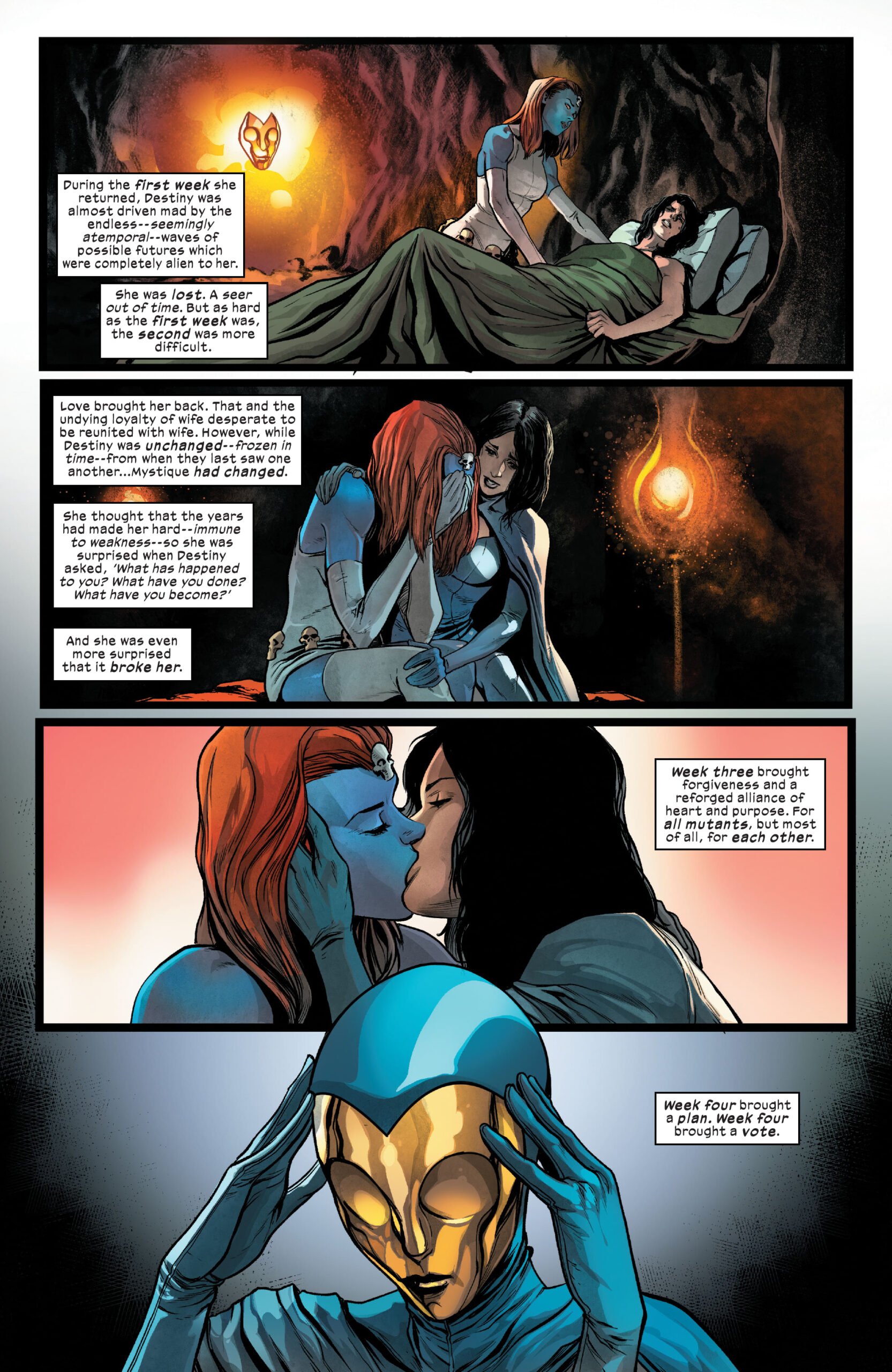
Krakoa recontextualized and fleshed out their decades-long relationship. Mystique’s mutation allows her to live longer, but even as Destiny aged, Mystique was loyal to her. Over the course of Jonathan Hickman’s X-Men, Mystique went to profound lengths to bring Destiny back to life, to the point where even readers well used to her backstabbing couldn’t help but feel sympathetic to her and her yearning for the woman she loved.
Their marriage issue wasn’t an entirely satisfying affair, but it did cement the couple for who they are: out for themselves, largely, but deeply loyal to one another. And on Valentine’s Day, that’s worth celebrating.
Mystique’s other relationships have been with Sabertooth, Wolverine, and Iceman. It’s obvious to see why each one failed. Iceman was a closeted gay man, and now that he’s out and living his best life, revisiting it is impossible. Sabertooth is a character steeped in violence and blood, and the product of their union was a genocidal villain in Graydon Creed. It’s hard to ever buy into such a relationship when so much of it was built on hate and convenience.
And then there’s Wolverine and Mystique. The movies and some of the comics of the 2000s certainly pushed this relationship, but it never clicked into place. Mystique’s treacherous nature and Wolverine’s deep skepticism created an untenable situation for them. The encounters bring up uncomfortable topics of consent, and it’s no wonder that comic writers have firmly tried to put that behind the characters.
These three relationships have served to define entire eras of X-Men history, and each is unique, speaking to a different facet of romance that help diversifies the romantic history of Marvel Comics. While traditional, more wholesome relationships like Reed Richards and Sue Storm or Peter Parker and Mary Jane have broad appeal, the X-Men often show that there is power and appeal in the more tumultuous areas of romance.
Rogue and Gambit, Cyclops and Phoenix, Mystique and Destiny; none of these relationships are by any means perfect, but there is a beauty in how, even when all is darkest, or when the odds are stacked against them, or when others are inserted into their relationships, these characters always choose one another. There is a gravity to their relationships that define the characters and define the X-Men.
So, for Valentine’s Day, may this love find you.