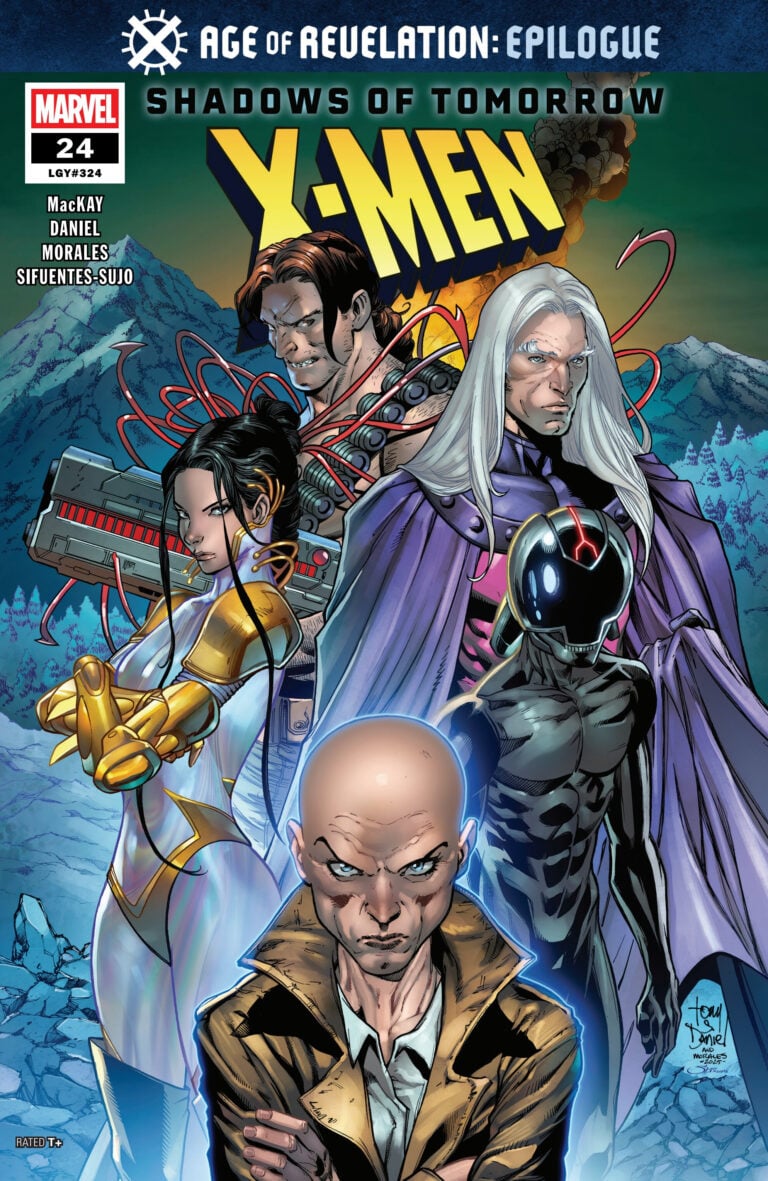
Following the return from the Age of Revelation, it’s not just the X-Men who are reeling from Cyclops’s sojourn to the future and the past/future swap that occurred. 3K, the X-Men’s main enemies during this run, are also in a state of chaos.

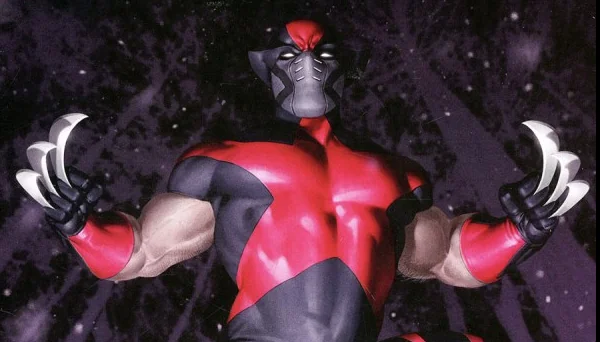
X-Men: Age of Revelation Finale #1 ended with the bombshell reveal that the mysterious, masked Chairman of 3K is in fact Beast. Not the Beast of the Factory, who is currently on the X-Men, but the Beast of Krakoa: The Beast of the Original X-Men, who has taken a dark turn and embraced villainy.
Thought to be dead after the events of Benjamin Percy and Joshua Cassara’s X-Force, Beast is in fact alive, and now serves as the Chairman of 3K, the mutant terror organization that has been turning humans into mutants. And it is this Beast that went to the future with Cyclops, witnessing what the future beheld, and now returns to the past armed with that foresight and knowledge.
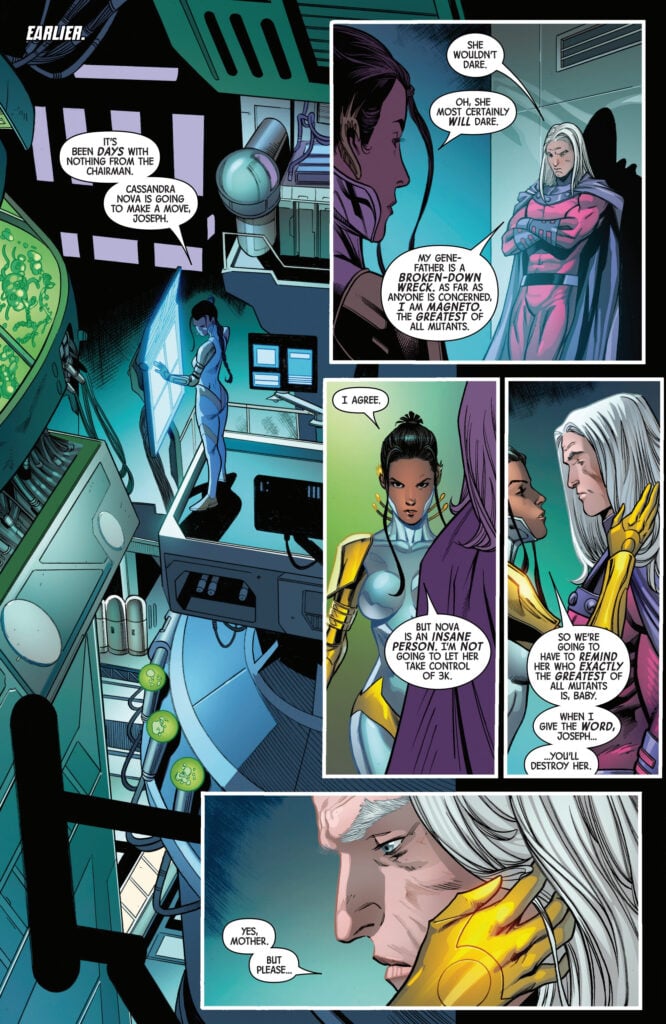
With the Chairman absent for the past week, while the Age of Revelation took place, 3K has reached a boiling point. Never an organization that seemed to get along well, the leading members are at odds with one another. Cassandra Nova seeks to take power, and the main force standing in her way is Astra, who commands the loyalty of the Magneto clone Joseph. Wyre, the brutal drill sergeant of 3K, stands in the middle, with 3K’s X-Men loyal to him, and able to decide the fate of such a battle.
It’s a compelling premise. 3K has been mysterious and shadowy, by design, but 24 issues into this X-Men run, MacKay wisely decides to give us a much clearer picture of the group, rather than keep them in the shadows. It’s a decision that feels overdue, and it is rewarding to get this clearer glimpse of this run’s main villains.
The scheming and backstabbing suit a villainous organization, and each member is given a distinct personality and a clear reason to dislike the others. Their alliance is a tenuous one, and it underscores the importance of Beast (who shall be referred to as the Chairman henceforth, to avoid confusion with the X-Men’s Beast) in this organization, able to corral these dueling egos and keep everyone focused and in check.

Pay at least $16 for these 10 items
The pacing remains a weakness in this comic; as mentioned earlier, the inner workings of 3K make for a compelling story, but feel long overdue. And while the issue reaches some interesting conclusions, MacKay’s decompressed storytelling style in X-Men prevents much development from happening in a single issue, which hinders the flow of the narrative.
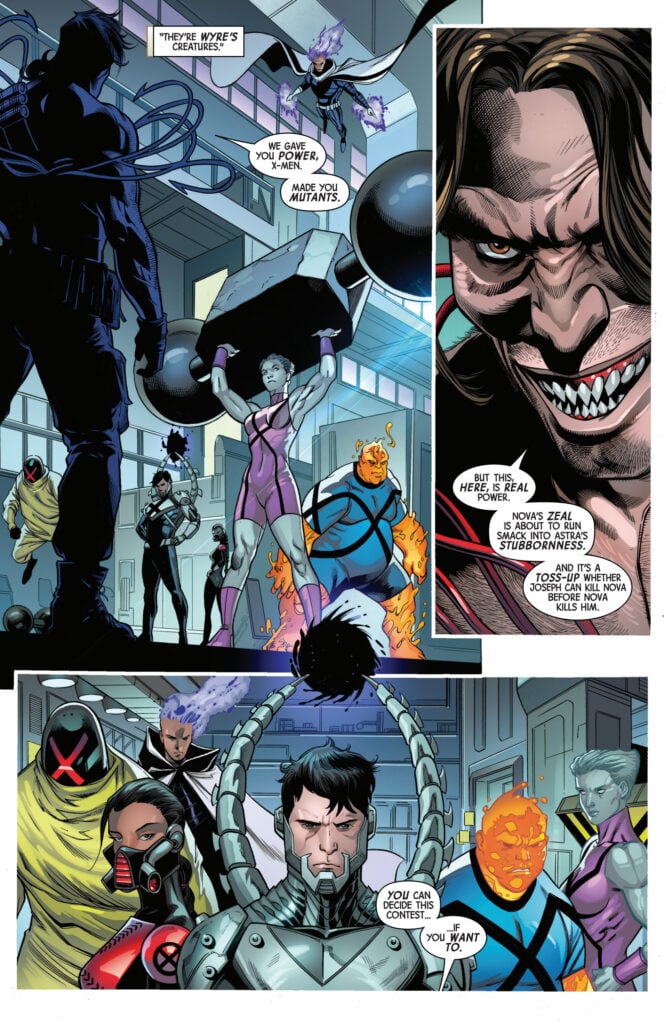
Still, X-Men #24 is a successful issue, and one of the strongest of the run so far. This is in large part due to Tony Daniel’s art. Daniel draws characters like Cassandra Nova, Astra, and Joseph particularly well, and shines with his rendition of Beast. The visual storytelling in the closing pages is cinematic and highly effective.
Daniel’s pencils are inked by Mark Morales and colored by Fernando Sifuentes-Sujo. If there were growing pains in the previous issue over the balance of colors used, that issue seems to have been rectified here. Sifuentes-Sujo’s colors are slightly more restrained and muted, less shiny on the skins of the characters, and make everyone look more natural, save for when some glow is called for, such as when the Chairman reveals his plans.

X-Men #24 is ultimately a successful outing by Jed MacKay and Tony Daniel, with some sharp art complementing a well-written and well-scripted story. While there is a sense that more could have been revealed and shown to the reader, X-Men #24 still comes out as one of the best issues of Jed MacKay’s time on X-Men.
‘X-Men #24’ | The Chairman’s Identity and the Chaos of 3K
X-Men #24 is ultimately a successful outing by Jed MacKay and Tony Daniel, with some sharp art complementing a well-written and well-scripted story. While there is a sense that more could have been revealed and shown to the reader, X-Men #24 still comes out as one of the best issues of Jed MacKay’s time on X-Men.