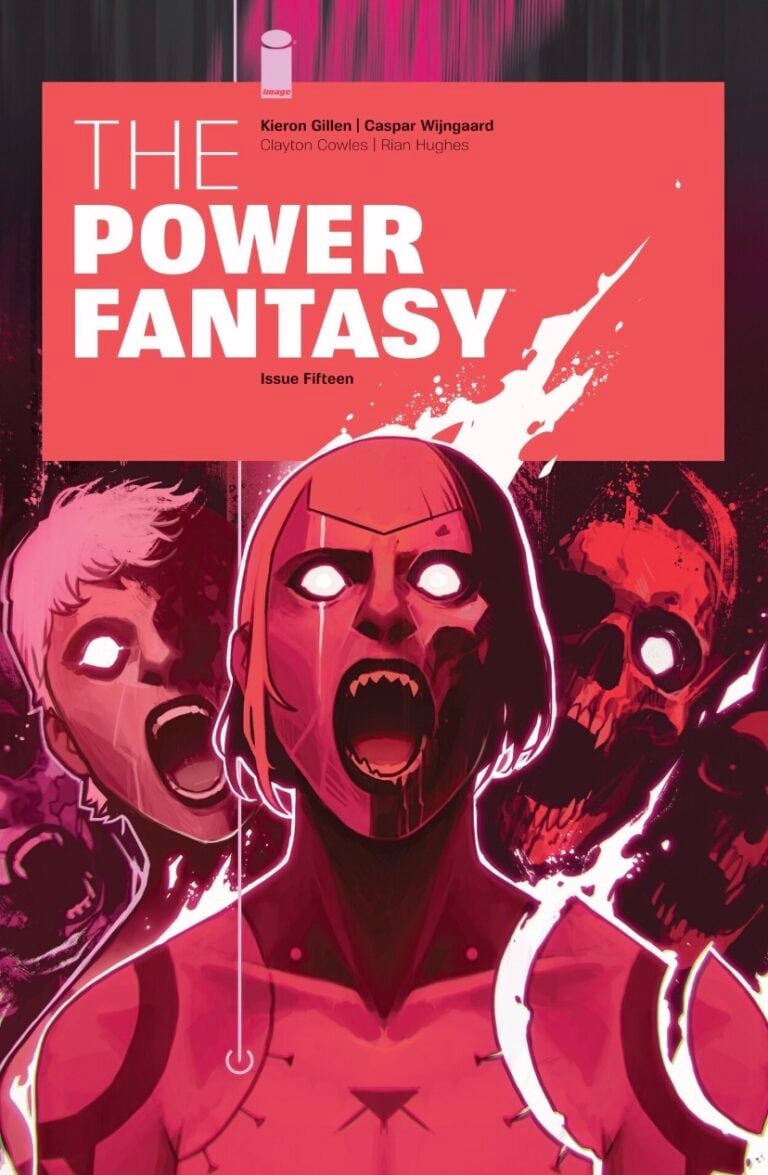
When superpowers fight, everyone loses. That has been the thesis statement of Kieron Gillen and Caspar Wijngaard’s The Power Fantasy. It’s a book that has thrived on tension and the ultimate goal of avoiding a fight between people with different goals who all have all the power they need to achieve them. For decades, it was the ever-ethical telepath, Etienne, who kept them off the path of destruction. Two issues after his death, we finally see why.

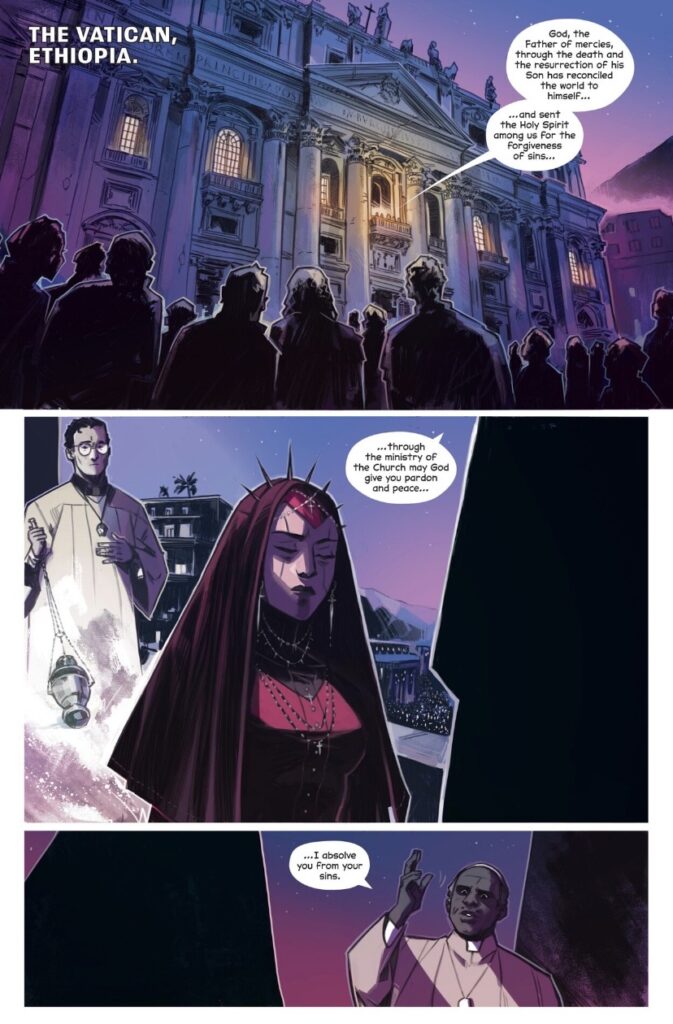
Years ago, Eliza sold her soul in order to gain enough power to stop the end of the world. It was a noble sacrifice, especially for someone already so devout, and after this decision, she was under the impression that there was a God who believed in her; someone who appreciated her sacrifice and promised to grant her absolution for her sins.
But that’s not the full picture. Her “God” was little more than the telepath Etienne trying to keep her from learning what really awaited her after death. Not salvation, but a very real and concrete eternity in Hell. Without Etienne around to keep the illusion alive, Eliza peeked behind the curtain to see her future.
She has every reason to be livid, to wage war against the world, but in this issue, we don’t see an enraged Eliza; we see something more heartbreaking. Someone who made a noble choice, who was told their whole life that good would be rewarded, being shown that her efforts were for nothing. She wants some kind of understanding. She punches a hole to hell with the support of Magnus as Valentina races to try and stop her with whatever support she can gather.
For a story that really lives in character beats, The Power Fantasy #15 is far more plot-centric than what we’ve come to expect. In some ways, that can bring down this issue. Character moments don’t have quite as much time to breathe, with Magnus and Heavy in particular feeling more underserviced. Yet, at the same time, nothing is left feeling undeserved.
This issue has the space to be far more plot-centric because of all of the character work done prior. Nothing feels out of character, and even when some moments feel more rushed, they never lack emotional punch or clarity. Not to mention the characters that do shine are borderline blinding.
Eliza is undeniably the star of the show here. Her complex relationship with the world, with her religion, and with her friends is so apparent in her actions and dialogue. She comes across as someone in a desperate search for an olive branch. She’s not evil or angry; she’s scared and alone. Gillen shows an Eliza who is less a demon from hell and more a woman who was promised everything and has nothing.
Other characters find their footing as well. Masumi and Isabella share a touching scene that shows Masumi’s maturity and rebuilds their relationship without psychic interference, while Valentina’s morality crumbles without Etienne and she’s forced to take on the role he used to fill. Even when moving at breakneck speed, Gillen masterfully brings these characters towards the ends of their arcs without losing sight of the book’s thesis for even a moment.
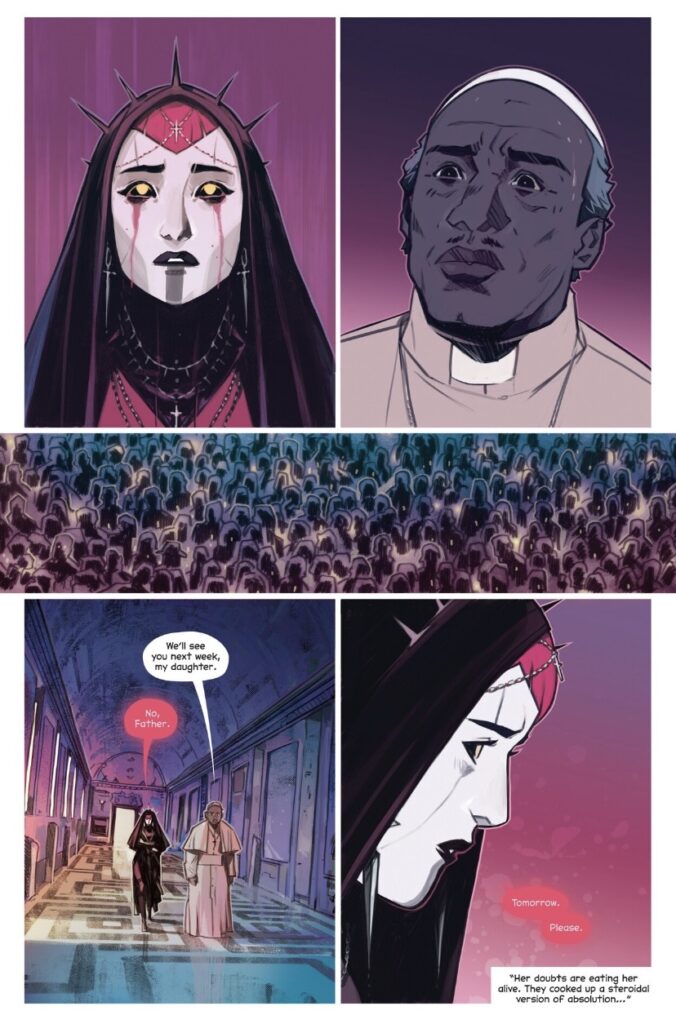
As strong as the story is from Gillen, it’s not hard to argue that Caspar Wijngaard’s work on art is stronger. The visual identity of this book is so integral to the story it’s telling. Wijngaard is a master of his craft in every way. The colors are especially strong with this issue, using each character’s distinct color scheme to highlight scenes and to show Eliza’s impact on the world as everything becomes overwhelmed by her bright shade of magenta.
But where the art really shines is in the character work. Yet again, Eliza is the standout here, with each panel selling the image of someone lost. There’s one panel in particular on the third-to-last page that feels so incredibly illustrative of the tragedy of her character, and the mix of facial expression and disfigurement is something that will stick with readers for a long time.
Though Wijngaard is undeniably the superstar here, Clayton Cowles’s lettering continues to be the best on the stands, and the design work of Rian Hughes is the perfect complement to Wijngaard’s art in creating the visual identity of this book.

The future of The Power Fantasy remains uncertain. Kieron Gillen mentions in his letter at the end of the book that, after the next issue, the team will go on a hiatus at the bare minimum while they discuss where they want the story to go and (more importantly) whether they want it to continue at all.
While it would be a loss to no longer have the series to look forward to, the brilliant tragedy that Gillen and Wijngaard have weaved together here is already making it one of the best books of the decade. So even with the future unclear, after reading issue 15, you can absolutely count on a finale that fires on all cylinders.
‘The Power Fantasy’ #15 | The Heartbreaking Illusion of Divine Salvation
While it would be a loss to no longer have the series to look forward to, the brilliant tragedy that Gillen and Wijngaard have weaved together here is already making it one of the best books of the decade. So even with the future unclear, after reading issue 15, you can absolutely count on a finale that fires on all cylinders.