KPB Interview: Richard A. Hamilton on ‘Leo Da Vinci: Renaissance Kid’ and Turning Leonardo into a YA Hero

Phillip Creary | May 15, 2026

May 15, 2026

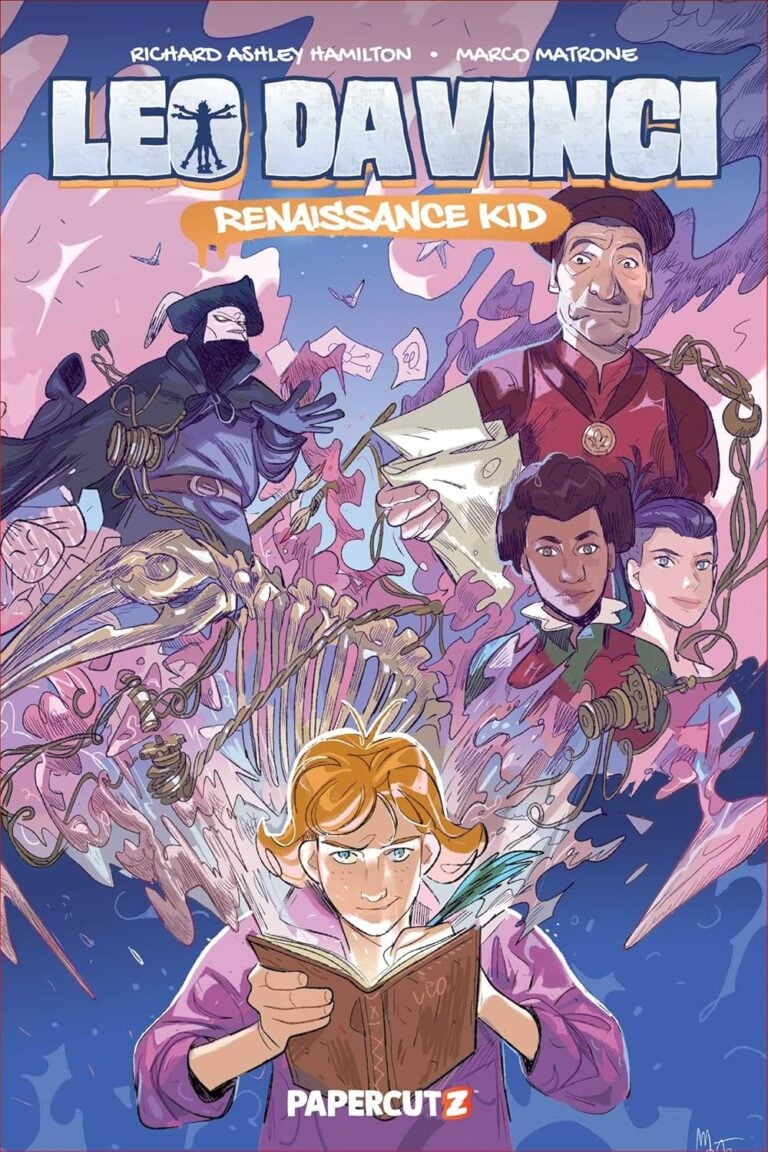
I recently caught up with Richard A. Hamilton, a writer whose decade at DreamWorks clearly informs his cinematic approach to comics. We talked about his new graphic novel, Leo Da Vinci: Renaissance Kid, co-created with artist Marco Matrone. It reimagines Leonardo da Vinci not as a finished, untouchable master, but as a mischievous, brilliant teenager navigating the dangerous streets of Florence. We also geeked out over how a trip to Italy sparked the idea, why Da Vinci is the perfect YA hero, and how Eminem actually influenced a story about a 15th-century genius. 
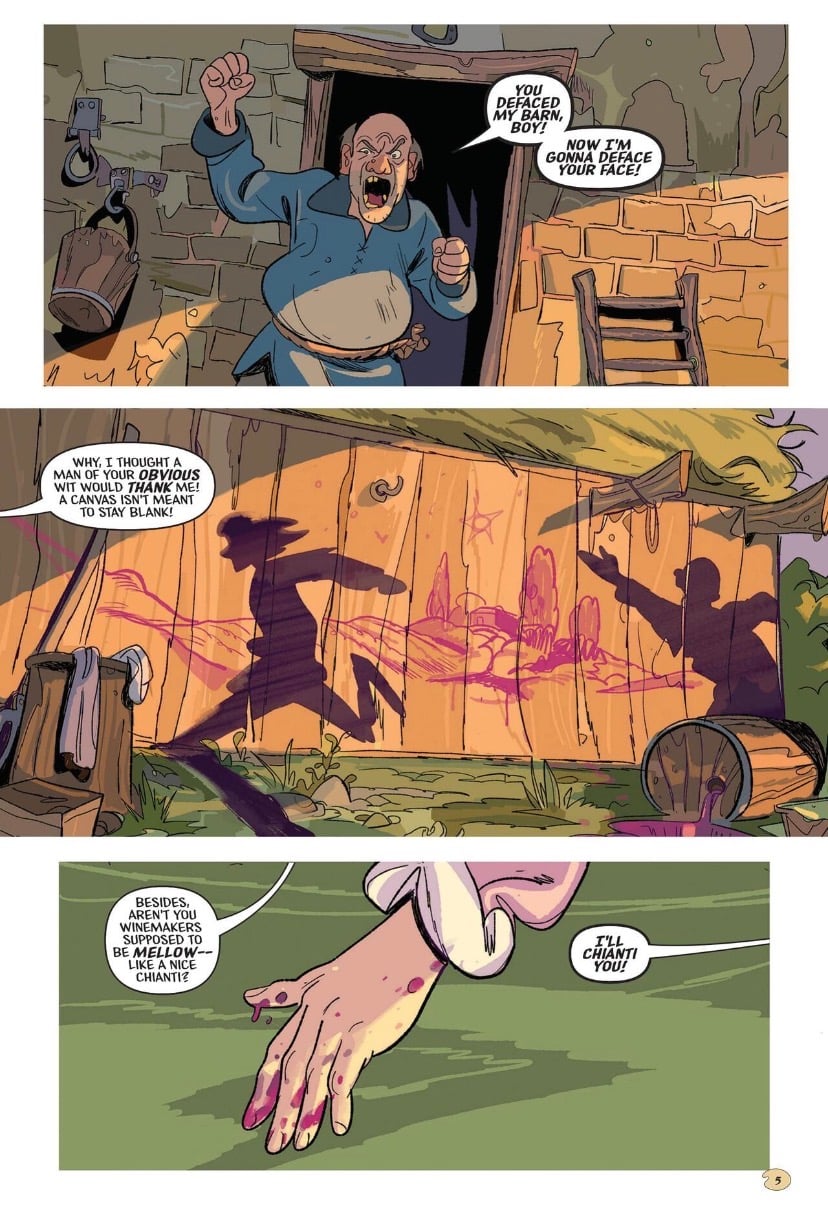
Leo Da Vinci: Renaissance Kid, art Marco Matrone

The Venice Spark and the Southpaw Secret

Phillip Creary: Where did the spark for this version of Leonardo da Vinci come from?

Richard A. Hamilton: It came from Italy: not to be cute about it, but it’s the truth. A long time ago, when I was a teenager, my parents took me and my brother to Venice. We went to this one museum that had a traveling exhibit of Leonardo da Vinci’s actual sketchbook pages. They’d taken them out of the books and put them between two pieces of glass so you could see them front and back. You could read his infamous backward handwriting if you knew Italian.

Phillip Creary: He was a lefty, right? 

Richard A. Hamilton: That’s right! There are all these apocryphal stories about secret clues or trade secrets he didn’t want people to understand. In reality, he just didn’t want to smudge the ink across the page as a southpaw. Seeing those sketchbook pages up close made a huge impact. Unlike the Mona Lisa at the Louvre, which you can only see from a distance behind crowds of tourists, I could put my nose right up to the glass of these sketches. They weren’t finished; they were doodles. Pictures of muscle-bound guys in neat armor, dragons, and monsters with words next to them. They looked like comic book pages. A few years ago, it hit me: if there had been comic books in the Renaissance, Leonardo da Vinci totally would have been a fan.
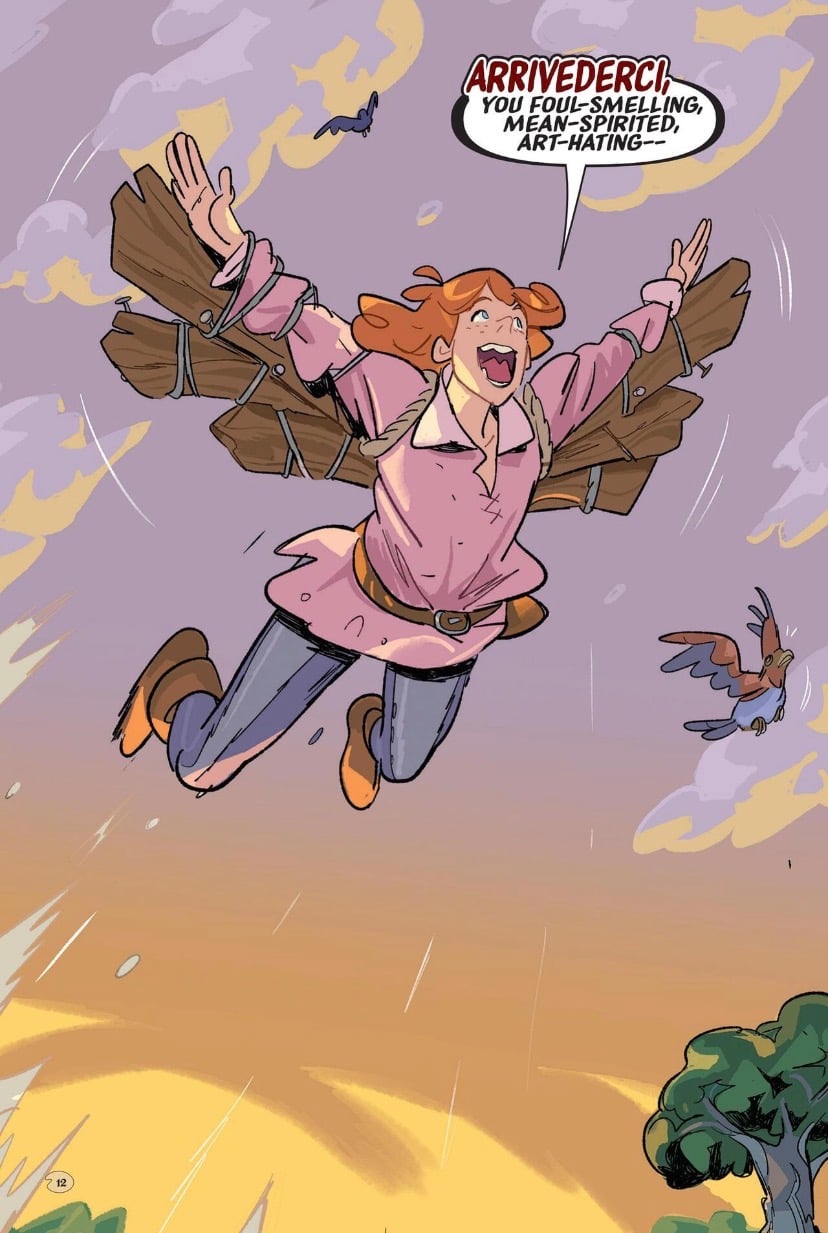
Leo Da Vinci: Renaissance Kid, art Marco Matrone

Why Leonardo is the Perfect YA Hero

We usually think of Da Vinci as this untouchable, finished genius. I don’t think I’ve ever thought about him as a child, but everyone starts somewhere. We all had that awkward teenage phase. Why was this the perfect playground for a YA story?

It was almost a selfish impulse. I’ve been reading comics since I was three years old. I always felt like I was falling short of heroes like Superman or Captain America. You could say the same about Da Vinci: he’s the world’s best artist and inventor. I wanted to present him as a young guy to show readers that he wasn’t perfect either. His talents were born out of insecurity about his parentage and upbringing.

The other part is that I’m a dad. My youngest son is around Leo’s age in the book. Middle school is a nightmare; it’s a pressure cooker where everyone is at their most vulnerable. I wanted to tell this story so my son could see that even Da Vinci went through these things. He wasn’t perfect, he believed in himself, and it worked out.
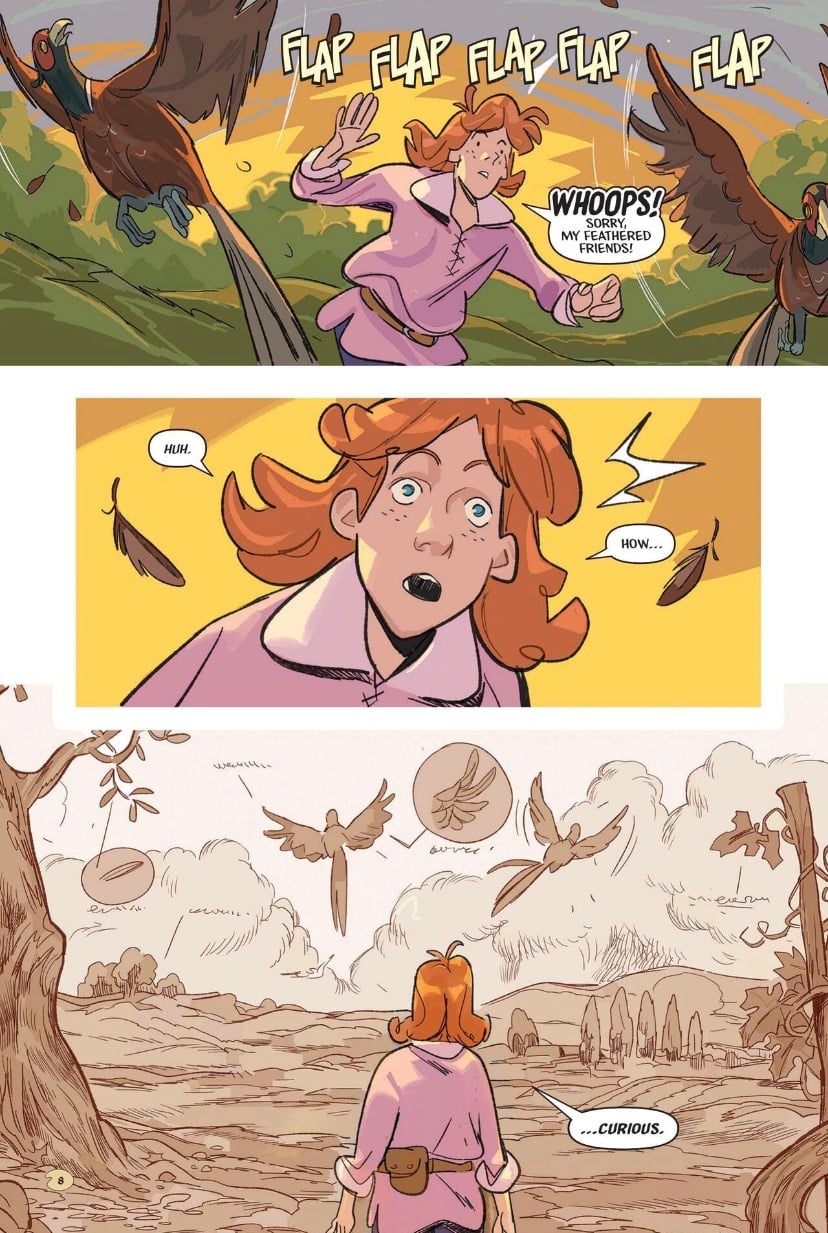
Leo Da Vinci: Renaissance Kid, art Marco Matrone

Writing a Genius Without the Easy Wins

How do you write a genius like Da Vinci without making everything seem too easy for him? And how do you make a living legend relatable to a middle schooler who might be a C-student struggling to get by?

To the second part: Leo doesn’t know he’s a legend yet. Based on my research, even later in life, he was never fully satisfied with his work. He’d hold onto projects for decades because they weren’t exactly how he envisioned them. We present him as someone whose ego and overconfidence sometimes get in the way.

For the first part, I used a rule from an improv guy named Del Close, who taught people like Bill Murray and Tina Fey. He’d say, “Don’t invent, remember.” Instead of making up a fictional detail, I’d think back to my own life or research. If we got stuck, my co-creator Marco Matrone and I would go back to the research. The answer was always in there. Leonardo was smart, but he was a kid from the small town of Vinci who moved to the big city of Florence. He was a fish out of water. Even if you’re a genius, you’re going to have a hard time in those circumstances.
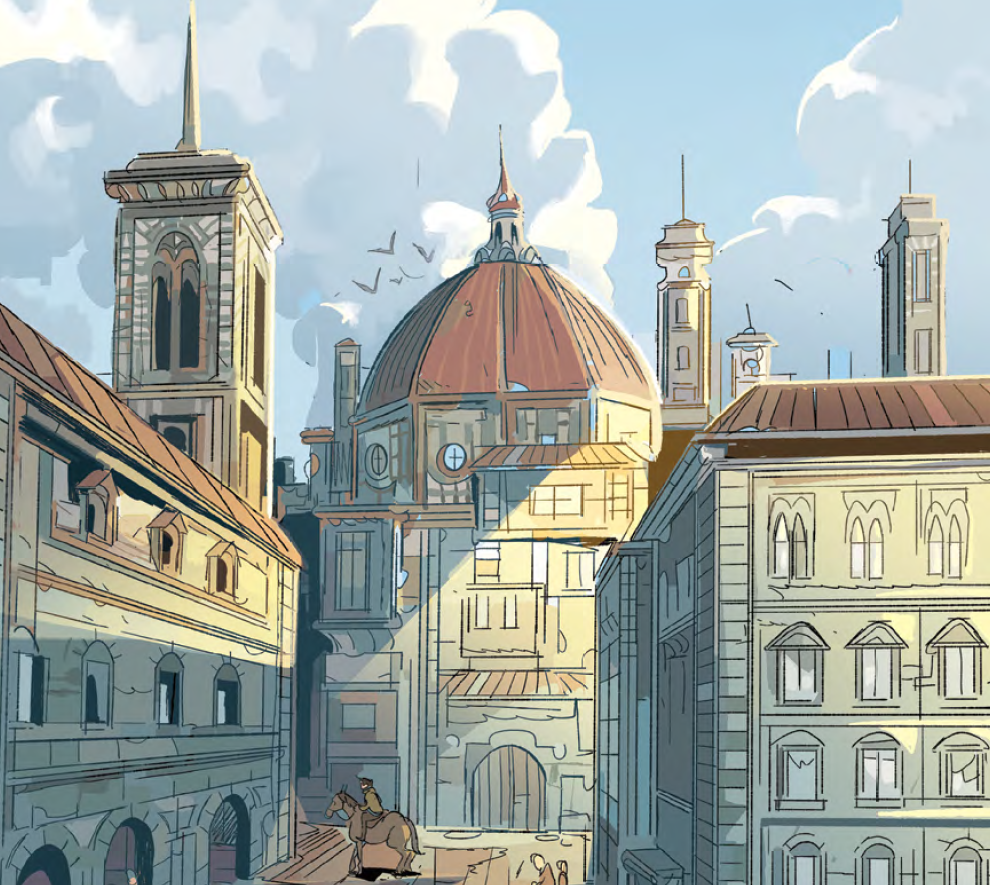
Leo Da Vinci: Renaissance Kid, art Marco Matrone

The Shadow Wars and Social Friction of Florence

Florence is a huge part of the story. It feels alive, dangerous, and full of action. Leo is bouncing between his country roots and his city job, and there’s this friction between the rich and the poor. Was that class warfare a central part of the story from the start, or did that come in later?

Both, really. It’s all true history. It was an era of tremendous economic inequality: the super-rich and everyone else. There was also a shadow war brewing between Florence and Venice. It’s a huge parallel to today. My son’s generation is growing up around this stuff. The Renaissance also mass-produced art and content, just like the things we see on our screens 24/7. Sometimes it was a work of art, sometimes it was just junk, and sometimes it was propaganda. They had their own version of fake news back then. I wanted to keep it true to the era while making it urgent for readers today. 
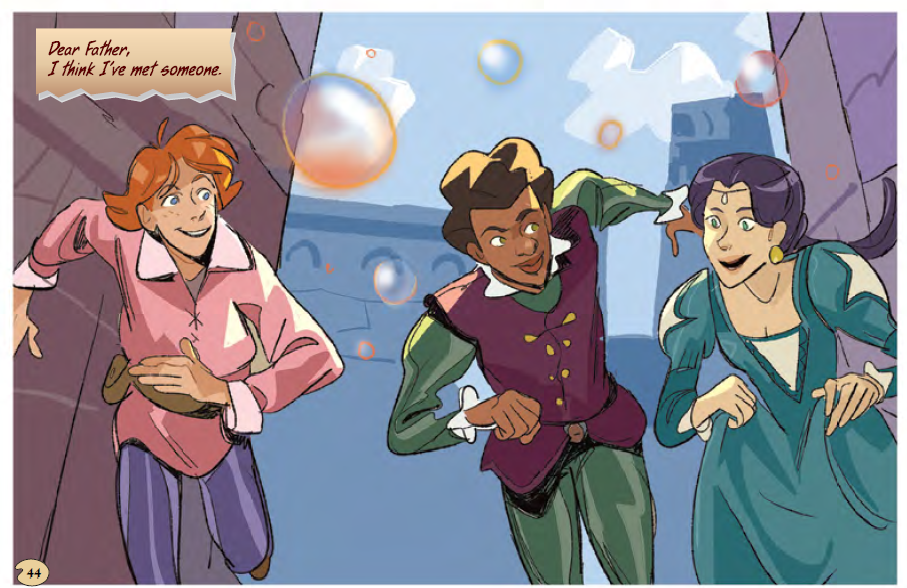
Leo Da Vinci: Renaissance Kid, art Marco Matrone

Fast Friends: Philomena and Tano

In this story, Da Vinci has two close friends: Philomena, who I think you modeled after the Mona Lisa, and Tano from Tunisia. What was the inspiration for them, and what do they bring to Leo at this stage?

They are fictional characters designed to be friends and foils for Leo. Philomena is meant to eventually inspire that famous smile: Leo calls her his “Sphinx.” I think of themes like a beam of light through a prism. The light breaks into different colors, and the characters are those colors. Each character represents a different aspect of the theme. Tano and Philomena give us a fuller sense of the world. Tano doesn’t look like anyone else in town, and Philomena deals with the unfairness of being a woman in that era. I think because they’re outcasts in different ways, it kind of makes them come together better. 

This book has a lot of gems, like the “goat milk latte.” How do you decide when to lean into the funny, modern bits and when to stay historically accurate?

It’s pure instinct. I love horror movies. I recently saw Hokum with my son, and that movie has scary moments followed by funny moments. That pressure and release is wonderful. Even though Leo isn’t a horror story, we have heavy emotions and big action. It is a good idea to counterbalance that.

Humor is how kids that age cope. The goat milk latte joke comes from my decade at DreamWorks. You pick up a certain type of humor there. It’s a very Shrek sort of joke. It sounds enough like “oat milk latte” that any kid reading the book will get it.

There are a lot of pranks pulled in here. Was Leo being a prankster a historical thing, or did you add that?

It’s a slight exaggeration. He was notoriously a puckish jokester who hid subtle meanings in his paintings. We wanted this to be a “romp,” not a history book. We wanted it to appeal to the audiences that grew up on Captain Underpants or Dogman. It’s a fun way to do historical fiction.
Leo Da Vinci: Renaissance Kid, art Marco Matrone

Designing a Spooky Silhouette

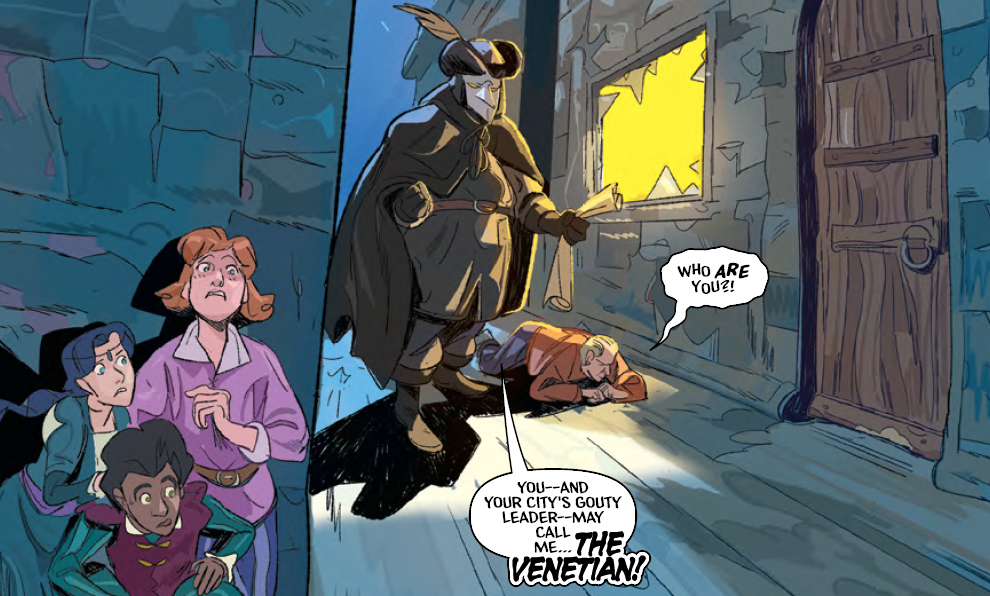
I love the villain’s design, the Venetian. It looks really cool and sinister. What was the inspiration there?

All credit goes to Marco Matrone. In my office, I have a collection of Venetian masks. Before cosplay was a big thing, those were the closest you could get to a cool superhero or supervillain mask. We knew we wanted the villain’s identity to be a mystery. Marco is Italian and lives in Italy, so he picked the right period clothes to create a spooky silhouette. 

There are a lot of doodles and inventions in here. How did you make sure they looked like Da Vinci sketches while still seeming functional?

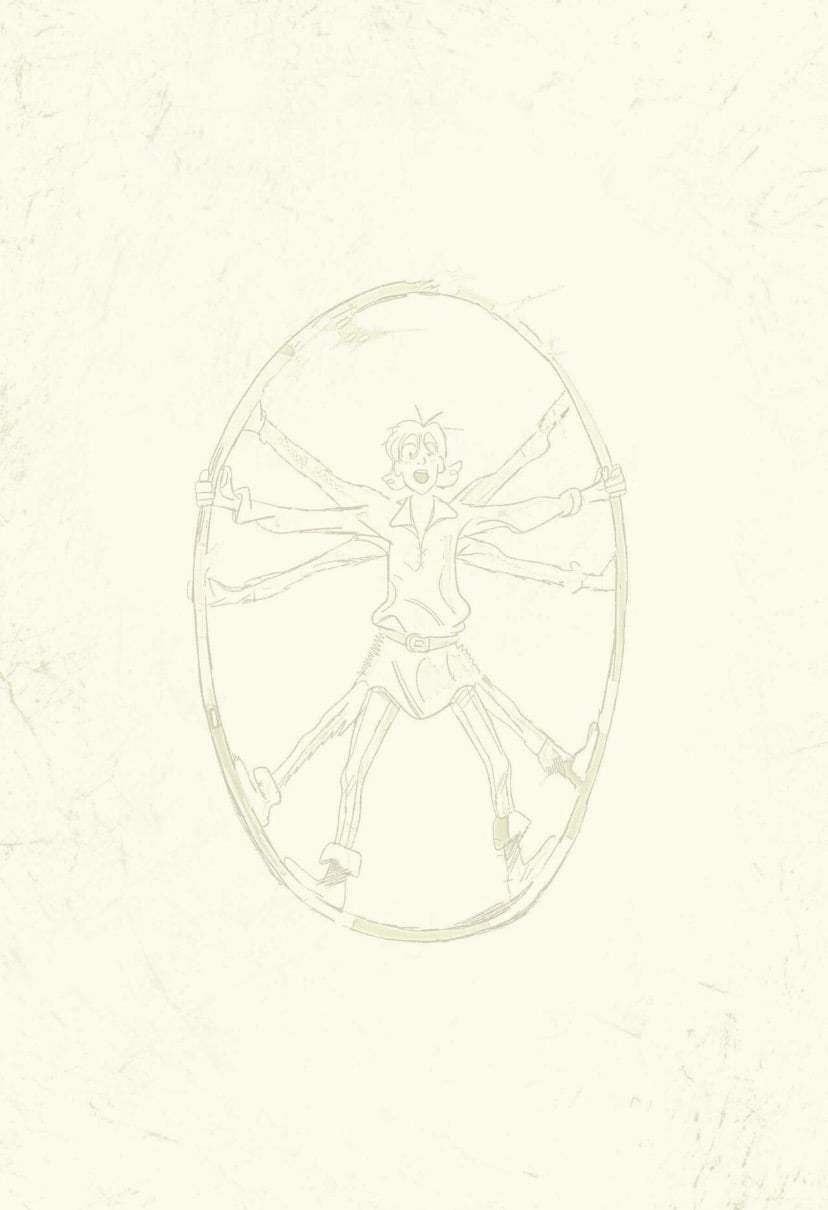
Again, credit to Marco. We wanted to show the most famous inventions in prototype phases, like the different Mark armors in Iron Man. I used the movie 8 Mile as a reference, too. Throughout that movie, you hear Eminem figuring out the lyrics, and the theme evolves until the final rap battle. We did the same with Leo’s inventions, such as the Batwing, which actually inspired Bob Kane and Bill Finger. In fiction, characters often do things right the first time, but that’s unrealistic. We wanted to be honest about practice and progress. We also knew we could never recreate his exact style. There was only one Da Vinci. Marco provided his interpretation with a timeless flair and some street-art elements.

In your opinion, who is the “Leonardo” of today? Who’s got that same “impossible level” of creative energy?

I’ve never met him, but James Cameron is someone who successfully walks that line between artist and engineer. Every film he does is technically impossible when he starts. They have to invent the technology to make it. That’s a cool way of doing business: forcing yourself to advance the medium to tell a story. So I think like there’s definitely some Da Vinci spirit in him. I would also say, to a certain extent, Guillermo del Toro, whom I have met and have been lucky enough to work with a little. He keeps sketchbooks like da Vinci and has real technical proficiency in the way he creates his work. 

I’d add Eiichiro Oda, the creator of One Piece. The world he’s been building for 30 years is so sprawling and cool. To see a vision through from start to finish over that long a span is incredible.

That’s a good one. I’m sure in those 30 years, he’s invented storytelling moves that advanced the medium. That’s a real Da Vinci element, not just being the best in your field, but changing the field for others.
Leo Da Vinci: Renaissance Kid, art Marco Matrone

The Bridge Across the Connection Gap

After living in Leo’s head for so long, has it changed how you look at your own creative process?

I hope so. I’m still critical of myself, but I think I go easier on myself now. It reminded me of the importance of patience. You have to play the long game. Leonardo was also one of the first practitioners of mindfulness in the West. He was fascinated with the patterns found in the infinite works of nature. He learned by watching animals and landscapes and seeing how it all fit together. I have to remind myself to enjoy the now and not just focus on future plans. It’s a tough balance to strike in a work-focused, goal-driven age, but you have to find a way to be in the present.

What is one piece of advice from teenage Leonardo you hope every young creator takes away?

Make art. Whatever kind of art you want. It doesn’t have to be comics or painting. It could be cooking, pottery, or dance. Personal expression helps you find yourself, but it also gives you the opportunity to connect with others. The best art isn’t made for its own sake; it’s made to bring us together. These are tough, isolated times. But we can use our art to bring ourselves closer to the people and the world around us.


How to Support

We had a blast catching up with Richard A. Hamilton and talking through the process of turning history’s greatest mind into a relatable teen. If you’re as hooked on this vision as we are, you can support the team and grab a copy of Leo Da Vinci: Renaissance Kid over on their official website.
KPB Interview: Richard A. Hamilton on ‘Leo Da Vinci: Renaissance Kid’ and Turning Leonardo into a YA Hero

May 15, 2026

I recently caught up with Richard A. Hamilton, a writer whose decade at DreamWorks clearly informs his cinematic approach to comics. We talked about his new graphic novel, Leo Da Vinci: Renaissance Kid, co-created with artist Marco Matrone. It reimagines Leonardo da Vinci not as a finished, untouchable master, but as a mischievous, brilliant teenager navigating the dangerous streets of Florence. We also geeked out over how a trip to Italy sparked the idea, why Da Vinci is the perfect YA hero, and how Eminem actually influenced a story about a 15th-century genius. 

Leo Da Vinci: Renaissance Kid, art Marco Matrone

The Venice Spark and the Southpaw Secret

Phillip Creary: Where did the spark for this version of Leonardo da Vinci come from?

Richard A. Hamilton: It came from Italy: not to be cute about it, but it’s the truth. A long time ago, when I was a teenager, my parents took me and my brother to Venice. We went to this one museum that had a traveling exhibit of Leonardo da Vinci’s actual sketchbook pages. They’d taken them out of the books and put them between two pieces of glass so you could see them front and back. You could read his infamous backward handwriting if you knew Italian.

Phillip Creary: He was a lefty, right? 

Richard A. Hamilton: That’s right! There are all these apocryphal stories about secret clues or trade secrets he didn’t want people to understand. In reality, he just didn’t want to smudge the ink across the page as a southpaw. Seeing those sketchbook pages up close made a huge impact. Unlike the Mona Lisa at the Louvre, which you can only see from a distance behind crowds of tourists, I could put my nose right up to the glass of these sketches. They weren’t finished; they were doodles. Pictures of muscle-bound guys in neat armor, dragons, and monsters with words next to them. They looked like comic book pages. A few years ago, it hit me: if there had been comic books in the Renaissance, Leonardo da Vinci totally would have been a fan.

Leo Da Vinci: Renaissance Kid, art Marco Matrone

Why Leonardo is the Perfect YA Hero

We usually think of Da Vinci as this untouchable, finished genius. I don’t think I’ve ever thought about him as a child, but everyone starts somewhere. We all had that awkward teenage phase. Why was this the perfect playground for a YA story?

It was almost a selfish impulse. I’ve been reading comics since I was three years old. I always felt like I was falling short of heroes like Superman or Captain America. You could say the same about Da Vinci: he’s the world’s best artist and inventor. I wanted to present him as a young guy to show readers that he wasn’t perfect either. His talents were born out of insecurity about his parentage and upbringing.

The other part is that I’m a dad. My youngest son is around Leo’s age in the book. Middle school is a nightmare; it’s a pressure cooker where everyone is at their most vulnerable. I wanted to tell this story so my son could see that even Da Vinci went through these things. He wasn’t perfect, he believed in himself, and it worked out.

Leo Da Vinci: Renaissance Kid, art Marco Matrone

Writing a Genius Without the Easy Wins

How do you write a genius like Da Vinci without making everything seem too easy for him? And how do you make a living legend relatable to a middle schooler who might be a C-student struggling to get by?

To the second part: Leo doesn’t know he’s a legend yet. Based on my research, even later in life, he was never fully satisfied with his work. He’d hold onto projects for decades because they weren’t exactly how he envisioned them. We present him as someone whose ego and overconfidence sometimes get in the way.

For the first part, I used a rule from an improv guy named Del Close, who taught people like Bill Murray and Tina Fey. He’d say, “Don’t invent, remember.” Instead of making up a fictional detail, I’d think back to my own life or research. If we got stuck, my co-creator Marco Matrone and I would go back to the research. The answer was always in there. Leonardo was smart, but he was a kid from the small town of Vinci who moved to the big city of Florence. He was a fish out of water. Even if you’re a genius, you’re going to have a hard time in those circumstances.

Leo Da Vinci: Renaissance Kid, art Marco Matrone

The Shadow Wars and Social Friction of Florence

Florence is a huge part of the story. It feels alive, dangerous, and full of action. Leo is bouncing between his country roots and his city job, and there’s this friction between the rich and the poor. Was that class warfare a central part of the story from the start, or did that come in later?

Both, really. It’s all true history. It was an era of tremendous economic inequality: the super-rich and everyone else. There was also a shadow war brewing between Florence and Venice. It’s a huge parallel to today. My son’s generation is growing up around this stuff. The Renaissance also mass-produced art and content, just like the things we see on our screens 24/7. Sometimes it was a work of art, sometimes it was just junk, and sometimes it was propaganda. They had their own version of fake news back then. I wanted to keep it true to the era while making it urgent for readers today. 

Leo Da Vinci: Renaissance Kid, art Marco Matrone

Fast Friends: Philomena and Tano

In this story, Da Vinci has two close friends: Philomena, who I think you modeled after the Mona Lisa, and Tano from Tunisia. What was the inspiration for them, and what do they bring to Leo at this stage?

They are fictional characters designed to be friends and foils for Leo. Philomena is meant to eventually inspire that famous smile: Leo calls her his “Sphinx.” I think of themes like a beam of light through a prism. The light breaks into different colors, and the characters are those colors. Each character represents a different aspect of the theme. Tano and Philomena give us a fuller sense of the world. Tano doesn’t look like anyone else in town, and Philomena deals with the unfairness of being a woman in that era. I think because they’re outcasts in different ways, it kind of makes them come together better. 

This book has a lot of gems, like the “goat milk latte.” How do you decide when to lean into the funny, modern bits and when to stay historically accurate?

It’s pure instinct. I love horror movies. I recently saw Hokum with my son, and that movie has scary moments followed by funny moments. That pressure and release is wonderful. Even though Leo isn’t a horror story, we have heavy emotions and big action. It is a good idea to counterbalance that.

Humor is how kids that age cope. The goat milk latte joke comes from my decade at DreamWorks. You pick up a certain type of humor there. It’s a very Shrek sort of joke. It sounds enough like “oat milk latte” that any kid reading the book will get it.

There are a lot of pranks pulled in here. Was Leo being a prankster a historical thing, or did you add that?

It’s a slight exaggeration. He was notoriously a puckish jokester who hid subtle meanings in his paintings. We wanted this to be a “romp,” not a history book. We wanted it to appeal to the audiences that grew up on Captain Underpants or Dogman. It’s a fun way to do historical fiction.

Leo Da Vinci: Renaissance Kid, art Marco Matrone

Designing a Spooky Silhouette

I love the villain’s design, the Venetian. It looks really cool and sinister. What was the inspiration there?

All credit goes to Marco Matrone. In my office, I have a collection of Venetian masks. Before cosplay was a big thing, those were the closest you could get to a cool superhero or supervillain mask. We knew we wanted the villain’s identity to be a mystery. Marco is Italian and lives in Italy, so he picked the right period clothes to create a spooky silhouette. 

There are a lot of doodles and inventions in here. How did you make sure they looked like Da Vinci sketches while still seeming functional?

Again, credit to Marco. We wanted to show the most famous inventions in prototype phases, like the different Mark armors in Iron Man. I used the movie 8 Mile as a reference, too. Throughout that movie, you hear Eminem figuring out the lyrics, and the theme evolves until the final rap battle. We did the same with Leo’s inventions, such as the Batwing, which actually inspired Bob Kane and Bill Finger. In fiction, characters often do things right the first time, but that’s unrealistic. We wanted to be honest about practice and progress. We also knew we could never recreate his exact style. There was only one Da Vinci. Marco provided his interpretation with a timeless flair and some street-art elements.

In your opinion, who is the “Leonardo” of today? Who’s got that same “impossible level” of creative energy?

I’ve never met him, but James Cameron is someone who successfully walks that line between artist and engineer. Every film he does is technically impossible when he starts. They have to invent the technology to make it. That’s a cool way of doing business: forcing yourself to advance the medium to tell a story. So I think like there’s definitely some Da Vinci spirit in him. I would also say, to a certain extent, Guillermo del Toro, whom I have met and have been lucky enough to work with a little. He keeps sketchbooks like da Vinci and has real technical proficiency in the way he creates his work. 

I’d add Eiichiro Oda, the creator of One Piece. The world he’s been building for 30 years is so sprawling and cool. To see a vision through from start to finish over that long a span is incredible.

That’s a good one. I’m sure in those 30 years, he’s invented storytelling moves that advanced the medium. That’s a real Da Vinci element, not just being the best in your field, but changing the field for others.

Leo Da Vinci: Renaissance Kid, art Marco Matrone

The Bridge Across the Connection Gap

After living in Leo’s head for so long, has it changed how you look at your own creative process?

I hope so. I’m still critical of myself, but I think I go easier on myself now. It reminded me of the importance of patience. You have to play the long game. Leonardo was also one of the first practitioners of mindfulness in the West. He was fascinated with the patterns found in the infinite works of nature. He learned by watching animals and landscapes and seeing how it all fit together. I have to remind myself to enjoy the now and not just focus on future plans. It’s a tough balance to strike in a work-focused, goal-driven age, but you have to find a way to be in the present.

What is one piece of advice from teenage Leonardo you hope every young creator takes away?

Make art. Whatever kind of art you want. It doesn’t have to be comics or painting. It could be cooking, pottery, or dance. Personal expression helps you find yourself, but it also gives you the opportunity to connect with others. The best art isn’t made for its own sake; it’s made to bring us together. These are tough, isolated times. But we can use our art to bring ourselves closer to the people and the world around us.


How to Support

We had a blast catching up with Richard A. Hamilton and talking through the process of turning history’s greatest mind into a relatable teen. If you’re as hooked on this vision as we are, you can support the team and grab a copy of Leo Da Vinci: Renaissance Kid over on their official website.
Share:

Comments

Leave the first comment

<!-- if comments are disabled for this post then hide comments container -->
<style> 
<?php if(!comments_open()) { echo "#nfps-comments-container {display: none !important;}"; }?>
</style>