
This issue of Wonder Woman #26 is a fascinating, if sometimes frustrating, chapter in Tom King’s run. It drops us right into the grim origin story of the villain, Mouse Man, and the terrifying, totalitarian island he controls. While Wonder Woman is on the island trying to rescue a baby, the issue offers a chilling glimpse into what happens when the fear of superheroes is weaponized to create an oppressive society.
The bulk of the issue is dedicated to the backstory, which follows a man named Ernest Pye. Pye lost everything in a crisis and, believing his wife would still be alive if superheroes didn’t exist, he sets out to champion a sanctuary. This island is supposed to be a safe, happy place: a peaceful community free from the trouble and chaos that often follow super-people, but that doesn’t last long.
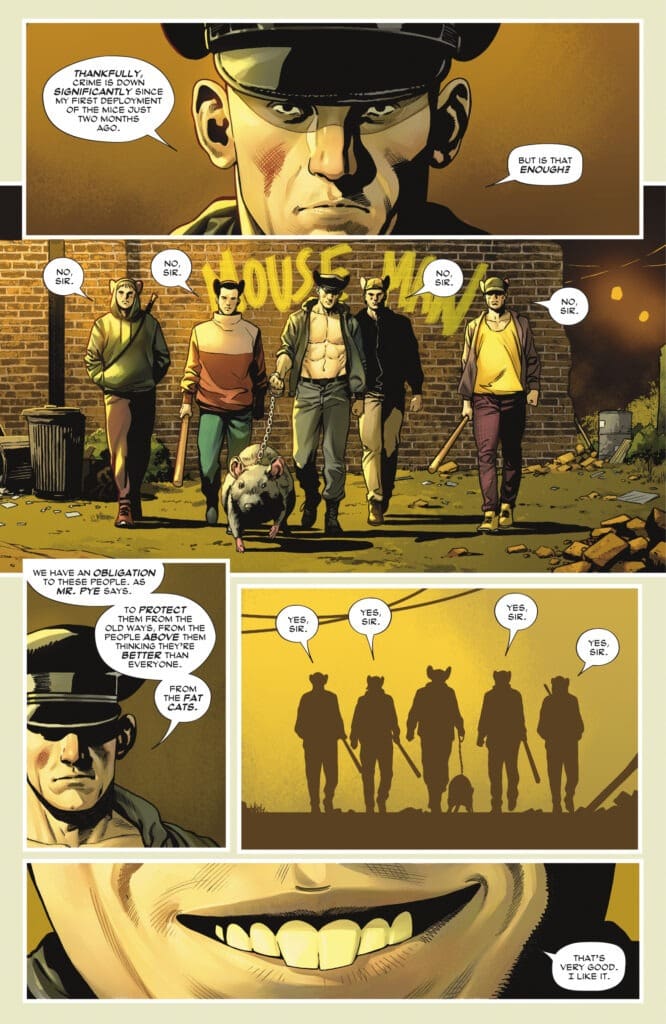
Hoping to escape his own superhero troubles, Pye is joined by Carl Dentor, who brings his beloved mice along: a seemingly minor detail that quickly becomes important. Dentor, who is actually the future Mouse Man, initially helps curb the rising crime and petty violence on the island. This island, planned initially as a utopia, swiftly descends into chaos. Mouse Man justifies his control, seeing himself as a protector shielding people from the so-called “fat cats.” However, when Pye tries to call for Superman, he incurs Mouse Man’s wrath.
King uses Mouse Man here to explore powerful themes of fear, manufactured opposition, and the rapid, toxic rise of totalitarianism. Mouse Man, a quirky Silver Age villain, is smartly reinvented as a figure who manipulates the legitimate grievances of people like Ernest Pye. Pye’s desire for safety and peace is co-opted and corrupted by Mouse Man, who replaces one form of ‘oppression’ (that of super-people) with his own.
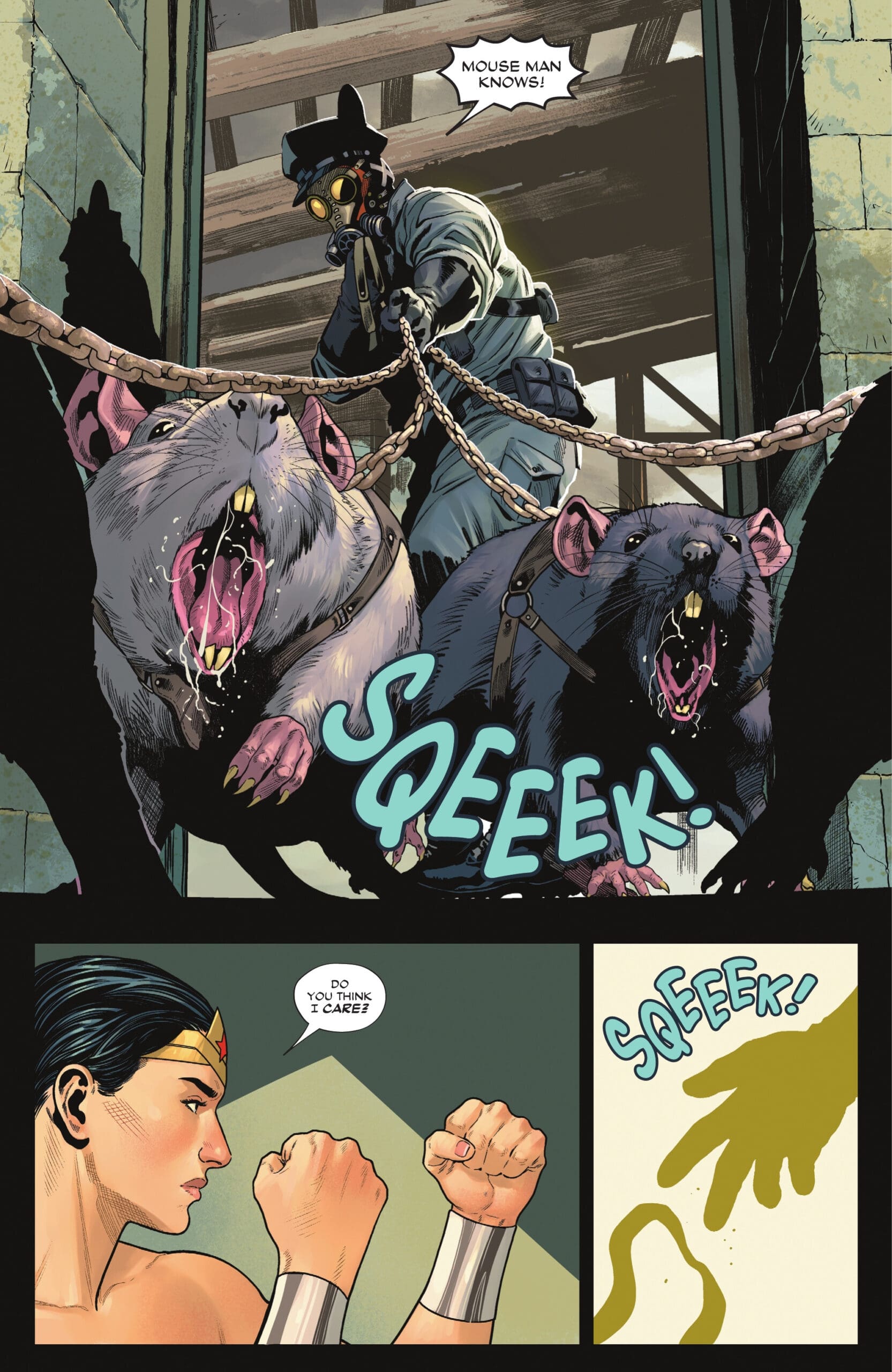
His rise is painted as a terrifyingly effective populist movement. The phrase “Mouse Man Knows” becomes a chilling, cult-like slogan, a means of vocal control over the populace. People cheer for their supposed freedom even as Mouse Man brutally exerts control, going so far as to tell his officers to put mice on their tongues for questioning the mouse laws. It’s a bold, almost heavy-handed, but incredibly relevant political allegory.
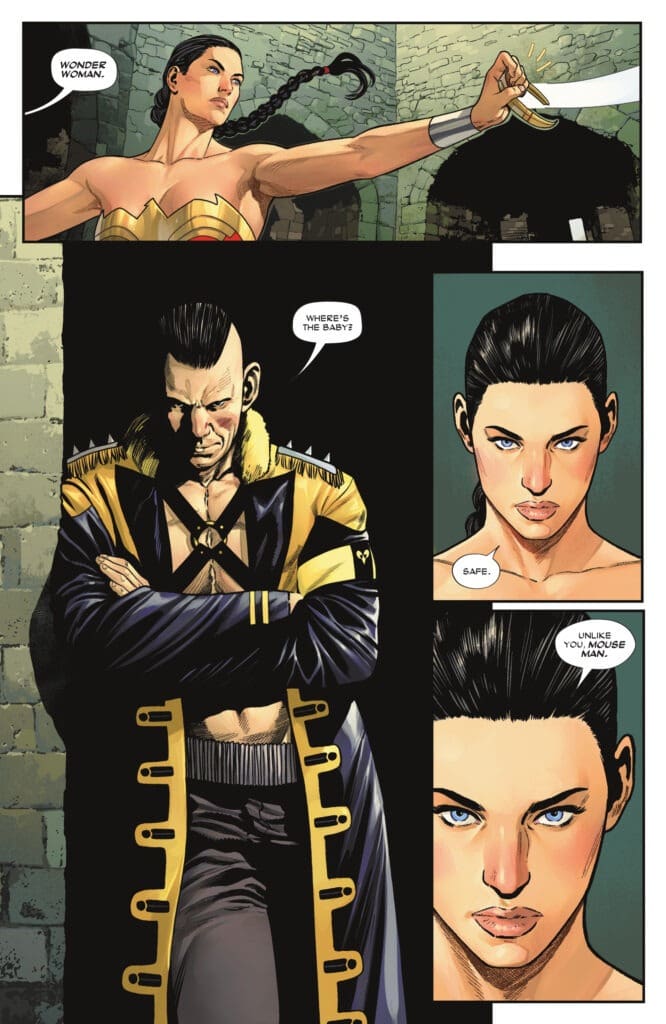
Wonder Woman’s role here is mostly reactive and physical. She’s on the island to retrieve a baby, a simple but powerful motivator that grounds the action. Her attempts to reason with Mouse Man are met with contempt, as he sees her as a symbol of the elite power he claims to be fighting against.
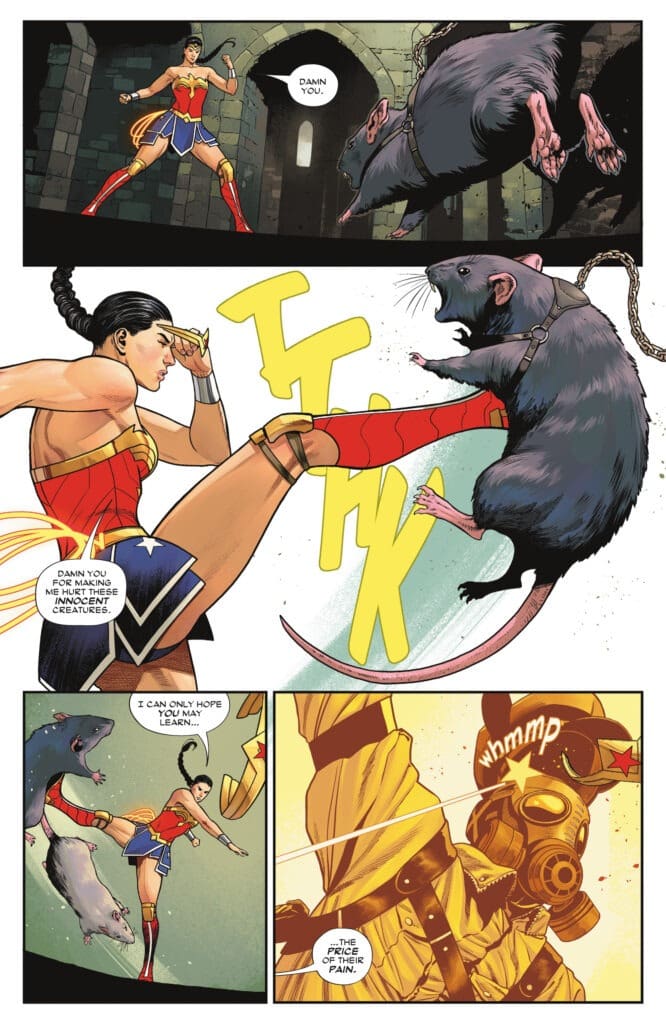
While some readers might feel Wonder Woman takes a backseat to the villain’s origin, this issue and the arc as a whole have been some of the most fascinating I’ve read. Forget the constant mentions of “Mice Have Ears” and “Mouse Man Knows” for a second, and what you get is a modern reinvention of a ‘silly’ comic book villain to his terrifying apex. Mouse Man is legitimately scary, not just because of his hold on the populace, but because he is legion. I mean, who would want to fight millions of rats and giant mutant rats? He has the potential to be a major-league threat, bringing the same chilling aura that Geoff Johns’ treatment of Black Hand brought to Green Lantern years ago. It’s a testament to King’s expert plotting and writing.
The art team makes this a visually stunning book. Daniel Sampere’s artwork stands out, blending power and grace in Wonder Woman’s design, but his most impactful work is the terrifying, massive rats she must fight, giving shocking visual weight to the Mouse Man concept. Tomeu Morey’s brilliant colors enhance the mood, using bright, hopeful yellows and blues for the initial scenes that are later brutally dashed. Finally, Clayton Cowles’s sharp lettering is crucial, with sound effects like the terrifying squeaks and brutal cracks adding real impact.
Wonder Woman #26 is a strong, if polarizing, read. The issue completely succeeds by using the absurd premise of Mouse Man to deliver a deeply political and relevant story about the creation of a fascist state built on paranoia and fear of the ‘other.’ The art team of Sampere, Morey, and Cowles delivers a visually stunning book that gives the dark themes and the character’s struggle the weight they deserve. It sets the stage for a tense confrontation with an unexpectedly complex and terrifying villain.
‘Wonder Woman’ #26 The Dark Origin of Mouse Man
Wonder Woman #26 is a strong, if polarizing, read. The issue completely succeeds by using the absurd premise of Mouse Man to deliver a deeply political and relevant story about the creation of a fascist state built on paranoia and fear of the ‘other.’