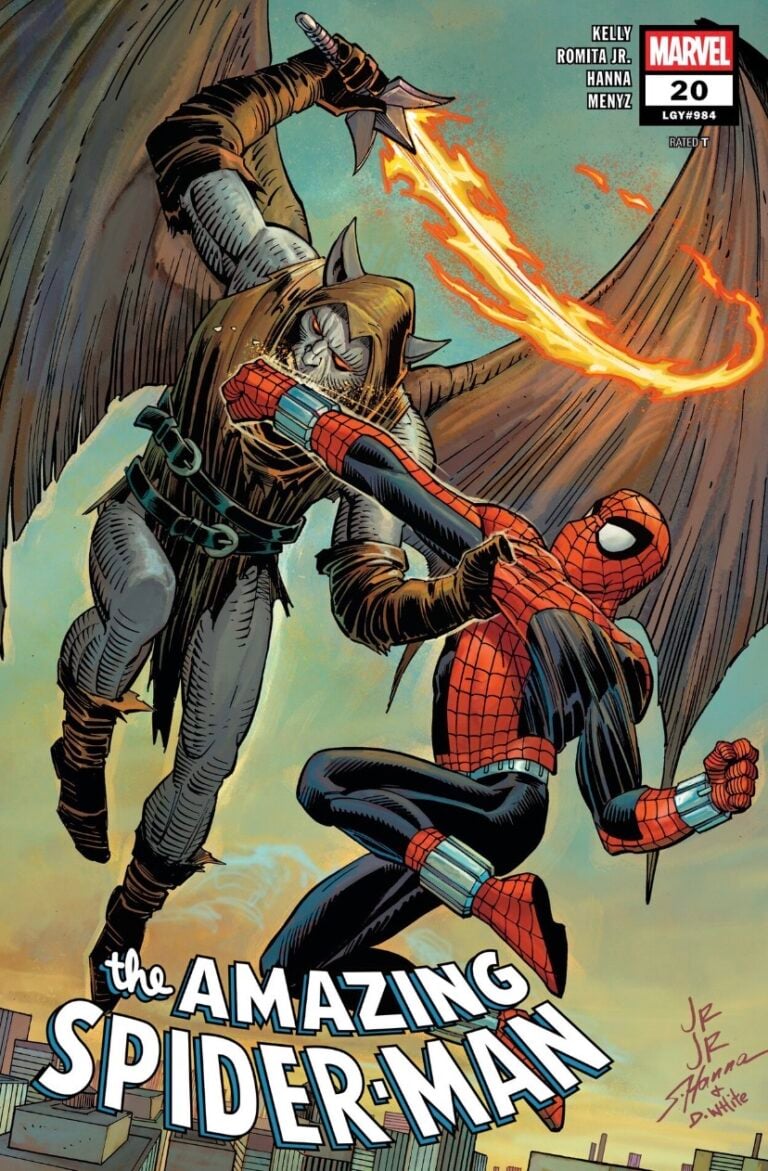
The Amazing Spider-Man #20 is sprinting when it should walk. By page ten, author Joe Kelly has already taken us through five subplots, none of which gets room to breathe. What should have been a focus on Norman Osborn’s redemption has become a cluttered mess. This rapid pace is threatening to drown Kelly’s best ideas.

Norman is still the best part of this book. Kelly knows he’s living in the shadow of Dan Slott’s Superior Spider-Man when it comes to Peter’s villains taking on Spidey’s persona, so he smartly reverses Norman’s motivations. Norman didn’t become Spider-Man in spite of Peter, as Otto Octavius did; he adopted the suit because of him.
It’s a cathartic moment when new character Kintsugi rebukes Norman’s past sins, telling him it’s more important who we are today than who we were yesterday. Artist Paco Diaz beautifully renders Norman’s face through a half-ripped mask, showing surprise on the normally unflappable millionaire’s face. It’s these lessons that Spider-Man comics have been teaching us since 1962, and they’re just as relevant today.
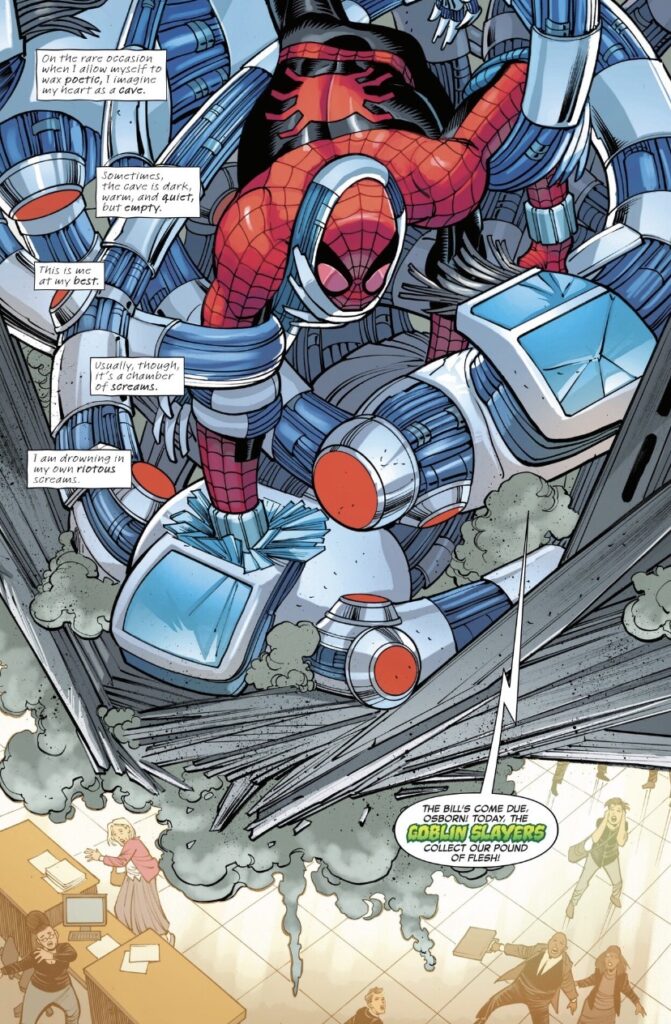
Unfortunately, we don’t just focus on Norman. This issue juggles Aunt May confronting a rude receptionist, Ben Reilly and Janine bailing on Peter’s life, Peter’s childhood friend Brian Nehring being carted off to the hospital, the extended Spider-Family joining Norman’s fight, and Roderick Kingsley rubbing elbows with a secret society. It’s exhausting.

Pay at least $16 for these 10 items
This is most egregious in the handling of Ben Reilly. He was finally gaining some momentum by sabotaging Peter and Brian’s work, but spends this issue washing the dye out of his hair before casually exiting his role in Peter’s life. We’ve spent seven issues with him as the co-lead of this story, all for Kelly to dedicate a single page to him. This reframes Ben as a convenient plot device to drive a wedge between Brian and Peter instead of a fleshed-out character. It’s a complete shift compared to issue #16, where he goes through a full range of emotions tied to his imposter syndrome, and this issue suffers for it.

It’s hard to get invested in a series that speeds along this quickly, and that rings doubly true for the inclusion of Miles, Gwen, and the rest of the Spider-Family. They’ve felt shoehorned in since their first appearance and only show up to provide Norman motivation. It’s another example of Kelly using characters as convenient tools; there is no development or meaningful interaction for them.
A new series was announced for April, The Amazing Spider-Man: Spider-Versity, which is going to focus on Norman mentoring these characters. It makes their presence here feel like advertising rather than storytelling.
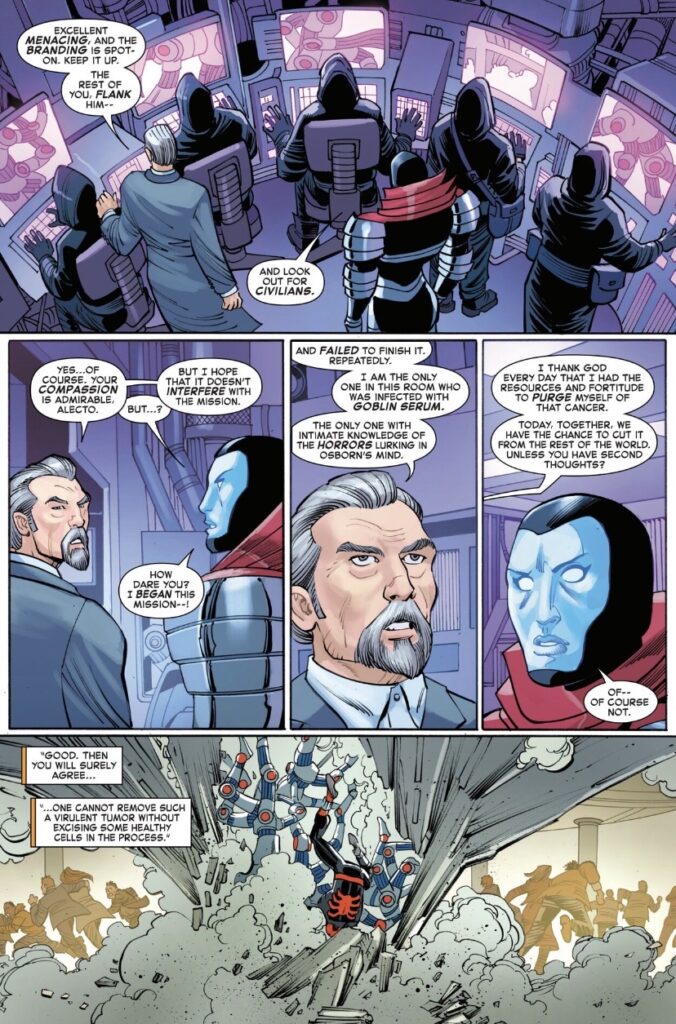
This issue’s congested nature bleeds into the artwork as well. Three different pencillers worked on this book—John Romita Jr., Paco Diaz, and Todd Nauck—and the sudden shifts between them on pages 19 and 22 are jarring. Normally, when you have this many artists, they’re switching between specific characters or subplots, but the transitions here happen during the same fight sequence.
Diaz’s pages are the standouts. There’s weight when his Spider-Man springs into action, his fluid poses are striking, and fine lines detail each character’s face. Colorist Erick Arciniega enhances these panels with rich colors. The dynamic shading on Norman’s suit helps the warm reds and blues pop, while each member of the Spider-Family has their own distinct color palette. Joe Caramagna uses his letters to capture Norman’s emotional turbulence, wisely bolding his dialogue and text boxes to enhance his intensity.

This comic proves Kelly understands Norman’s psychology, but he won’t let us spend time with it. Between Aunt May’s subplot, Ben’s one-page exit, and the Spider-Family’s promotional cameo, Norman’s best moments drown in clutter. Kelly needs to cut his cast in half and give his strongest threads space. Peter returns in issue #22. Kelly’s focus needs to return with him, because this book is running on empty.
‘The Amazing Spider-Man’ #20 Sprints When It Should Walk
This comic proves Kelly understands Norman’s psychology, but he won’t let us spend time with it. Between Aunt May’s subplot, Ben’s one-page exit, and the Spider-Family’s promotional cameo, Norman’s best moments drown in clutter. Kelly needs to cut his cast in half and give his strongest threads space. Peter returns in issue #22. Kelly’s focus needs to return with him, because this book is running on empty.