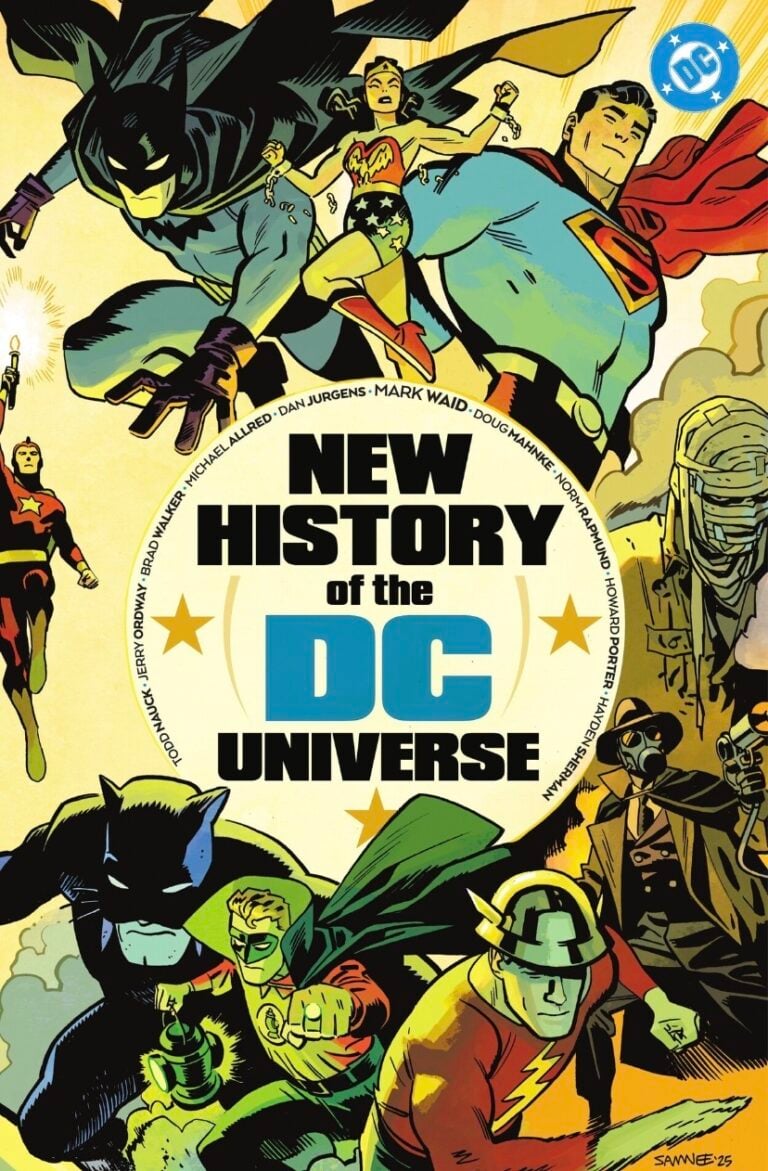
It is no secret that being a DC Comics fan often feels like you need a PhD in Crisis Management. Between the infinite earths, the Crises that reset everything, and the retcons that change your favorite hero’s origin story every five years, keeping track of DC’s 90-year history is a massive task. Whether it is the convoluted mess of Hawkman’s past or the ever-rotating door of Flashes, the DC Universe is a beautiful but undeniably tangled web.
Fortunately, The New History of the DC Universe HC arrives at the perfect moment. With James Gunn’s DCU making waves and fresh readers looking for a way in, this collection aims to be the definitive roadmap for the modern era.

The story is framed through a very specific and grounded lens. Following the events of Absolute Power, Barry Allen has lost his speed. For a man who has spent his life moving at Mach 10, the sudden stillness is jarring. To fill the time, Barry decides to document the history of the multiverse. This is a clever choice by writer Mark Waid because Barry is the man who essentially kicked off the Multiverse in the classic Flash #123; he is the ultimate narrator for this kind of project.
The tone of his narration is surprisingly clinical, acting as a straightforward chronicler rather than an emotional storyteller. While the narration can lean toward the dry side at times, it serves a specific purpose by laying out the essential facts of a 90-year-old legacy without getting too bogged down in melodrama. Waid is perhaps the only writer in the industry today with the historical knowledge required to untangle these threads, and his passion for the medium shines through every page.
One of the greatest strengths of this collection is how the art evolves to match the era being described. It is a visual celebration of DC’s publishing history that guides the reader’s eye effortlessly across the page. The first chapter, focusing on the Golden Age, features the energetic and expressive work of Jerry Ordway and Todd Nauck. Their panels flow with a natural rhythm, subtly echoing the styles of the greats while tracing the Big Bang all the way to the emergence of the Justice Society. Chris Samnee’s cover for this section instantly brings to mind the late Darwyn Cooke’s The New Frontier, capturing a retro-modern vibe with clean lines and bold compositions.
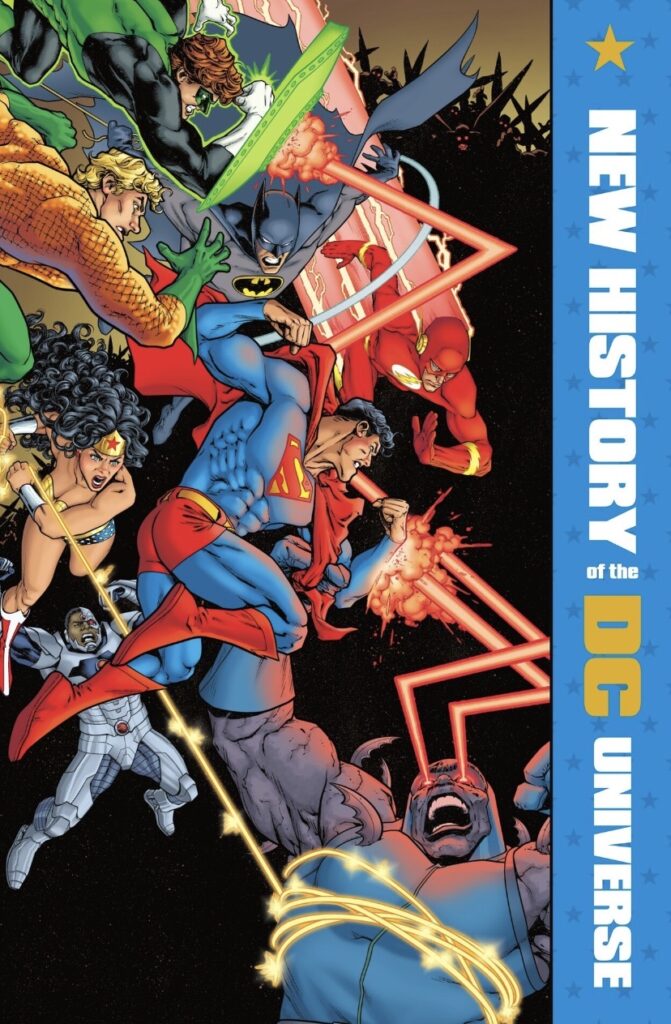
As the story moves into the Silver and Bronze Ages, Michael Allred and Brad Walker take over the visuals. Their work is a pop-art masterpiece that captures the whimsical yet heroic energy of the 1960s and 70s. The highlights here include the evolving costumes of the Justice League and a gut-wrenching recreation of the end of Crisis on Infinite Earths. The image of Superman holding a lifeless Supergirl remains one of the most powerful and haunting moments in comic history, and the art team captures that tragedy with incredible precision.
The post-Crisis era is handled by legends Dan Jurgens and Doug Mahnke, whose work captures the atmosphere of the 90s and early 2000s with striking accuracy. Their compositions are carefully arranged to make the storytelling feel dynamic, further elevated by the vibrant colors of John Kalisz and David Baron. Finally, Hayden Sherman and Howard Porter bring the chronicle into the present day, covering the fallout of Flashpoint and the rise of new legends like Jon Kent and Jackson Hyde. Their collaboration gives the final chapters a grand, immersive quality that feels both vast and alive.
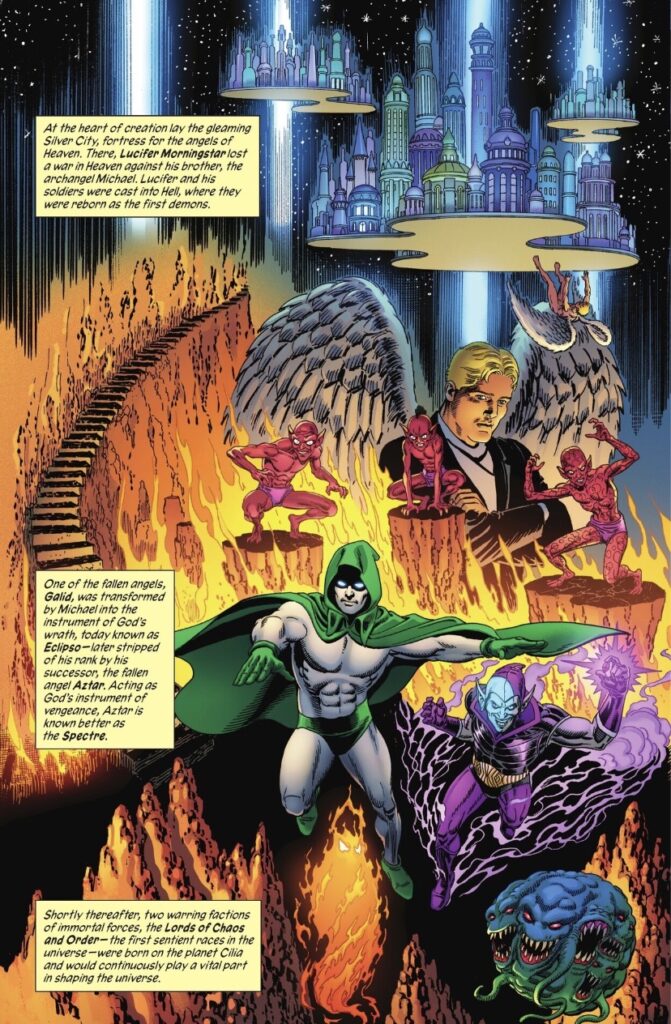
As much as Mark Waid is a master historian, even he struggles to bridge some of DC’s fundamentally incompatible timelines. The book attempts to merge the Pre-Crisis and Post-Crisis canons, which leads to some continuity-induced headaches for longtime fans. For instance, the book integrates the New 52 origin, which features Cyborg as a founding member, into the Silver Age timeline. While this streamlines things for new readers, it creates friction for those who remember Vic Stone’s deep roots with the Teen Titans.
Another point of contention is the treatment of Power Girl. Once again, Karen Starr is presented as the sole survivor of Earth-2, but this claim feels shaky given the conflicting stories published in recent years. Furthermore, some readers may find it frustrating that the book ignores certain historical deaths, such as the death of Helena Wayne, or the misplacement of Barbara Gordon’s Oracle persona debut. It becomes clear that The New History of the DC Universe is best viewed as Mark Waid’s personal vision of a “perfect” timeline rather than a strict, flawless historical account. It picks and chooses the most impactful stories to create a cohesive narrative, even if a few pieces of the puzzle do not fit perfectly.
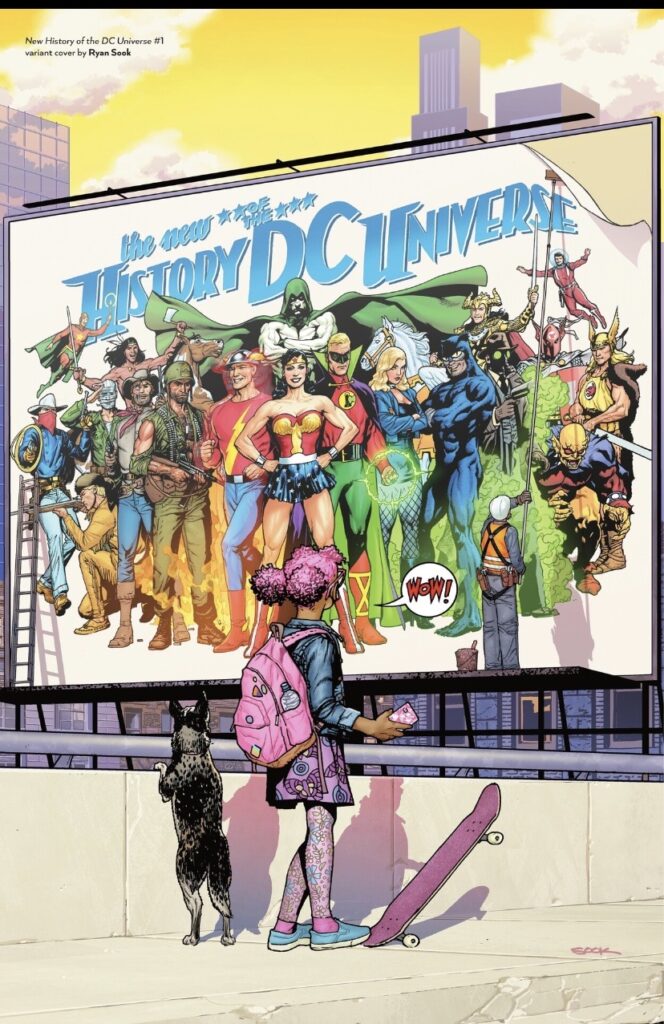
If the main story is the guided tour, the back matter is the comprehensive encyclopedia. At the end of the hardcover, Dave Wielgosz provides a massive set of annotations that build on Waid’s research. This is arguably the most valuable part of the entire book. These notes link specific panels and events back to the original comics they reference, serving as a roadmap for readers who want to explore the source material.
The benefit to new readers is immense. If someone is curious about the origins of Atlantis or the first meeting of the Justice Society, the annotations tell them exactly which back issues to seek out. For veteran fans, these notes provide a layer of depth that could inspire months of deep reading. Even when the main narrative stumbles over a retcon, the bibliography and annotations provide a sense of grounded history that makes the collection feel like an essential reference tool.

Ultimately, The New History of the DC Universe is an ambitious, beautiful, and occasionally flawed love letter to 90 years of storytelling. It does not solve every continuity problem, but it succeeds in making a tangled web feel like a single, epic tapestry. If you are a DC devotee, you will want this for the art and the annotations alone. If you are a new reader, this is the cheat sheet you have been looking for. It reminds us all that while the DC timeline may be messy, it is the sense of legacy and history that makes this universe special.
‘New History of the DC Universe HC’ Review of Mark Waid’s Ultimate Guide to 90 Years of Continuity
The New History of the DC Universe is an ambitious, beautiful, and occasionally flawed love letter to 90 years of storytelling. It does not solve every continuity problem, but it succeeds in making a tangled web feel like a single, epic tapestry.