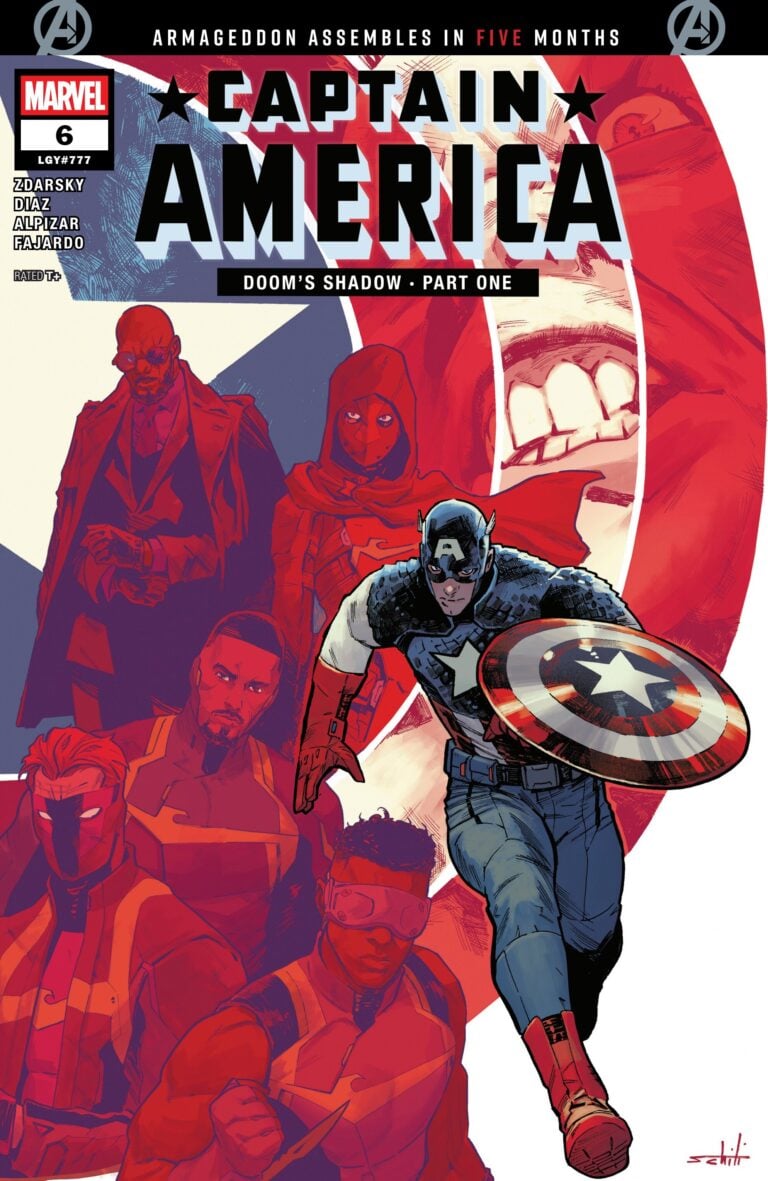
Featuring a time skip from the past five issues, Chip Zdarsky’s Captain America #6 feels a lot more burdened by the Marvel universe at large than its entry arc. On top of the major 9-issue event of One World Under Doom that this issue epilogues, the looming (and fast-approaching) Armageddon weighs heavily on this issue and threatens to undermine the early potential of the series with too much baggage.

This issue takes a major leap forward from the conclusion of issue #5. Instead of being with a freshly thawed Steve Rogers, we see one that’s properly in modern Marvel continuity. Complete with decades of history, ranging from an evil Hydra Captain America to Doctor Doom’s rule over the world.
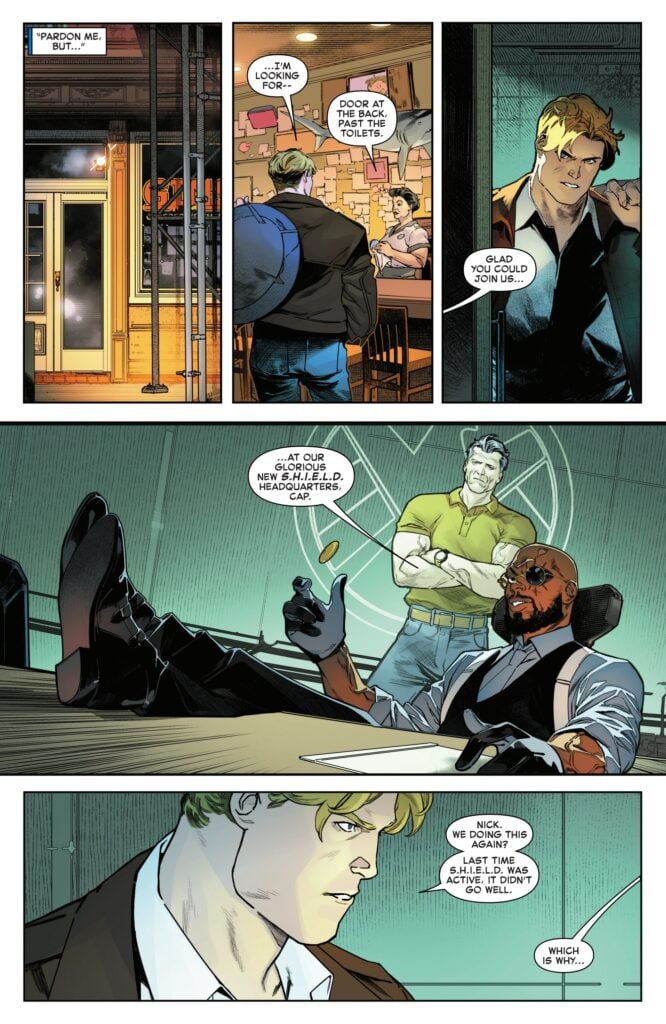
Cap is noticeably more weary, and after being thrown into jail for fighting a group of guys at a bar who were hoping to fill the vacuum Doctor Doom left, Steve learns there’s far more at stake with Latveria in particular in a crisis of leadership. With both Thunderbolt Ross and a reformed S.H.I.E.L.D. helmed by Nick Fury both vying for Steve’s help in taking control of Latveria, Steve begrudgingly chooses S.H.I.E.L.D. as the lesser of two evils to try and stop a global catastrophe on foreign soil.
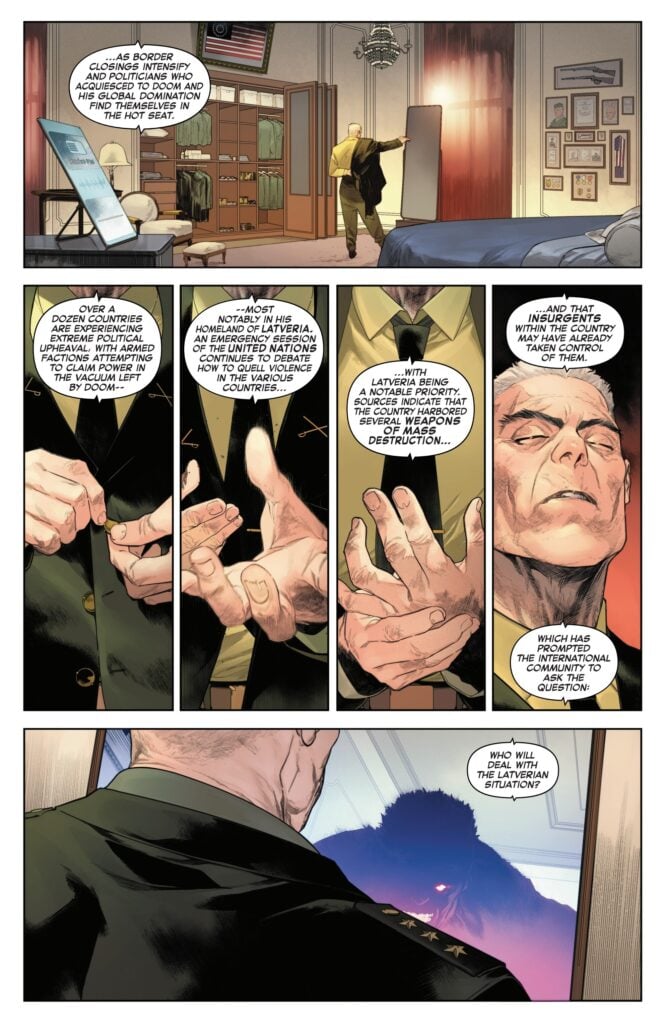
Coming off the heels of what felt like a strong opening arc to this new run, issue #6 feels a bit underwhelming. While the setup already feels like a retread of the first arc, the biggest issue lies in the time jump forward. Zdarsky has a lot of work to do, not just in the wake of One World Under Doom, but in Steve’s modern placement in the Marvel universe.
The last arc was so unburdened by continuity and event tie-ins that this issue feels like a splash of freezing water. It perhaps wouldn’t feel quite as burdensome if the issue had more action, but due to the sheer amount of ground to cover, it ends up being a “talking heads” kind of issue. There’s a lot of exposition that sometimes reads more like a Marvel history lesson than it does a story. It’s important work, especially after a time skip, but it doesn’t make for the same compelling read as the first five issues.

Pay at least $16 for these 10 items
The art in this issue, provided by Delio Diaz and Frank Alpizar, does a competent job of filling in while Valerio Schiti works on the next arc, but there is something missing. There’s plenty of technical prowess on display here; details are rich and help this book continue to feel premium, but so much of the series’ identity felt built on Schiti’s art that its absence is just sorely felt, especially in an issue that is largely talking.
With that being said, the final page promises a much more action-packed next issue where the team will have room to shine. While Frank Martin’s colors are also missed, Romulo Fajardo Jr. complements this art brilliantly, especially in how he plays with lighting. The letters from Joe Caramagna, though decent, do feel like they could have gone further, especially with the end-of-issue reveal.
Overall, the final package of Captain America #6 makes for a weird middle point in Zdarsky’s run. It feels like the start to a story that will suffer from being sandwiched in between two major events, and unfortunately, it seems like one that will be forgotten compared to what came before and what is sure to come after.
‘Captain America’ #6 | Does Chip Zdarsky’s Series Stumble After the Time Skip?
Overall, the final package of Captain America #6 makes for a weird middle point in Zdarsky’s run. It feels like the start to a story that will suffer from being sandwiched in between two major events, and unfortunately, it seems like one that will be forgotten compared to what came before and what is sure to come after.