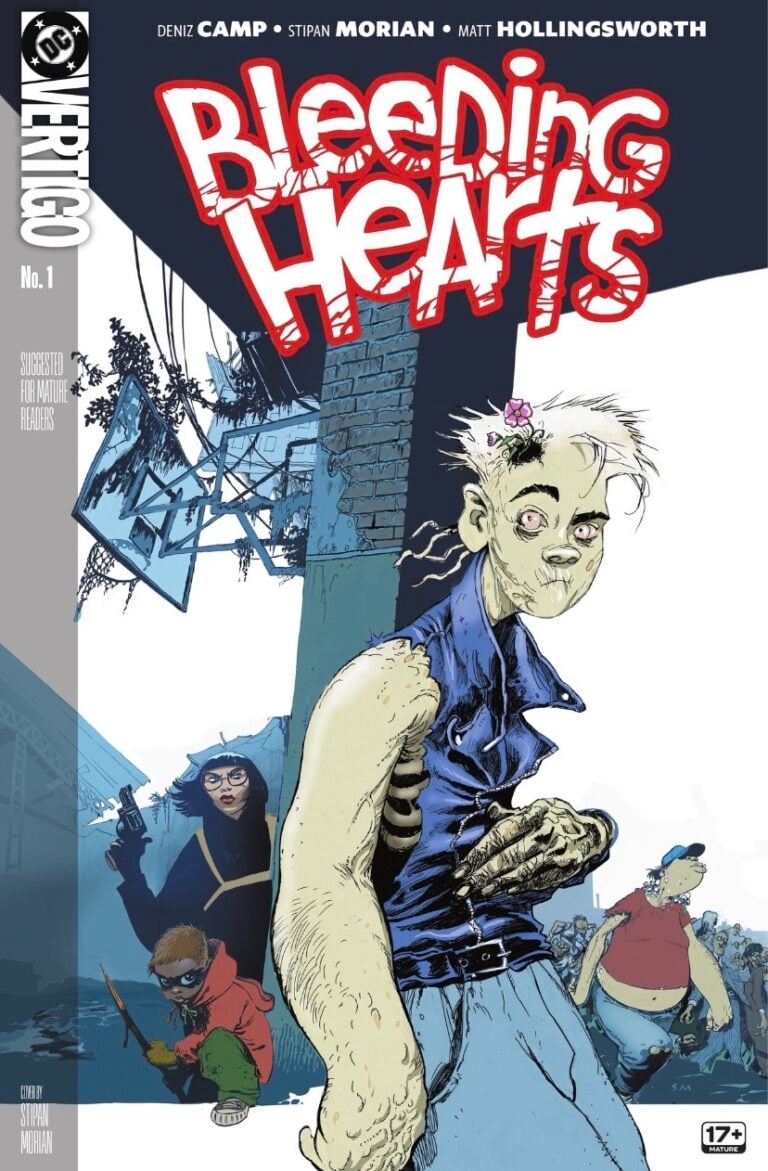
DC’s Vertigo imprint debuted in 1993 to immediate acclaim with books like Preacher and Hellblazer, and its revival in 2024 was met with genuine excitement. Bleeding Hearts is one of its first titles, bringing writer Deniz Camp and artist Stipan Morian together for an original take on the zombie apocalypse. Their first issue gives us a tale that’s equal parts horror and heart.

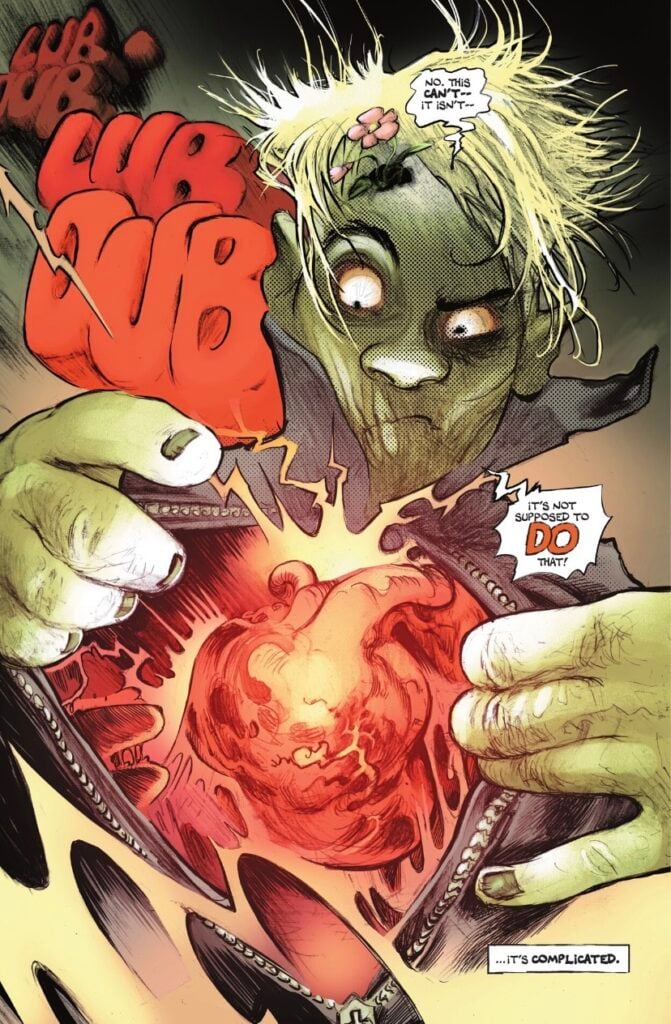
The story centers on a zombie named Mouse-Pokes-Golf-Ball-Out-Of-Head-Hole, or Poke as he’s more commonly known. He’s fairly normal amongst his fellow zombies, except for one crucial difference: His heart has started beating again. Morian shows us this sick development on page four as Poke spreads his chest open to reveal the pulsating organ. Panicked eyes and a stiff frown blanket his face, while his heart bursts with bulging veins and arteries. Matt Hollingsworth smartly uses his colors to show the difference between what’s alive and dead. Poke’s heart shines with bright reds in stark contrast to the grey, pallid skin that surrounds it.
This recent development causes him to question not only his way of life but zombie society as a whole. There’s a lot of world-building done here, but Poke’s inner dialogue is entertaining enough that you barely notice it. His commentary brings us to the suburbs, where he and his closest friend, Mush, have come to explore. His internal struggles reach a breaking point as he stumbles across two living survivors, ending the book with their fate in the balance.
Bleeding Hearts isn’t really about zombies though; they’re just a way for Camp to frame the human experience. He explores the need for social connection and the natural urge of species to form communities. The zombies have a culture all their own. They may be nomadic with few formal rules, but it helps them survive and connect with each other. Poke even remarks on this, asserting that “it’s unnatural to be too alone.” It’s a truth that’s as real for humans as it is for the undead.
It’s fascinating to see how normal the zombies are beyond their rotting flesh and desire to eat humans. They talk about where to find food sources, how to manage resources, and even get offended when certain words are used. Each conversation feels like something you’d have with a neighbor, albeit with a horror twist. It sounds appalling to us when they float the idea of creating a breeding colony of humans for a recurring food source, but it’s a simple matter of farming to them. It’s nothing personal; we’ve all got to eat, and when you’re not on top of the food chain anymore, it’s likely that you could become dinner.
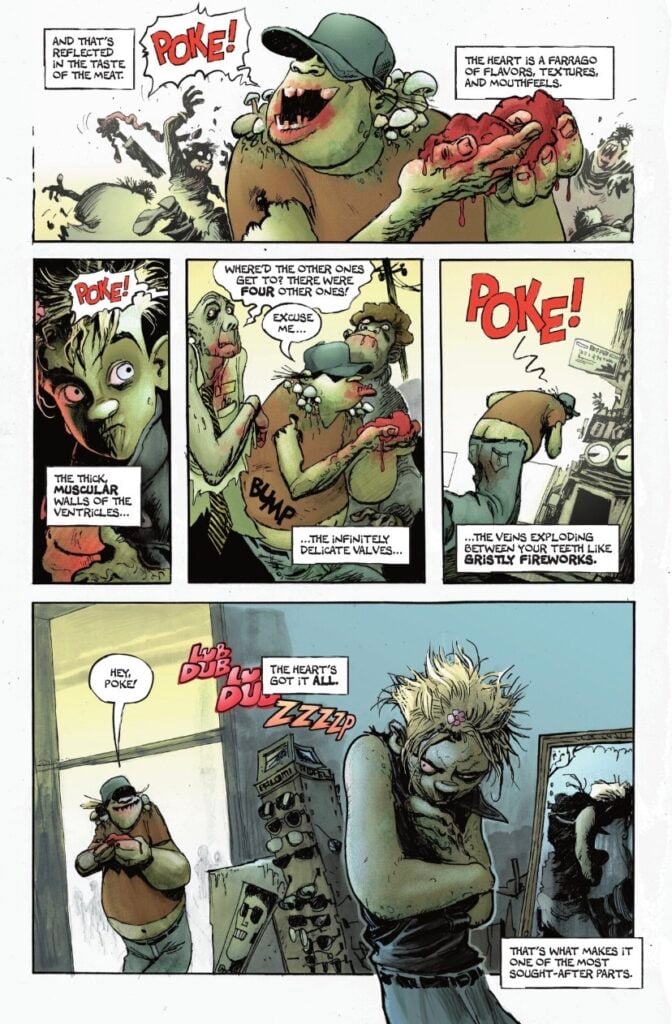
Poke’s newly beating heart is a constant problem though. Not only does it cause his newfound mental turmoil, but it’s also a loud and uncommon sound in the zombie world. Letterer Hassan Otsmane-Elhaou represents each beat with a punctuated “Lub Dub” sound effect that differs in size based on the sound level. It’s a clever technique that allows you to feel Poke’s anxiety each time it starts around his fellow zombies.

This book suffers from the common problem most first issues do. It’s a lot of setup, which can cause some messy pacing. Besides the two sequences where the zombies maul their victims, this story largely focuses on exposition. It’s a minor complaint, but was still noticeable.
Bleeding Hearts #1 proves Camp understands that great horror uses monsters to explore our own humanity. The zombie horde isn’t disturbing because of their actions; it’s because they mirror our own society. Poke’s heartbeat gets louder as his world grows more complicated, while Morian and Hollingsworth’s art makes each beat visually stunning. It’s a promising debut for DC Vertigo and a genuinely fresh take on an over-saturated genre.
Read More from KPB Comics:
‘Bleeding Hearts’ #1 | DC Vertigo’s New Zombie Horror
Bleeding Hearts #1 proves Camp understands that great horror uses monsters to explore our own humanity. The zombie horde isn’t disturbing because of their actions; it’s because they mirror our own society. Poke’s heartbeat gets louder as his world grows more complicated, while Morian and Hollingsworth’s art makes each beat visually stunning. It’s a promising debut for DC Vertigo and a genuinely fresh take on an over-saturated genre.