


The premiere of Alien: Earth introduced a wide cast of characters, among them the hybrid Wendy (Sydney Chandler) and her brother Hermit (Alex Lawther). By the third episode, the focus shifts slightly away from the siblings to allow others more room to develop. The choice pays off, as the ensemble’s personalities stand out with greater clarity.
In episode 3, titled “Metamorphosis,” the idea of transformation takes on multiple layers, applying not only to the alien creatures but also to the characters themselves, each undergoing a change that reflects both physical and personal evolution.
The story finally leaves the confines of the wrecked ship, allowing the narrative to branch out past Wendy, Hermit, and Samuel Blenkin’s unsettling Boy Kavalier. The series juggles a range of threads, from whispers of rebellion and divided loyalties among the Lost Boys to chilling undertones of manipulation. Where previous installments of the franchise thrived on stripped-down terror, Alien: Earth layers on transhumanist anxieties and political intrigue. Even so, the show never forgets its roots, ensuring that when the creatures strike, the chaos feels both terrifying and inevitable.

Disney+
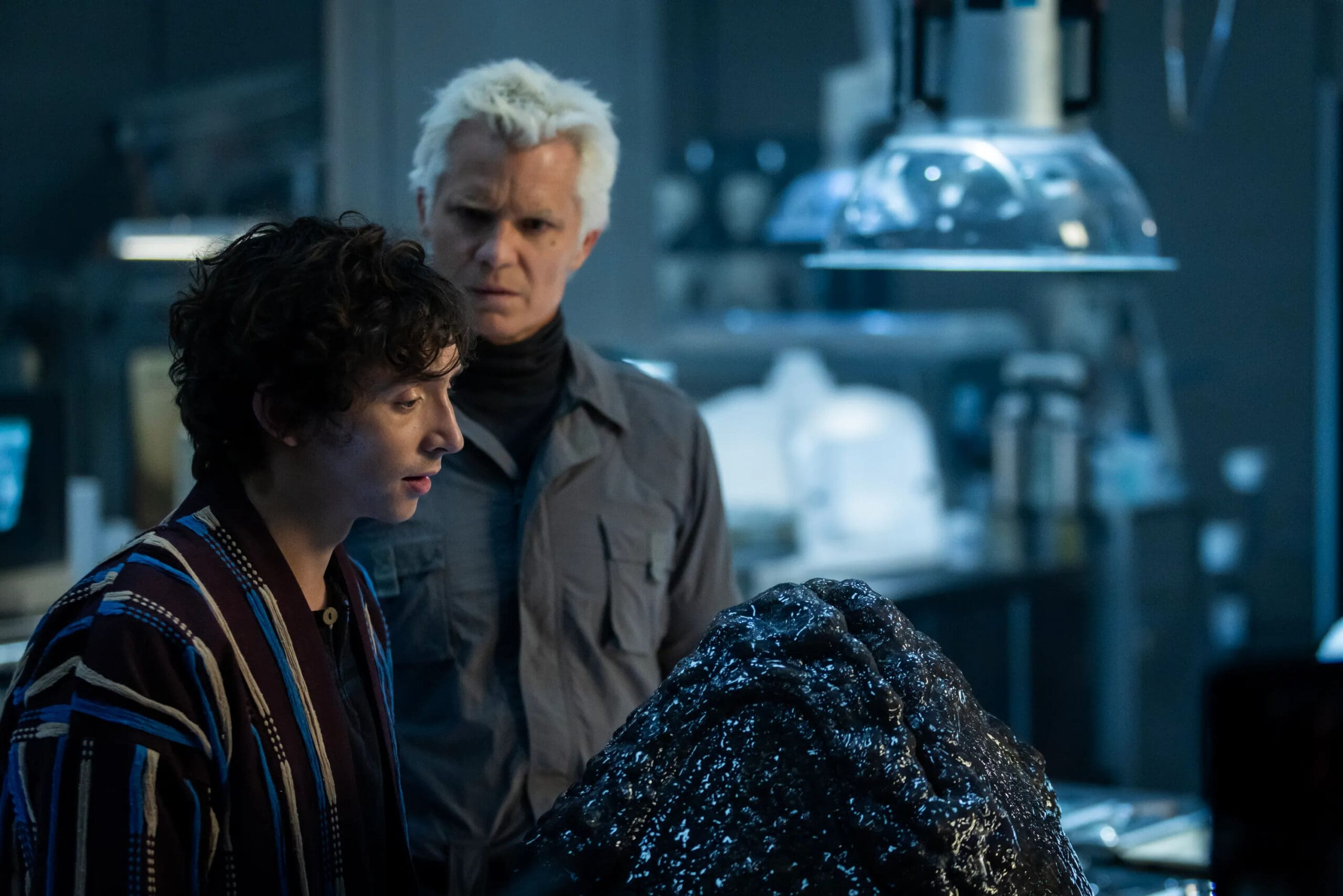
Most of the episode centers on the Lost Boys, overseen by Kirsh (Timothy Olyphant), as they collect data on the ship’s alien cargo. Alongside Kirsh’s sharp, sassy wit, the show expands the lore with the debut of the tadpole stage, bridging the gap between facehugger and chestburster. This unsettling creature proves adaptable, thriving in lungs or even artificial tanks. Kirsh also clarifies that the eggs respond to nearby lifeforms, but the mystery remains more frightening than any explanation, which is why too much exposition risks dulling their terror.
But Babou Ceesay as the android Morrow is the real standout here. He delivers a performance that deserves serious recognition, even if science fiction rarely receives the awards attention it should. His portrayal is chilling, especially in the way he transforms something as simple as plugging into the ship’s computer into a display of menace. Watching a few blinking lights become threatening in his hands is a reminder of how skilled he is at elevating even the smallest details.
The story reveals that he carries direct orders from Yutani herself, played by Sandra Yi Sencindiver, the current Weyland-Yutani CEO who inherited her role from her grandmother. Her connection to Morrow underscores just how dangerous he will be moving forward. Unlike Ash from the original movie, who hid his true nature until it was too late, Morrow is openly manipulative from the start, even influencing one of the Prodigy’s hybrids.
Disney+
“Metamorphosis” closes on an unexpected but fitting musical choice: Metallica’s “Wherever I May Roam” from their legendary 1991 Black Album. It is not the first track most listeners recall from that record, yet its lyrics feel uncannily suited to the world of Alien. A brilliant visual reinforces this connection: during Kirsh’s dissection of the xenomorph egg, the camera shifts to the facehugger’s point of view, peering through fluid at the synthetic scientists. It is a perspective rarely, if ever, seen in the franchise, and paired with Metallica’s song, it resonates thematically. The track’s focus on parasitism, lack of control, and endless wandering mirrors the alien life cycle. Much like the xenomorph itself, the lyrics evoke a perfect survivor—cold, ruthless, and driven only by the primal imperatives to endure and replicate, without purpose beyond survival.
Overall, episode three of Alien: Earth builds on the momentum of the two-part premiere while shifting gears into something more measured. It serves as a transitional chapter that ties up earlier threads with a quieter, more deliberate approach. The pacing is steady, giving the narrative room to breathe and ensuring the story has longevity beyond a few explosive installments.
From the outset, it was clear this series aimed to be more than just another encounter with xenomorphs, and this episode reinforces that ambition. With careful worldbuilding and evolving tensions, Alien: Earth continues to prove itself, setting the stage for the next installment to dive back into the universe with renewed purpose. The show is carefully layering intrigue and horror, crafting a story where the lines between survival, evolution, and humanity blur in unsettling ways.
‘Alien: Earth’ Episode 3 Review: Wherever Aliens May Roam
Overall, episode three of Alien: Earth builds on the momentum of the two-part premiere while shifting gears into something more measured. It serves as a transitional chapter that ties up earlier threads with a quieter, more deliberate approach. The pacing is steady, giving the narrative room to breathe and ensuring the story has longevity beyond a few explosive installments.