'The Last Spartan: Red Tape' Graphic Novel Review: Red Tape, Raw Justice

KPB Exclusive Interview: Tyler Mane & Renae Geerlings: The Graphic Novel Confronting Human Trafficking

Phillip Creary | November 1, 2025

November 1, 2025

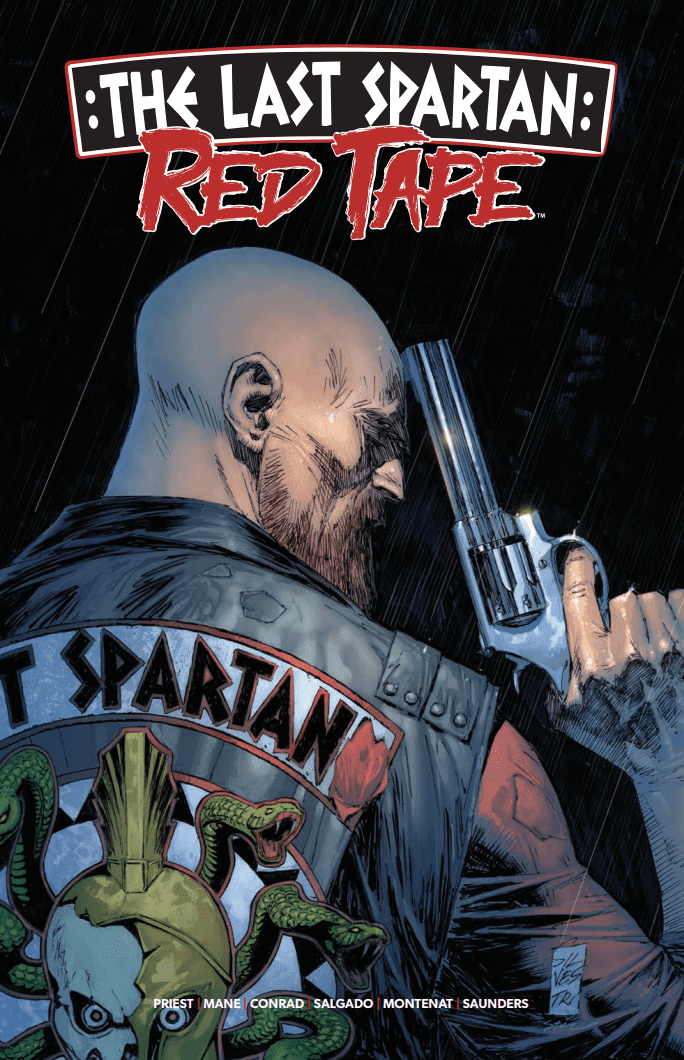
We recently sat down with Tyler Mane (actor/producer) and Renae Geerlings (writer/editor) about their intense new graphic novel, The Last Spartan: Red Tape.

This book, which they co-wrote with the legendary Christopher Priest, is a dark and powerful story. It follows Frank, a former military specialist driven by ancient prophecies, as he takes on the horrific world of human trafficking.

In our conversation, Tyler and Renae opened up about how they collaborated, the challenge of mixing Greek mythology with high-stakes action, and the serious real-world research they did to make the story feel so authentic. Plus, they told us about their commitment to fighting this issue, which led to a key partnership with the anti-trafficking organization, Deliver Fund.
Mane Entertainment

Phillip Creary: You guys have an amazing team: you, Tyler, Renae, and Christopher Priest. Thinking back to your first meeting, what was one idea that Priest dropped that really made you think, “Yes, that’s a key part that we have to have”?

Tyler Mane: Wow, that’s a good question.

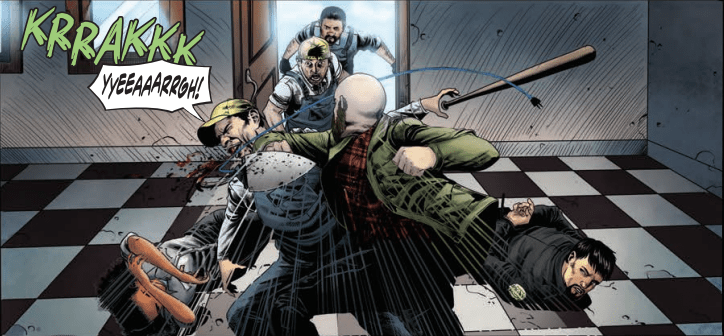
Renae Geerlings: When we brought Christopher Priest on, we already knew that we loved what he had done with solitary, laconic characters in the past. We were developing this from an original novel, where you have the luxury of telling the audience what the character is thinking. You lose that in any visual medium, such as TV or comics.

Right away, when we sat down with Christopher, he started discussing ways to develop the character of Frank without making him a “chatty Cathy.” We already had a character, Amanda Harper, that we wanted to add to the story, and he immediately came up with the idea of a debrief from her so that we have this narrator. Of course, she ends up being a fairly unreliable narrator at some point, but we learn a lot about Frank through Amanda’s character, which I thought was really, really smart.

PC: Renae, you co-wrote with Tyler and Christopher. How did you manage to balance all three of your voices (Christopher’s signature crime-gritty edge, Tyler’s action-thriller side, and your own perspective) to shape the final script?

RG: I always find it interesting when groups collaborate. To return to my original Witchblade days, I saw how a team with diverse perspectives worked. Tyler was kind of the Michael Turner of our group; he’s very visual. That’s really how Tyler thinks—very visual and character-based.

Christopher is brilliant at breaking down a story and how comics work. He’s a genius and incredibly skilled in granular details, and he’s very research-based.

I came along with a lot of story beats that I wanted to see done, but also being a little bit of the voice of reason. I kind of am the line producer in the comic book where I say, “That’s great, but we’re not going to do 160 pages. We’re going to do 128. So, let’s find a way.” It was very collaborative.

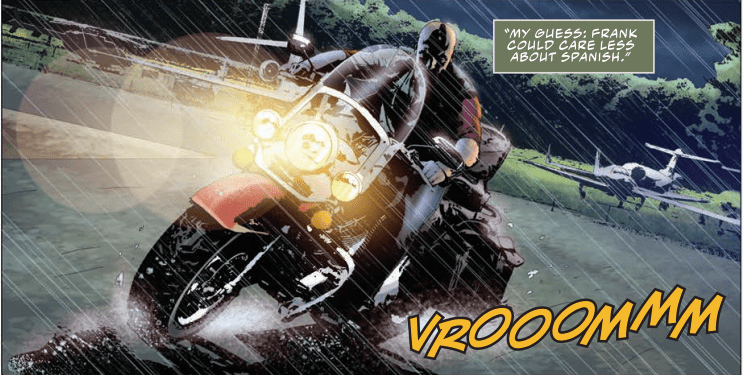
TM: Since it was based on a novel originally set 15 or 16 years ago, we had to figure out how to update and modernize it, especially in terms of how it tells the story and addresses the human trafficking aspect in today’s world, which is heavily influenced by technology. That was not a part of the original novel.

We’d come to Christopher with ideas, and he’d be like, “That never happened,” and we’d show him exactly that it did happen. We all kind of evolved and realized just how serious a topic this is. Talking with the CEO of Deliver Fund, Nick McKinley, who is a former CIA operative, he confirmed all the things we were talking about.
Mane Entertainment

Frank, Harper & the Elements of Humor and Mysticism

PC: This book is also surprisingly funny. There is a moment where Frank and Harper are having a very serious conversation, and he’s on the toilet! How important is it to sprinkle that sense of humor into a story that’s so heavy?

RG: Especially with the scene that it was dealing with, you have to lighten it up somehow. A story like this can get so dark that it becomes heavy. That was one of the first scenes Christopher wrote, and he wanted Frank to be so irreverent. He wanted this character to have so little regard for propriety or what normal civilization would think. 

TM: He does not care. He has his mission, and he’s sticking to it.

PC: Frank is the main character, and he follows a strict code, driven by an omen from the gods, which is a cool nod to the original Spartans. Since the story is such a raw, street-level crime drama, how important was it to add that mystical edge?

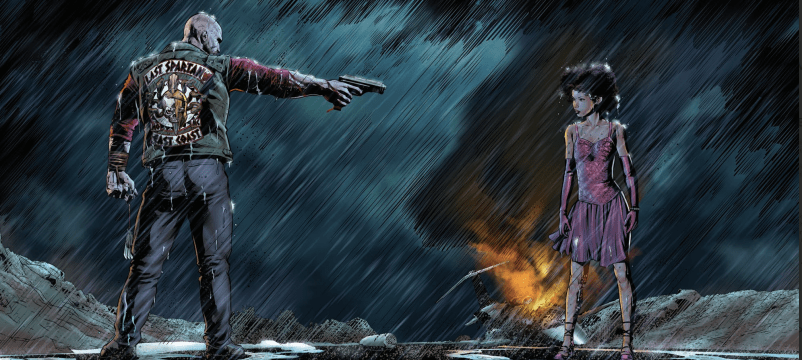
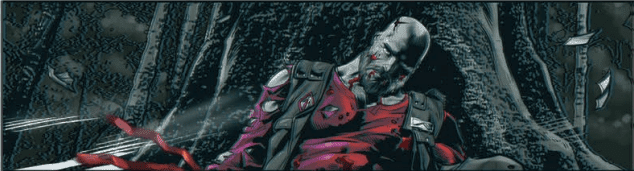
TM: We wanted to set Frank apart and have him be guided in accomplishing his goals. He is Spartanistic (very minimalist and focused) and led by those omens. 

RG: It sets him apart because we’ve seen so many of these solitary men on a mission. In this one, he has this mystical compass that drives him, that he believes in. The question throughout is, are these visions real? Is he really seeing them, or is he seeing what he wants to see? There’s a little twist about the visions at the end as well.

PC: Does Frank have powers?

TM: He’s a well-trained military machine, to begin with, and he’s very focused and driven to achieve his goal at whatever cost. 

RG: No, but do the gods use Frank? Do the gods bequeath Frank special knowledge or special strength? That’s the question. He is extremely strong, highly trained, brilliant, and has amassed a lot of resources. Is he being helped and guided? We’re going to leave that ambiguous.
Mane Entertainment

PC: On the partnership between Frank and Harper, they are total opposites. What was the hardest part about writing that dynamic and building towards that trust?

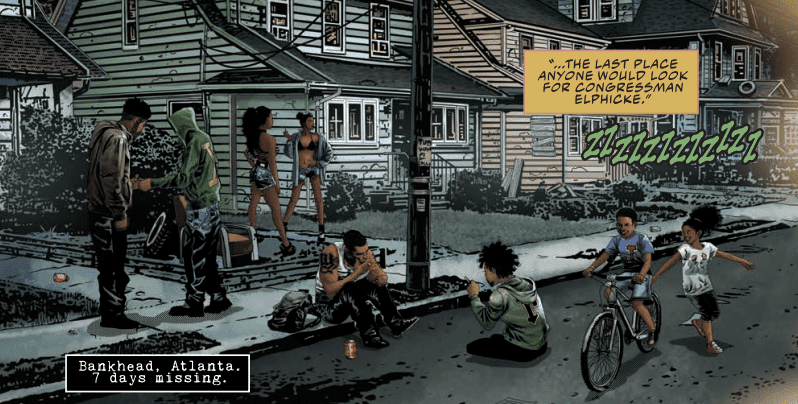
TM: We needed Amanda to fit into the decoy scenario, so she had to look young. When Frank finds her, she’s got a badge and is trying to take control of the situation, so they definitely butt heads a bit. 

RG: They are two warriors who are exact opposites, but because they are both warriors, they have a little crossover in the Venn diagram. Christopher did a really good job of highlighting how they are alike, yet also showing how they are always at odds.
Mane Entertainment

The Real-World Issue of Human Trafficking

PC: You tackled the horrifying reality that is human trafficking. Why did you choose the graphic novel medium as the best way to explore this complicated and dark real-world issue?

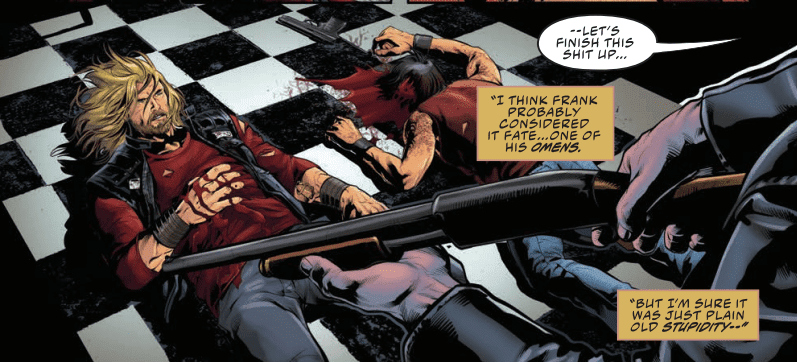
TM: I was originally planning to turn it into a TV series or a feature film, but Tom DeSanto and David Hayter suggested a graphic novel, as Renae has a history with comics. I thought, “Wow, this could be very interesting,” and it provides a proof of concept for future endeavors. We were very adamant about making it as realistic as possible. I was also very adamant that I wanted the drawings to look realistic.

RG: Honestly, it’s such a dark issue. We actually barely scratched the surface of what it is. It’s so depressing, so horrific, so dark, that putting it into a graphic novel, you have to think about how dark you really want to make this because it will limit your audience if you are completely honest about how bad it is. The research is fairly scarring.

TM: Through my interactions with fans at comic cons, talking about the book and the subject, usually at every convention, there are two or three people that this has personally affected, whether they are a first responder or family members of victims. They say, “Thank you for doing this because it needs to be brought to the forefront.” It’s out of sight, out of mind for most people.

We need to help raise awareness. One of the main reasons for writing the book is so that maybe families can read it together and talk to each other.
PC: You have a partnership with Deliver Fund. How did that partnership start specifically, and what do you hope readers will be inspired to do after finishing the book?

TM: After doing the research, I wanted to find an organization that is helping to put an end to it. I got to talk to Nick McKinley, the CEO and founder, and he’s a very straightforward guy. I really felt that we would be able to help them and spread the word. That’s why we wanted to put their mission statement in the back of the book. A portion of the proceeds from the graphic novel goes to Deliver Fund, so by getting a copy, you are also supporting them.

RG: Essentially, Nick said, “If law enforcement is the weapon against human trafficking, we are the laser sight.” With the use of AI, their ability to sift through information and photos, identify victims, and locate them is happening at an unprecedented speed. It takes so much time off of their ability to find the victims.
Mane Entertainment

The Deliver Fund Partnership & Artwork

PC: The book uses three different art teams across the three chapters: Will Conrad, Jimbo Salgado, and Michael Montenat. Talk about the decision to rotate the art team and how you kept the book looking consistent.

RG: We ran into scheduling timelines. Will Conrad is amazing, but it’s a long book, and we’re not Marvel or DC, so we couldn’t wait years. We had to find help. We were able to pull it off because the chapter structure was by design: the first is the origin story, the second is what happened, and the third is “what really happened.” Because there’s enough conceptual difference between the three sections, I think it worked well.

TM: It was a great learning experience for me; I’m used to the film and TV medium. I’m very proud of how they all merge.

PC: I saw that there’s a sequel (The Last Spartan: Lone Wolf) coming. Can you talk about it?

TM: I would love for this series to carry on with other issues. My end goal is to hopefully turn it into a TV series if we get enough of a following, so we can keep raising awareness.

RG: In this graphic novel, we take Frank, who came from a brotherhood, and we find him living in solitude. The first graphic novel is building a new team and brotherhood around him. Christopher had so many ideas and characters for this first story that we had to cut many to fit the page count. There is so much more to tell.

PC: Will Christopher Priest be coming back for the sequel?

RG: Christopher Priest has actually started working on some stuff. Justin Jordan wrote the following story, but Christopher is working on a lot more.
Mane Entertainment

PC: Frank is driven by these omens. What’s an everyday superstition that you secretly follow in your real life, whether it’s work-related or not?

RG: I can answer for Tyler! Tyler is very focused on energy and good energy. You cannot bring up a potential negative outcome because that is bad mojo. That’s hard for me because my editor brain is trained to look for what could go wrong!

PC: If you could pitch The Last Spartan as a crossover with any established comic book or film character, no matter how silly, who would you choose and why?

TM: I’d love to see Frank and The Punisher go together.

RG: I’m trying to think of a comic where there is actually Greek mythology in modern day. Like… Percy Jackson!

PC: Before we finish up, what’s the best place to get The Last Spartan: Red Tape, and how can people support the Deliver Fund?

TM: Go to TheLastSpartan.com. You can obtain copies of the hardcover, the softcover, and even the script book, which features Christopher Priest’s script with notes. It’s in stores this week, so you can also ask your local comic book shop for it!

For Deliver Fund, a portion of the proceeds from the graphic novel goes to them, or you can go directly to DeliverFund.org to donate and check out their resources.
Support the Cause

Thank you to Tyler Mane and Renae Geerlings for an eye-opening conversation. If you want to dive into the gripping world of Frank and Amanda Harper while supporting an incredible cause, pick up a copy of the graphic novel today.

  • Buy the Book: TheLastSpartan.com or ManeEntertainment.com
  • Support the Fight: Learn more and donate directly at DeliverFund.org
'The Last Spartan: Red Tape' Graphic Novel Review: Red Tape, Raw Justice

KPB Exclusive Interview: Tyler Mane & Renae Geerlings: The Graphic Novel Confronting Human Trafficking

November 1, 2025

We recently sat down with Tyler Mane (actor/producer) and Renae Geerlings (writer/editor) about their intense new graphic novel, The Last Spartan: Red Tape.

This book, which they co-wrote with the legendary Christopher Priest, is a dark and powerful story. It follows Frank, a former military specialist driven by ancient prophecies, as he takes on the horrific world of human trafficking.

In our conversation, Tyler and Renae opened up about how they collaborated, the challenge of mixing Greek mythology with high-stakes action, and the serious real-world research they did to make the story feel so authentic. Plus, they told us about their commitment to fighting this issue, which led to a key partnership with the anti-trafficking organization, Deliver Fund.

Mane Entertainment

Phillip Creary: You guys have an amazing team: you, Tyler, Renae, and Christopher Priest. Thinking back to your first meeting, what was one idea that Priest dropped that really made you think, “Yes, that’s a key part that we have to have”?

Tyler Mane: Wow, that’s a good question.

Renae Geerlings: When we brought Christopher Priest on, we already knew that we loved what he had done with solitary, laconic characters in the past. We were developing this from an original novel, where you have the luxury of telling the audience what the character is thinking. You lose that in any visual medium, such as TV or comics.

Right away, when we sat down with Christopher, he started discussing ways to develop the character of Frank without making him a “chatty Cathy.” We already had a character, Amanda Harper, that we wanted to add to the story, and he immediately came up with the idea of a debrief from her so that we have this narrator. Of course, she ends up being a fairly unreliable narrator at some point, but we learn a lot about Frank through Amanda’s character, which I thought was really, really smart.

PC: Renae, you co-wrote with Tyler and Christopher. How did you manage to balance all three of your voices (Christopher’s signature crime-gritty edge, Tyler’s action-thriller side, and your own perspective) to shape the final script?

RG: I always find it interesting when groups collaborate. To return to my original Witchblade days, I saw how a team with diverse perspectives worked. Tyler was kind of the Michael Turner of our group; he’s very visual. That’s really how Tyler thinks—very visual and character-based.

Christopher is brilliant at breaking down a story and how comics work. He’s a genius and incredibly skilled in granular details, and he’s very research-based.

I came along with a lot of story beats that I wanted to see done, but also being a little bit of the voice of reason. I kind of am the line producer in the comic book where I say, “That’s great, but we’re not going to do 160 pages. We’re going to do 128. So, let’s find a way.” It was very collaborative.

TM: Since it was based on a novel originally set 15 or 16 years ago, we had to figure out how to update and modernize it, especially in terms of how it tells the story and addresses the human trafficking aspect in today’s world, which is heavily influenced by technology. That was not a part of the original novel.

We’d come to Christopher with ideas, and he’d be like, “That never happened,” and we’d show him exactly that it did happen. We all kind of evolved and realized just how serious a topic this is. Talking with the CEO of Deliver Fund, Nick McKinley, who is a former CIA operative, he confirmed all the things we were talking about.

Mane Entertainment

Frank, Harper & the Elements of Humor and Mysticism

PC: This book is also surprisingly funny. There is a moment where Frank and Harper are having a very serious conversation, and he’s on the toilet! How important is it to sprinkle that sense of humor into a story that’s so heavy?

RG: Especially with the scene that it was dealing with, you have to lighten it up somehow. A story like this can get so dark that it becomes heavy. That was one of the first scenes Christopher wrote, and he wanted Frank to be so irreverent. He wanted this character to have so little regard for propriety or what normal civilization would think. 

TM: He does not care. He has his mission, and he’s sticking to it.

PC: Frank is the main character, and he follows a strict code, driven by an omen from the gods, which is a cool nod to the original Spartans. Since the story is such a raw, street-level crime drama, how important was it to add that mystical edge?

TM: We wanted to set Frank apart and have him be guided in accomplishing his goals. He is Spartanistic (very minimalist and focused) and led by those omens. 

RG: It sets him apart because we’ve seen so many of these solitary men on a mission. In this one, he has this mystical compass that drives him, that he believes in. The question throughout is, are these visions real? Is he really seeing them, or is he seeing what he wants to see? There’s a little twist about the visions at the end as well.

PC: Does Frank have powers?

TM: He’s a well-trained military machine, to begin with, and he’s very focused and driven to achieve his goal at whatever cost. 

RG: No, but do the gods use Frank? Do the gods bequeath Frank special knowledge or special strength? That’s the question. He is extremely strong, highly trained, brilliant, and has amassed a lot of resources. Is he being helped and guided? We’re going to leave that ambiguous.

Mane Entertainment

PC: On the partnership between Frank and Harper, they are total opposites. What was the hardest part about writing that dynamic and building towards that trust?

TM: We needed Amanda to fit into the decoy scenario, so she had to look young. When Frank finds her, she’s got a badge and is trying to take control of the situation, so they definitely butt heads a bit. 

RG: They are two warriors who are exact opposites, but because they are both warriors, they have a little crossover in the Venn diagram. Christopher did a really good job of highlighting how they are alike, yet also showing how they are always at odds.

Mane Entertainment

The Real-World Issue of Human Trafficking

PC: You tackled the horrifying reality that is human trafficking. Why did you choose the graphic novel medium as the best way to explore this complicated and dark real-world issue?

TM: I was originally planning to turn it into a TV series or a feature film, but Tom DeSanto and David Hayter suggested a graphic novel, as Renae has a history with comics. I thought, “Wow, this could be very interesting,” and it provides a proof of concept for future endeavors. We were very adamant about making it as realistic as possible. I was also very adamant that I wanted the drawings to look realistic.

RG: Honestly, it’s such a dark issue. We actually barely scratched the surface of what it is. It’s so depressing, so horrific, so dark, that putting it into a graphic novel, you have to think about how dark you really want to make this because it will limit your audience if you are completely honest about how bad it is. The research is fairly scarring.

TM: Through my interactions with fans at comic cons, talking about the book and the subject, usually at every convention, there are two or three people that this has personally affected, whether they are a first responder or family members of victims. They say, “Thank you for doing this because it needs to be brought to the forefront.” It’s out of sight, out of mind for most people.

We need to help raise awareness. One of the main reasons for writing the book is so that maybe families can read it together and talk to each other.

PC: You have a partnership with Deliver Fund. How did that partnership start specifically, and what do you hope readers will be inspired to do after finishing the book?

TM: After doing the research, I wanted to find an organization that is helping to put an end to it. I got to talk to Nick McKinley, the CEO and founder, and he’s a very straightforward guy. I really felt that we would be able to help them and spread the word. That’s why we wanted to put their mission statement in the back of the book. A portion of the proceeds from the graphic novel goes to Deliver Fund, so by getting a copy, you are also supporting them.

RG: Essentially, Nick said, “If law enforcement is the weapon against human trafficking, we are the laser sight.” With the use of AI, their ability to sift through information and photos, identify victims, and locate them is happening at an unprecedented speed. It takes so much time off of their ability to find the victims.

Mane Entertainment

The Deliver Fund Partnership & Artwork

PC: The book uses three different art teams across the three chapters: Will Conrad, Jimbo Salgado, and Michael Montenat. Talk about the decision to rotate the art team and how you kept the book looking consistent.

RG: We ran into scheduling timelines. Will Conrad is amazing, but it’s a long book, and we’re not Marvel or DC, so we couldn’t wait years. We had to find help. We were able to pull it off because the chapter structure was by design: the first is the origin story, the second is what happened, and the third is “what really happened.” Because there’s enough conceptual difference between the three sections, I think it worked well.

TM: It was a great learning experience for me; I’m used to the film and TV medium. I’m very proud of how they all merge.

PC: I saw that there’s a sequel (The Last Spartan: Lone Wolf) coming. Can you talk about it?

TM: I would love for this series to carry on with other issues. My end goal is to hopefully turn it into a TV series if we get enough of a following, so we can keep raising awareness.

RG: In this graphic novel, we take Frank, who came from a brotherhood, and we find him living in solitude. The first graphic novel is building a new team and brotherhood around him. Christopher had so many ideas and characters for this first story that we had to cut many to fit the page count. There is so much more to tell.

PC: Will Christopher Priest be coming back for the sequel?

RG: Christopher Priest has actually started working on some stuff. Justin Jordan wrote the following story, but Christopher is working on a lot more.

Mane Entertainment

PC: Frank is driven by these omens. What’s an everyday superstition that you secretly follow in your real life, whether it’s work-related or not?

RG: I can answer for Tyler! Tyler is very focused on energy and good energy. You cannot bring up a potential negative outcome because that is bad mojo. That’s hard for me because my editor brain is trained to look for what could go wrong!

PC: If you could pitch The Last Spartan as a crossover with any established comic book or film character, no matter how silly, who would you choose and why?

TM: I’d love to see Frank and The Punisher go together.

RG: I’m trying to think of a comic where there is actually Greek mythology in modern day. Like… Percy Jackson!

PC: Before we finish up, what’s the best place to get The Last Spartan: Red Tape, and how can people support the Deliver Fund?

TM: Go to TheLastSpartan.com. You can obtain copies of the hardcover, the softcover, and even the script book, which features Christopher Priest’s script with notes. It’s in stores this week, so you can also ask your local comic book shop for it!

For Deliver Fund, a portion of the proceeds from the graphic novel goes to them, or you can go directly to DeliverFund.org to donate and check out their resources.

Support the Cause

Thank you to Tyler Mane and Renae Geerlings for an eye-opening conversation. If you want to dive into the gripping world of Frank and Amanda Harper while supporting an incredible cause, pick up a copy of the graphic novel today.

  • Buy the Book: TheLastSpartan.com or ManeEntertainment.com
  • Support the Fight: Learn more and donate directly at DeliverFund.org
Share:

Comments

Leave the first comment

<!-- if comments are disabled for this post then hide comments container -->
<style> 
<?php if(!comments_open()) { echo "#nfps-comments-container {display: none !important;}"; }?>
</style>