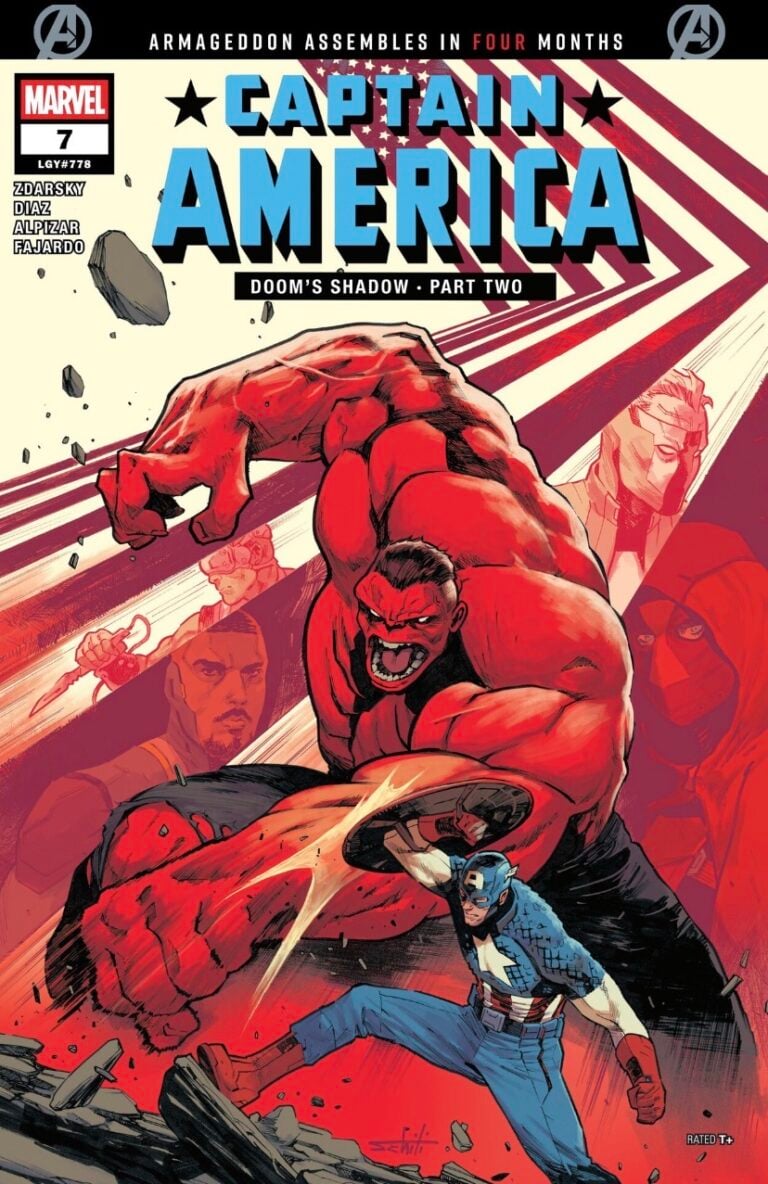
Latveria is without a ruler and Captain America has been once again called upon to make things right. With the US Military and an array of new Latverian political parties all fighting over their competing interests, Captain America #7 shows Steve trying to cut through the noise and find the best course for the innocent citizens of Latveria.

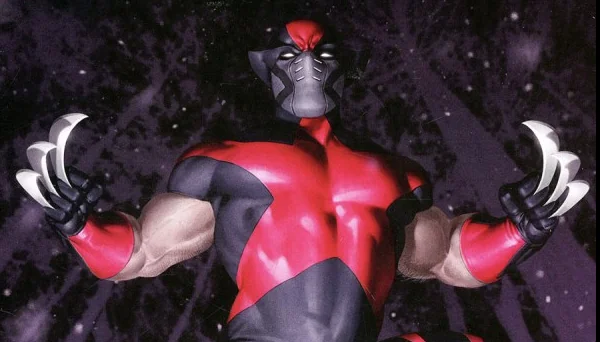
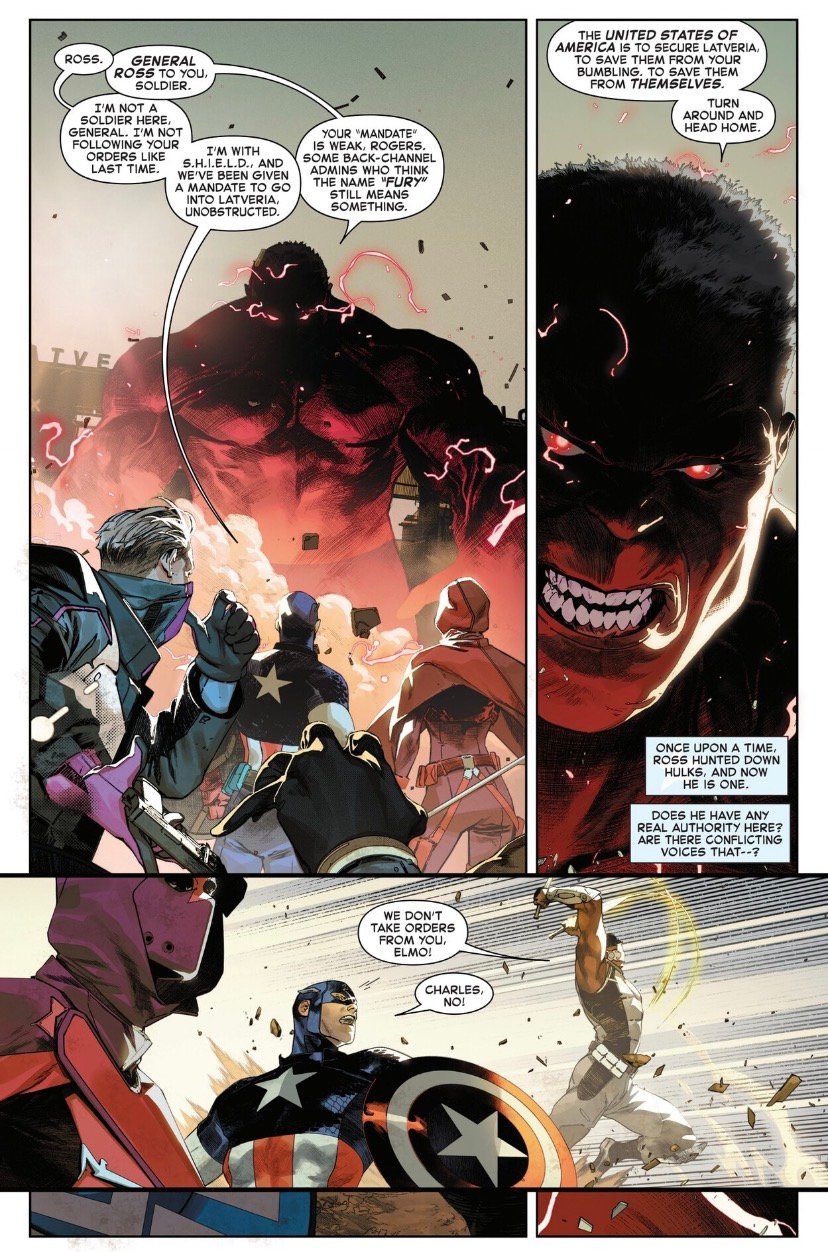
Picking off where issue #6 left off, Cap and his new team of hired guns from SHIELD are face to face with Thunderbolt Ross, General in the U.S. Military and also Red Hulk. Though the situation is diffused without violence, Ross leaves with a threat of it at a moment’s notice. With the Red Hulk out of the way, the team makes their way into Doomstadt and we get introduced to the various political parties at play through rousing speeches, gunfire in the streets, and Marius Wolf, a freedom fighter Steve met in his last excursion to Latveria who is trying to use the power vacuum to shape Latveria how he expects it to be. With so many different parties at play, and a potential warhead in play, Steve decides to hide his Cap uniform and go onto the streets of Latveria and speak directly to the people most affected by the political turmoil.
In my review of issue #6, I lamented that this arc was feeling underwhelming by virtue of being sandwiched between two big events and was burdened by the baggage of Marvel continuity, unlike the first five issues. Now, in issue #7, I can say that although these issues are present, they don’t hang as heavily on the actual story. There weren’t as many allusions to One World Under Doom or dialogue that referenced too much outside of this series, and it felt like Cap was able to breathe a bit more individually. There’s a particularly touching moment of Steve immersing himself in the city without the baggage of his superhero identity. He speaks to a woman and her child, citizens of Latveria tired of the constant power struggle. It’s the type of thing that makes Steve so endearing, the moments where he’s able to take a step back from the big picture to empathize and connect with the citizens being affected.
That’s not to say this issue doesn’t have its own problems, though. In the first arc, although the plot was largely about Latveria, what helped it feel at home was that it was still ultimately a commentary on America. To some extent it feels like Zdarsky is trying to continue the same theme, but it falls decisively more flat. Where the first arc felt like a condemnation of America’s faults while still praising the ideology behind it, this issue feels far less critical of American ideals. The entire premise of this arc still feels like Steve is regressing, repeating the same issues as the first arc in the series that makes me wonder if he learned from it at all.
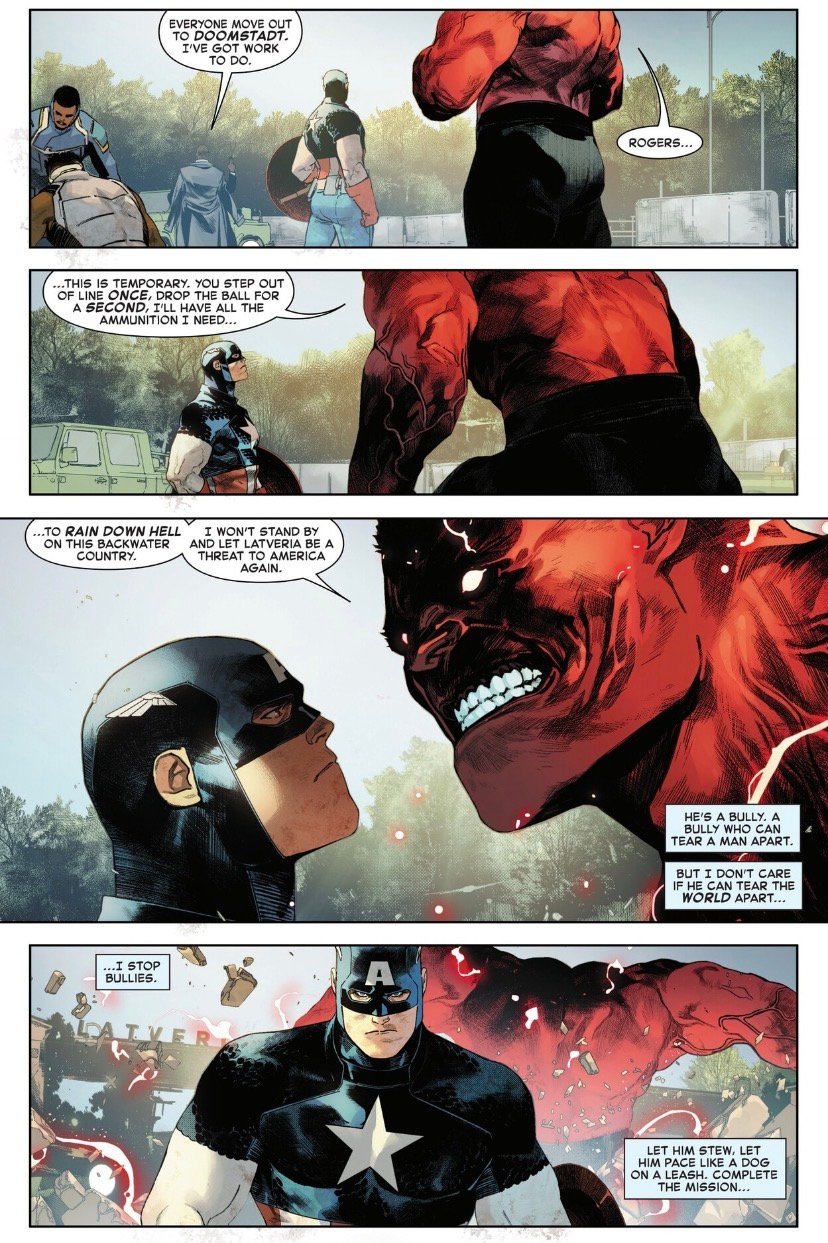
The art from Delio Diaz and Frank Alpizar continues to be the premium level that’s to be expected from a big two book. Especially in the brief bouts of action, Diaz and Alpizar shine with kinetic poses that keep the momentum going. On top of that there are some individual panels that did really stun me like the one of Steve looking out over Latveria. It does an excellent job of matching the tone in any given scene and helping communicate the story visually.
My only gripe with the art is that the faces can sometimes look a little uncanny or like they’re lacking in the emotion that is carried in the rest of the art. The coloring and letters from Romulo Fajardo Jr. and Joe Caramagna respectively do their jobs well and compliment the rest of the issue well. Fajardo Jr. does an especially strong job with the lighting in the scenes, contributing a lot to the tone setting mentioned earlier.

Captain America #7 is definitely an improvement over the previous issue. It spends more time on Steve and his journey and is not as held back by Marvel continuity as its predecessor. What it is held back by is the lack of forward momentum compared to the first five issues, going through a lot of the same beats but with slight twists that don’t feel like they add much. This arc is definitely improving, but it has a ways to go before it matches the highs of the start of Zdarsky’s run.
Read More from KPB Comics:
‘Captain America’ #7 | Steve Rogers, Red Hulk, and the Latverian Civil War
Captain America #7 is definitely an improvement over the previous issue. It spends more time on Steve and his journey and is not as held back by Marvel continuity as its predecessor. What it is held back by is the lack of forward momentum compared to the first five issues, going through a lot of the same beats but with slight twists that don’t feel like they add much. This arc is definitely improving, but it has a ways to go before it matches the highs of the start of Zdarsky’s run.