

Carol Danvers ignites with Phoenix-like power in Binary #1

‘Binary’ #1 Review: Did Carol Danvers Need the Phoenix Force?

A.S Tiger | October 8, 2025

October 8, 2025

Stephanie Phillips is joined by Giada Belviso (the main artist for Laura Kinney: Wolverine for fans of that comic) and colourist Rachelle Rosenberg to tell the mystery of Binary, X years in the future. The Age of Revelation revisits so many characters 10 years from our current 616 present, after Revelation has taken power in the US, and a devastating virus has wiped out a huge portion of humanity. Binary is Phillips’s slice of the pie, continuing in some respects, her work on Phoenix

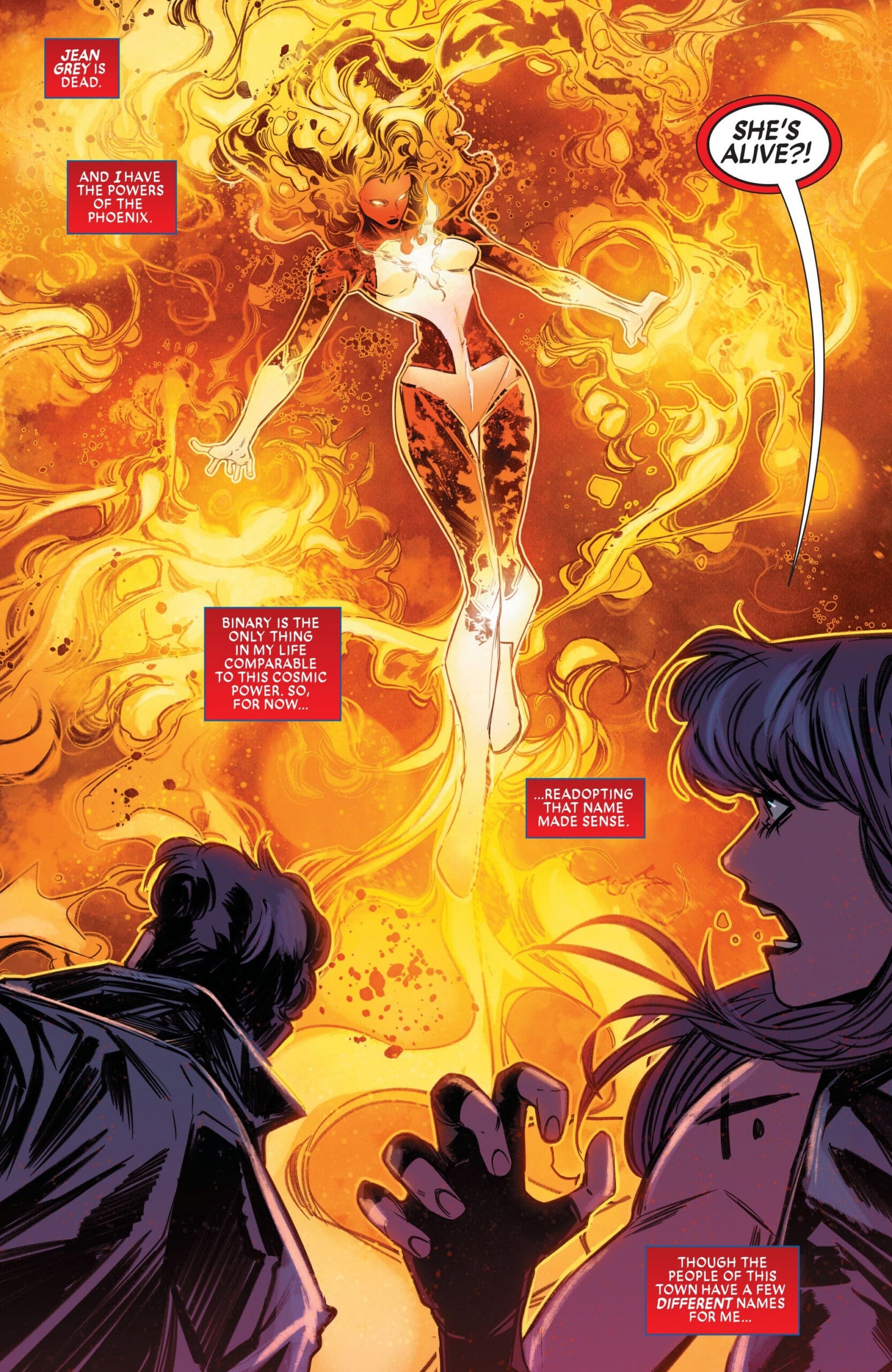
Binary is Carol Danvers, now host of the Phoenix Force. Jean Grey is dead, or so she believes, and now, blessed and cursed with the Phoenix powers she once had, Carol takes on the name Binary and resides in her hometown in Massachusetts, using the vast power of the Phoenix to keep her hometown safe. The only problem is that the townspeople, after 10 years of living in quarantine, are restless and believe that the X-Virus and the world outside their telekinetic walls is a conspiracy and fiction. There’s a nod to real-world politics there. The restless townspeople begin to cause some havoc, making Binary a target for their ire. Binary herself feels uncertain about her choices, noting that the Phoenix is restless and does not agree with her choices. Fueling the anger of the townspeople is a mysterious figure, cloaked in black, but bearing a striking resemblance to a character we have come to know well.
Marvel

Binary’s central conceit is perhaps the book’s greatest weakness. Jean and Carol had a very surface-level friendship in the Phoenix comic, so choosing her as the next host feels odd. And rather than continuing to tell the story of the character Phillips had already worked on for 15 issues, we instead pivot to Carol Danvers, who receives a reheated version of the Phoenix story told so far. One can’t help but feel that Phillips could have written a more interesting Jean Grey story with this premise rather than the one presented here. The only mystery and hook to this comic seems to be the mystery of what happened to Jean. Did she really die, or is there more to the situation than we think? But if the only major talking point about a comic book is what happened to a different character, then the comic itself has failed in some ways. 

Giada Belviso teams up with colourist Rachelle Rosenberg to provide the art for this issue, and here is the only noticeable improvement from Phillips’ Phoenix comic. The art and colours are lively, bright, and soaked in warm tones that suit the Massachusetts town and the flames of the Phoenix. The action is drawn well, as is the fire. The one downside might be that there is a slightly distracting similarity in the hair and eyes of certain characters, but other than that, it’s good work. 

Marvel

Binary is a reheated version of Phoenix, telling a more grounded story, but in a way that isn’t very compelling or interesting. One can’t help but feel that this was an unnecessary pivot in the story, rather than continuing with the one Phillips had already written. Belviso and Rosenberg do mostly good work on the art, however.

‘Binary’ #1 Review: Did Carol Danvers Need the Phoenix Force?

Binary is a reheated version of Phoenix, telling a more grounded story, but in a way that isn’t very compelling or interesting. One can’t help but feel that this was an unnecessary pivot in the story, rather than continuing with the one Phillips had already written.


6.5

AMAZON
BUY NOW
Carol Danvers ignites with Phoenix-like power in Binary #1

‘Binary’ #1 Review: Did Carol Danvers Need the Phoenix Force?

October 8, 2025

Stephanie Phillips is joined by Giada Belviso (the main artist for Laura Kinney: Wolverine for fans of that comic) and colourist Rachelle Rosenberg to tell the mystery of Binary, X years in the future. The Age of Revelation revisits so many characters 10 years from our current 616 present, after Revelation has taken power in the US, and a devastating virus has wiped out a huge portion of humanity. Binary is Phillips’s slice of the pie, continuing in some respects, her work on Phoenix

Binary is Carol Danvers, now host of the Phoenix Force. Jean Grey is dead, or so she believes, and now, blessed and cursed with the Phoenix powers she once had, Carol takes on the name Binary and resides in her hometown in Massachusetts, using the vast power of the Phoenix to keep her hometown safe. The only problem is that the townspeople, after 10 years of living in quarantine, are restless and believe that the X-Virus and the world outside their telekinetic walls is a conspiracy and fiction. There’s a nod to real-world politics there. The restless townspeople begin to cause some havoc, making Binary a target for their ire. Binary herself feels uncertain about her choices, noting that the Phoenix is restless and does not agree with her choices. Fueling the anger of the townspeople is a mysterious figure, cloaked in black, but bearing a striking resemblance to a character we have come to know well.

Marvel

Binary’s central conceit is perhaps the book’s greatest weakness. Jean and Carol had a very surface-level friendship in the Phoenix comic, so choosing her as the next host feels odd. And rather than continuing to tell the story of the character Phillips had already worked on for 15 issues, we instead pivot to Carol Danvers, who receives a reheated version of the Phoenix story told so far. One can’t help but feel that Phillips could have written a more interesting Jean Grey story with this premise rather than the one presented here. The only mystery and hook to this comic seems to be the mystery of what happened to Jean. Did she really die, or is there more to the situation than we think? But if the only major talking point about a comic book is what happened to a different character, then the comic itself has failed in some ways. 

Giada Belviso teams up with colourist Rachelle Rosenberg to provide the art for this issue, and here is the only noticeable improvement from Phillips’ Phoenix comic. The art and colours are lively, bright, and soaked in warm tones that suit the Massachusetts town and the flames of the Phoenix. The action is drawn well, as is the fire. The one downside might be that there is a slightly distracting similarity in the hair and eyes of certain characters, but other than that, it’s good work. 

Marvel

Binary is a reheated version of Phoenix, telling a more grounded story, but in a way that isn’t very compelling or interesting. One can’t help but feel that this was an unnecessary pivot in the story, rather than continuing with the one Phillips had already written. Belviso and Rosenberg do mostly good work on the art, however.

‘Binary’ #1 Review: Did Carol Danvers Need the Phoenix Force?

Binary is a reheated version of Phoenix, telling a more grounded story, but in a way that isn’t very compelling or interesting. One can’t help but feel that this was an unnecessary pivot in the story, rather than continuing with the one Phillips had already written.

6.5

Share:

Comments

Leave the first comment

<!-- if comments are disabled for this post then hide comments container -->
<style> 
<?php if(!comments_open()) { echo "#nfps-comments-container {display: none !important;}"; }?>
</style>