
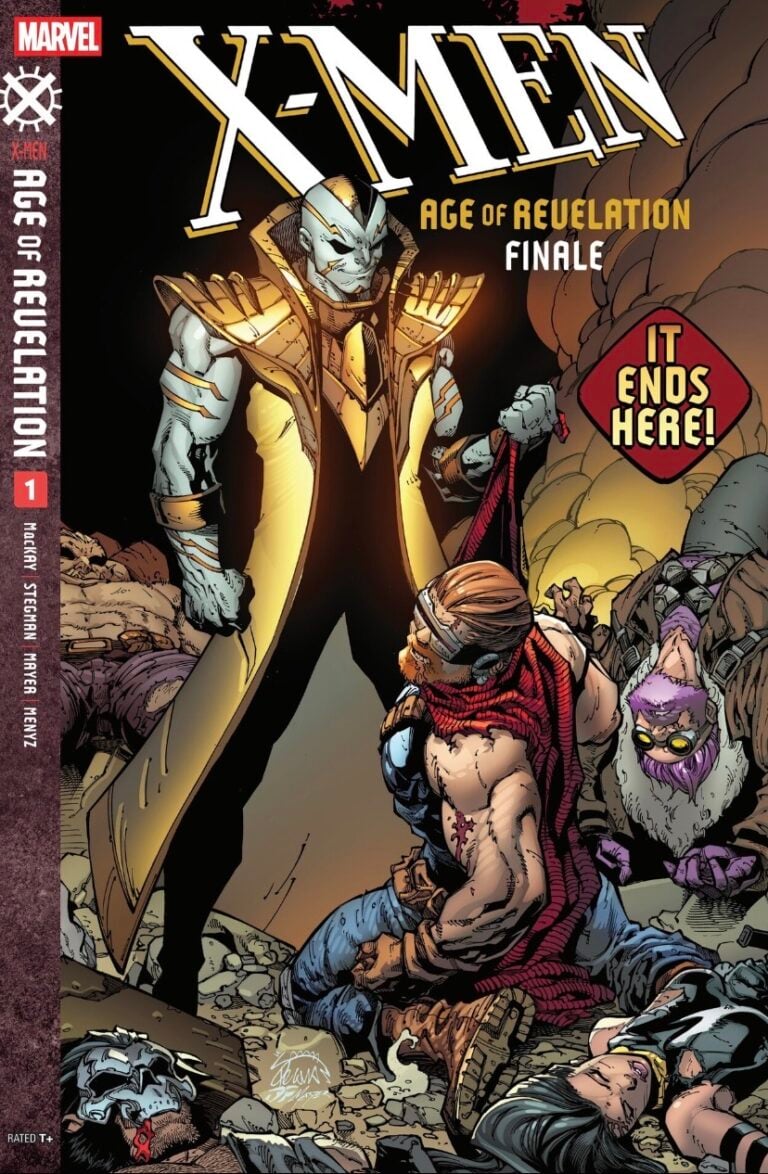
The Age of Revelation has finally come to a close, and not in the way you were probably expecting. Heroic tales are full of victories and triumphs, and while comic books are built on twists and turns, the twist that awaits you on the final page of X-Men: Age of Revelation Finale #1 will truly surprise you.

Bringing an alternate timeline event to a close is always a tricky business. In reading the finale to Age of Revelation, an event that spanned three months, seventeen comics, and over fifty individual issues, one is aware of the enormity of the task facing Jed MacKay. Age of Revelation wasn’t just a big event; it was a sprawling one. So many of the auxiliary comics spanned out in their own direction, fleshing out a world that was complicated, strange, and full of twists and turns.
X-Men is no stronger than these events as a franchise. Age of Apocalypse was 30 years ago and was a triumph of storytelling, one that changed comics. Age of X, Age of X-Man, and Sins of Sinister followed, each bringing something new to the table. Age of Revelation is the latest in a line of events that emphasize world-building and dystopia.

As big and sprawling as the event has been, however, Jed MacKay, with artist Ryan Stegman, inker J.P. Mayer, and colorist Marcio Menyz, keeps things quite contained and small in scale, focusing on the X-Men characters MacKay writes in the present, and who he has let readers follow in Amazing X-Men and in Book of Revelation.
The final showdown in Philadelphia begins, with Apocalypse, Xavier, and the Arakko legions attacking at the same time Cyclops and his X-Men strike. Taking advantage of the chaos, the X-Men immediately move to kill Revelation, whose plan is to merge all the planets into one organism, a living planet akin to Ego.
The reasons for why Revelation wants to do this are explained in some detail. A desire for the strong to protect the weak, rather than destroy them. An act of binding would ensure this equality, even at the cost of self. There is also Revelation’s supposed guilt at the deaths caused by the X-Virus, and how it motivates him to see his plan out. These explanations can work in a vacuum, though they feel jarring. Even with the knowledge that this is the future, the character of Revelation (Doug) in the present is so unlike this that the two feel like entirely different characters.
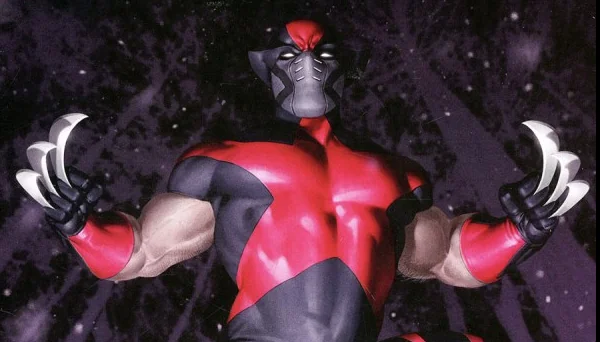
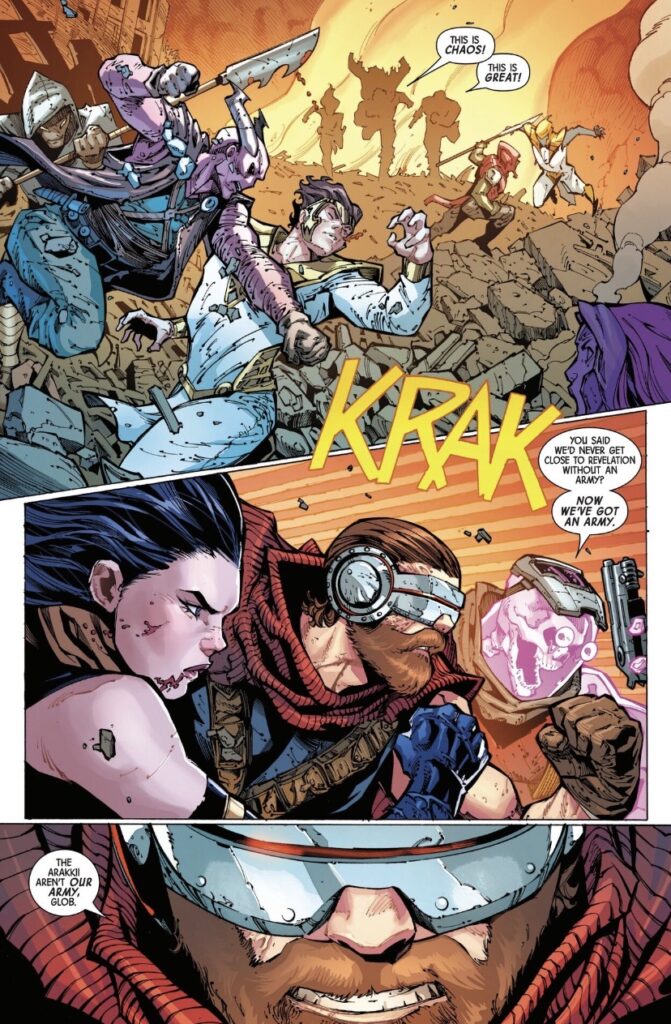
Regardless, with Revelation committed to his motives, the Arakko forces make short work of Revelation’s Choristers and Seraphim, while the X-Men encounter Wolverine, who, thanks to the events of The Last Wolverine, has awoken from his brainwashing and can now resist Revelation. The former Angel of Death is now intent on killing his former master, and there’s an enjoyable page featuring him and Cyclops greeting one another in the stoic, gruff way their characters should.
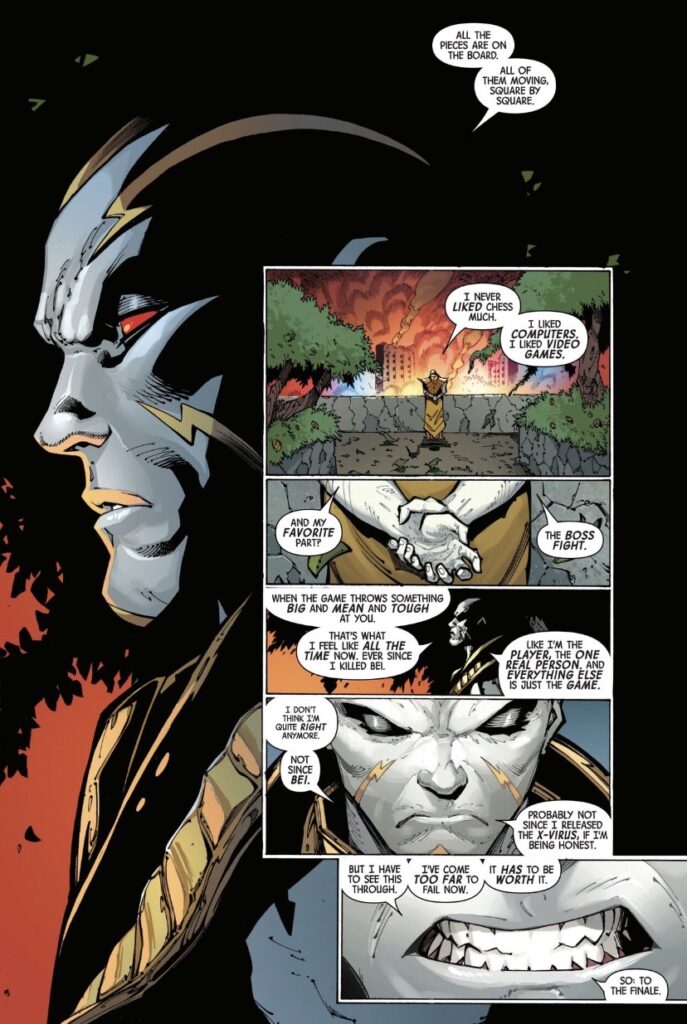
It is at the eve of victory where Revelation’s plan begins to unfold, and much to the horror of the heroes, they have fallen into Revelation’s trap. The merging of the planet begins, unstoppable, and now all that’s left to do is to send Cyclops and Beast back to the present, to stop Revelation before he can rise, as Future Cyclops and Beast were intended to do.
Future Beast returns first, though his sudden appearance shows that all is not as it should be; the X-Men plan went wrong somewhere, and Future Beast takes the last minutes he has to send critical information back. Cyclops is sent back to the present, finding himself locked up and detained by his own X-Men. His future self has wrought harm while he was in control of present Cyclops’ body, and much to Cyclops’ surprise, present day Beast has no clue what Cyclops is talking about.
The issue comes to a dark close, with Revelation in the future obtaining his victory, while in the present, and on the final page, a threat more dangerous than even Revelation now rises, armed with knowledge of the future in a way that could turn the tide decisively.
X-Men: Age of Revelation Finale #1 is surprisingly narrow in focus and scale, considering the huge, sprawling event that led up to it. Characters who seemed ideal for a final showdown with Revelation and were set up for it, such as the X-Vengers and the Expatriate X-Men team, do not appear. Nor does Storm or Phoenix, critical forces that could have turned the tide.
It doesn’t feel like a true finale in that sense; the dark and gruesome ending feels contrived rather than earned. Revelation’s threat from the very beginning has been suspect and not entirely well-explained. Seeing a villain on such shaky grounds succeed feels strange and unsatisfying, particularly as Revelation himself feels closer to villains like Stryfe or Cameron Hodge, perennial punching bags, rather than to Apocalypse or Magneto.
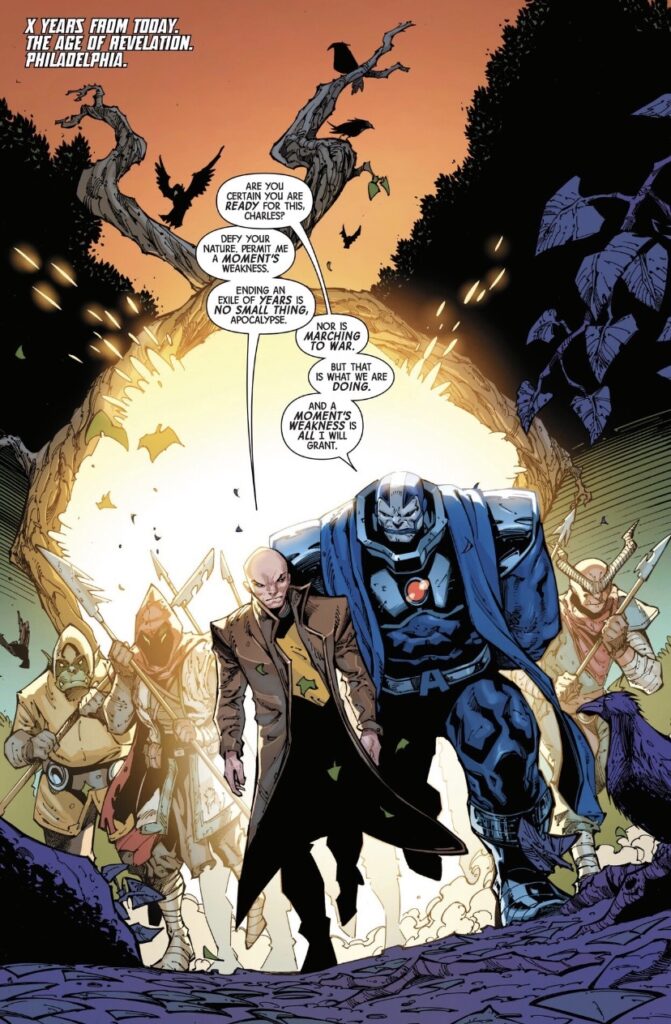
The stronger work comes in what it sets up for the future. The identity of the character on the final page might not shock readers who have paid attention to certain dialogue clues, but it will still surprise many. It’s exciting and offers a chance for the X-Office to redeem a character arc and choice that has been polarizing to this day. Likewise, Cyclops finds himself armed with this dangerous knowledge of the future, and with the chance to do something about it, especially as it pertains to the future Revelation himself, who has come to the X-Men asking for help.
Ryan Stegman finishes his X-Men run as the lead artist with this issue. Since From the Ashes began, Stegman has drawn nine issues, as well as the Overture and Finale issues of the Age of Revelation. J.P. Mayer joins him as the inker, and a new colourist, Marcio Menyz. Netho Diaz also supplies two pages of a psychic battle, which are well drawn and coloured, standing out quite distinctly.
Stegman’s art has been polarizing for the X-Men comics. Famous for his work on Venom and King in Black, Stegman’s stylistic choices for X-Men initially earned some ire for how young it made the characters seem, as well as the anatomical choices that were certainly heavily stylized to say the least. The finale encapsulates his X-Men work, showcasing both his best qualities and his weaknesses. Action sequences are drawn very well, with visceral, intense action and brutality. It is perhaps fair to say that Stegman has been ill-served by a writing style that suits discussion and drama over fights and action sequences, as it is in these moments where he shines. However, there are more than a few faces that look strangely drawn, and some of the smaller panels lack detail and clarity, looking messy and unfinished even.
Overall, the Age of Revelation Finale #1 issue encapsulates many of the triumphs and flaws of the writer and artist alike. MacKay skillfully sets up the future with a genuinely exciting, thrilling twist and builds a strong foundation for new stories. However, in the Revelation future, with the actual story told, he falls short, failing to write a compelling villain and to provide the necessary scale and dramatic tension to pull off the kind of conclusion he was reaching for.
The desperate circumstances feel heavily contrived and not the least bit earned. This reviewer can only hope that Revelation, as both a villain and a character, is done away with to make way for more exciting options. Likewise, Ryan Stegman’s art shines in action sequences, but looks poorly put together in other places, with a rushed, rough, and unfinished feel to it. The next era beckons: the Shadows of Tomorrow, where the events of the Age of Revelation will surely inspire many stories to come. Let’s hope these stories prove more satisfying than their source.
‘X-Men: Age of Revelation: Finale’ #1 Delivers a Polarizing End to a Sprawling Epic
Age of Revelation Finale #1 encapsulates many of the triumphs and flaws of this event. MacKay skillfully sets up the future with a genuinely exciting, thrilling twist and builds a strong foundation for new stories. However, in the Revelation future, with the actual story told, he falls short, failing to write a compelling villain and to provide the necessary scale and dramatic tension to pull off the kind of conclusion he was reaching for.