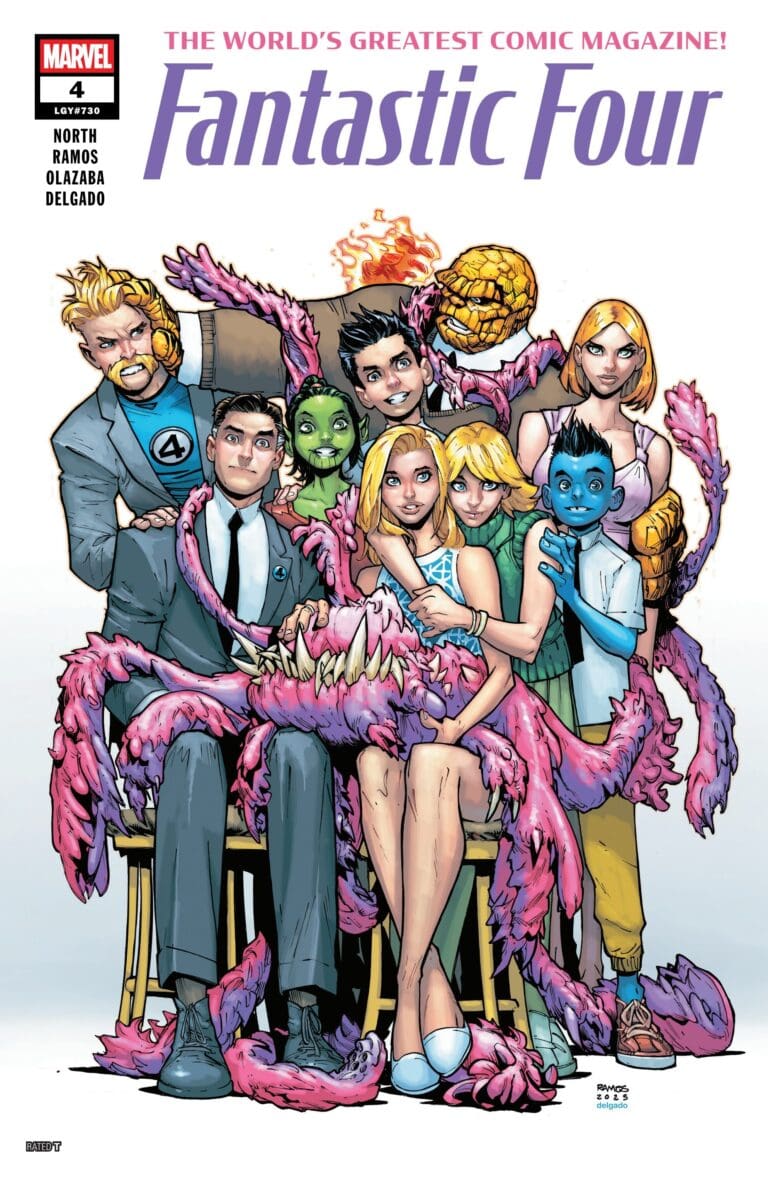
Fantastic Four #4, from writer Ryan North and artist Humberto Ramos, is the kind of mind-bending, sci-fi mystery that makes the best Fantastic Four stories so great. It’s a compelling, often unsettling standalone adventure that shines a spotlight on one of the family’s most invaluable (but often overlooked) members: Alicia Masters-Grimm.
The story kicks off with a seemingly harmless, adorable family addition: a dog named Jellybean. Everyone in the family (even the perpetually grumpy Thing) loves the new fluffball… except Alicia. As a blind sculptor whose entire life revolves around texture and touch, Alicia senses something is profoundly wrong with the new pet. She is essentially less vulnerable to what is going on because she doesn’t rely on sight, and the creature’s trick is entirely visual.
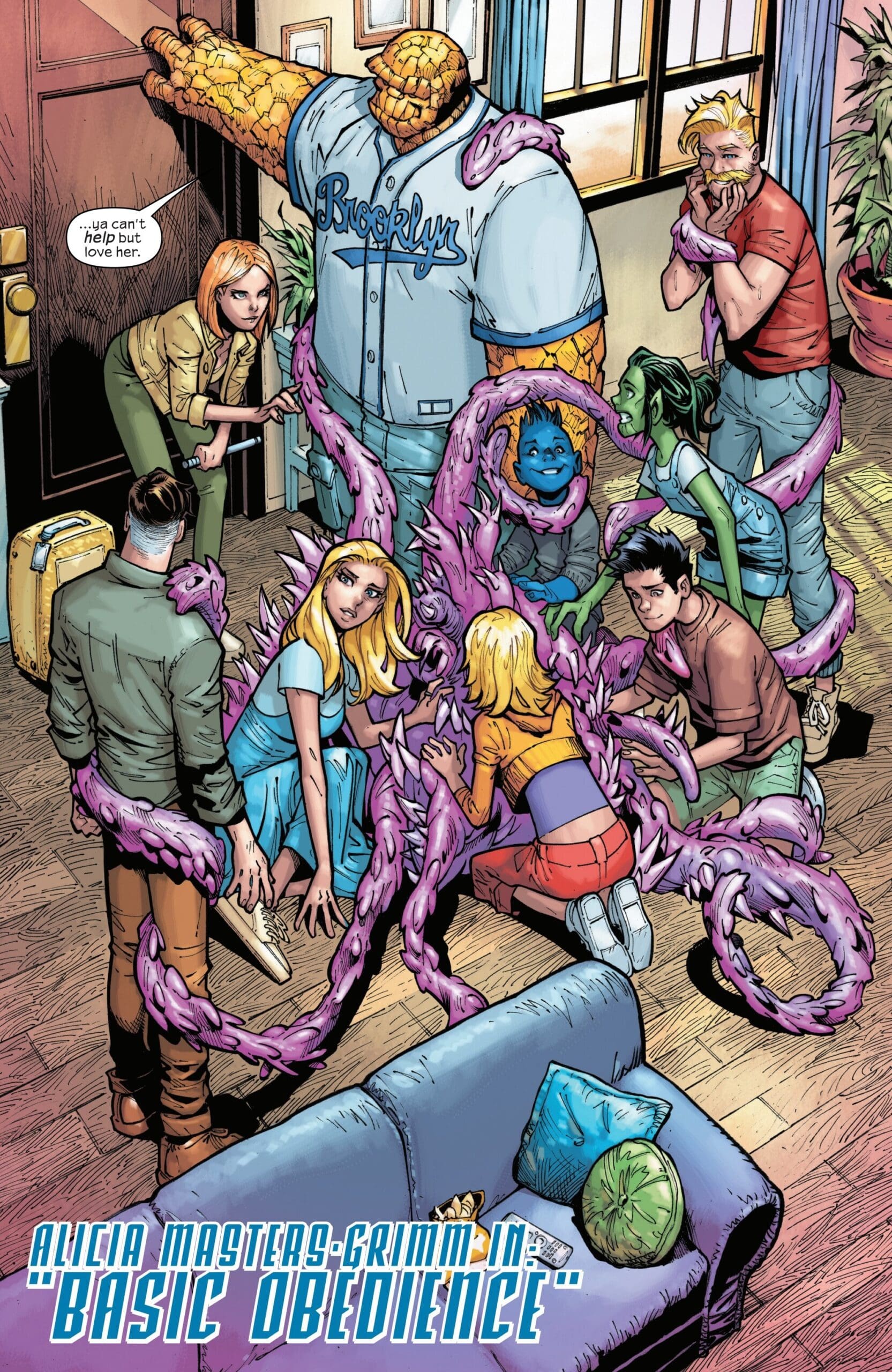
This conflict immediately centers the issue’s theme: perception versus reality. For everyone else, they see a cute dog. For Alicia, the touch of the creature is all wrong, making her the only person who can see through the disguise of this parasitic alien predator.
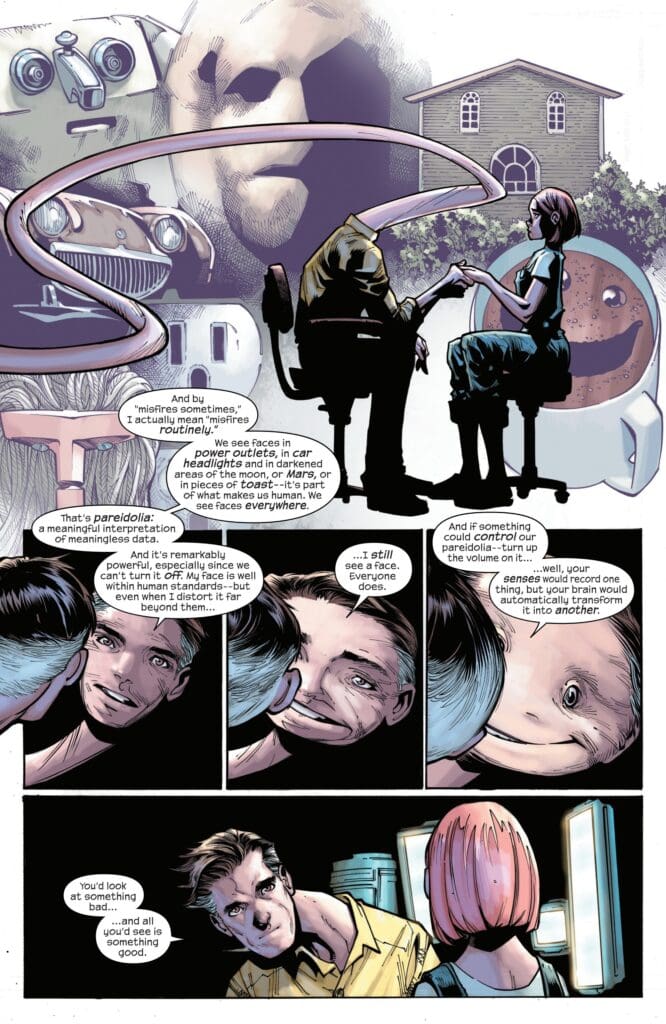
Taking her chilling hypothesis to her brother-in-law, Reed Richards, Alicia explores how a terrifying creature could make people perceive it as friendly. This is where writer Ryan North really shines. Reed deduces that the creature is hijacking pareidolia, that quirky cognitive phenomenon that makes our brains find meaning (like a face in a cloud) in meaningless data. In this case, the mechanism is making them see something awful and automatically transform it into something wonderful, like a harmless dog.
This is classic Reed Richards at his best: a perfect blend of theoretical physics and mad science. He builds a pareidolia inhibitor to suppress these cognitive misfires and reveal the creature’s actual, ugly appearance. When the inhibitor is flipped on, the visual shock is massive. The adorable “Jellybean” is shown to be a horrifying, tentacled, sharp-toothed purple-and-pink mass. It’s a terrifying sight.
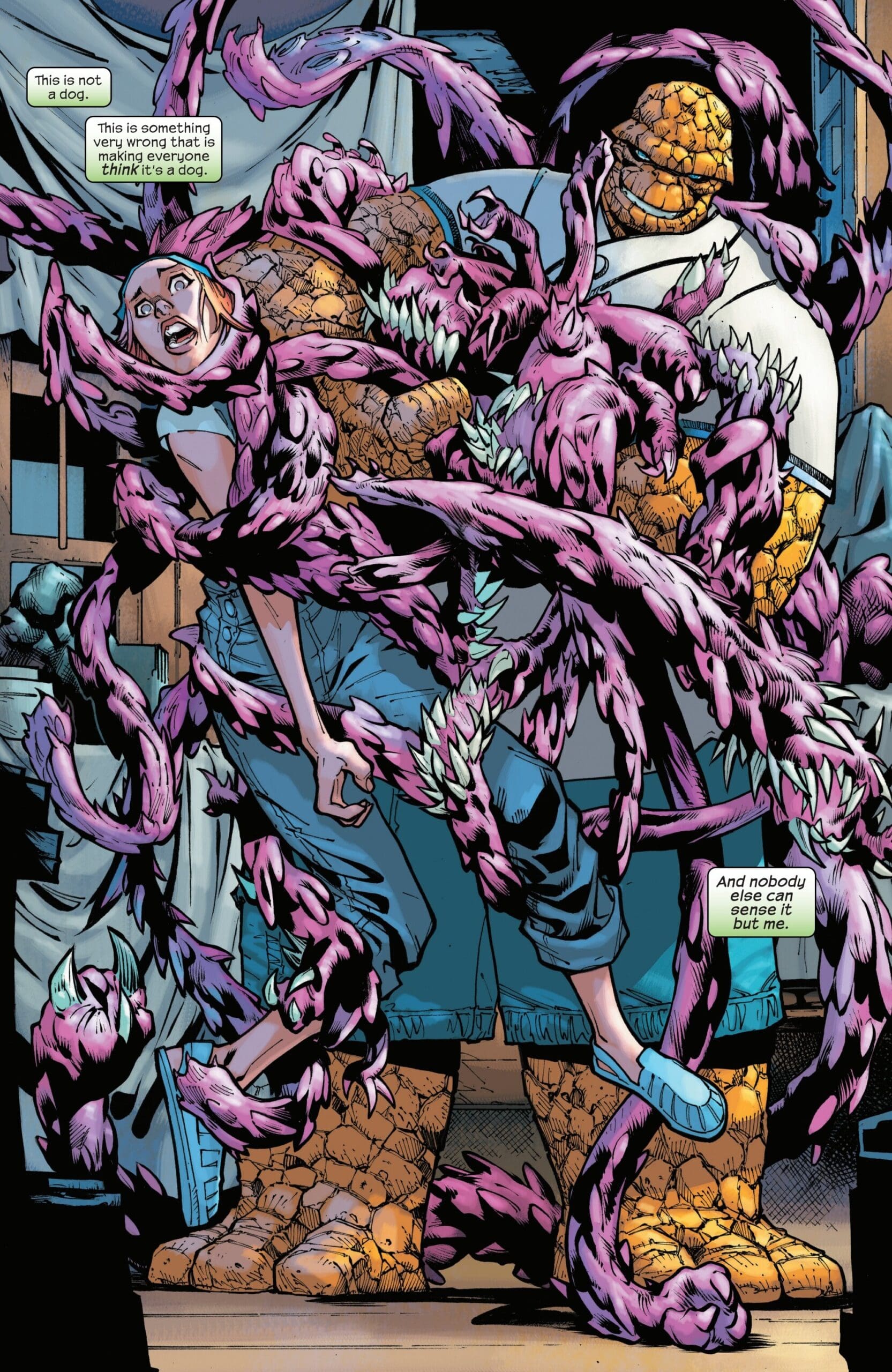
The artwork by Humberto Ramos and Victor Olazaba is characteristically dynamic and expressive, and it’s key to the story’s impact. The monster’s reveal, which happens surprisingly early, is jarring and visceral, a massive contrast to the cozy, domestic setting it had infiltrated. On a character note, Ramos’s faces, especially for Reed, manage to border on nightmare territory in the best possible way. Edgar Delgado’s bright, vibrant colors maintain that classic Fantastic Four energy, but the alien’s shocking palette makes its appearance truly otherworldly.
Reed’s device doesn’t just show them a monster; it exposes a terrifying plot: an alien species that makes everyone perceive them as “friend-shaped” until they reach a critical mass, at which point they’ll induce the inhabitants to literally sleepwalk into their meat grinders. It’s a clever, low-key, domestic infiltration leading to global stakes.
Ultimately, this issue is a powerful showcase for Alicia Masters-Grimm. Her blindness isn’t treated as a disability; it’s her superpower, making her uniquely suited to detect a threat that would fool even super-genius Reed Richards and the ultra-perceptive Invisible Woman, Sue Storm. The entire family’s rescue hinges on her perceptive touch and intellectual partnership with Reed. The issue concludes by acknowledging her heroism and metaphorically welcoming her to the Fantastic Four lineup.
With inventive, science-based plotting and an energetic art team, Fantastic Four #4 is an exciting, accessible, high-stakes one-shot. It’s a smart, fun read for both new fans and long-time readers, and it firmly solidifies Alicia’s place as an essential member of the family.
‘Fantastic Four’ #4 Review: The Dog That Wasn’t
With inventive, science-based plotting and an energetic art team, Fantastic Four #4 is an exciting, accessible, high-stakes one-shot. It’s a smart, fun read for both new fans and long-time readers, and it firmly solidifies Alicia’s place as an essential member of the family.