
Bruce Wayne has a surprisingly large supporting cast for a character often portrayed as a loner, and writer Joshua Williamson weaponizes those relationships in DC K.O.: Knightfight #2. Readers are often left wondering whether Bruce is right to bring these children into his world and what effect his lifestyle ultimately has on their growing psyches. This issue provides a disturbing answer, featuring those warped outcomes in all their dark glory.
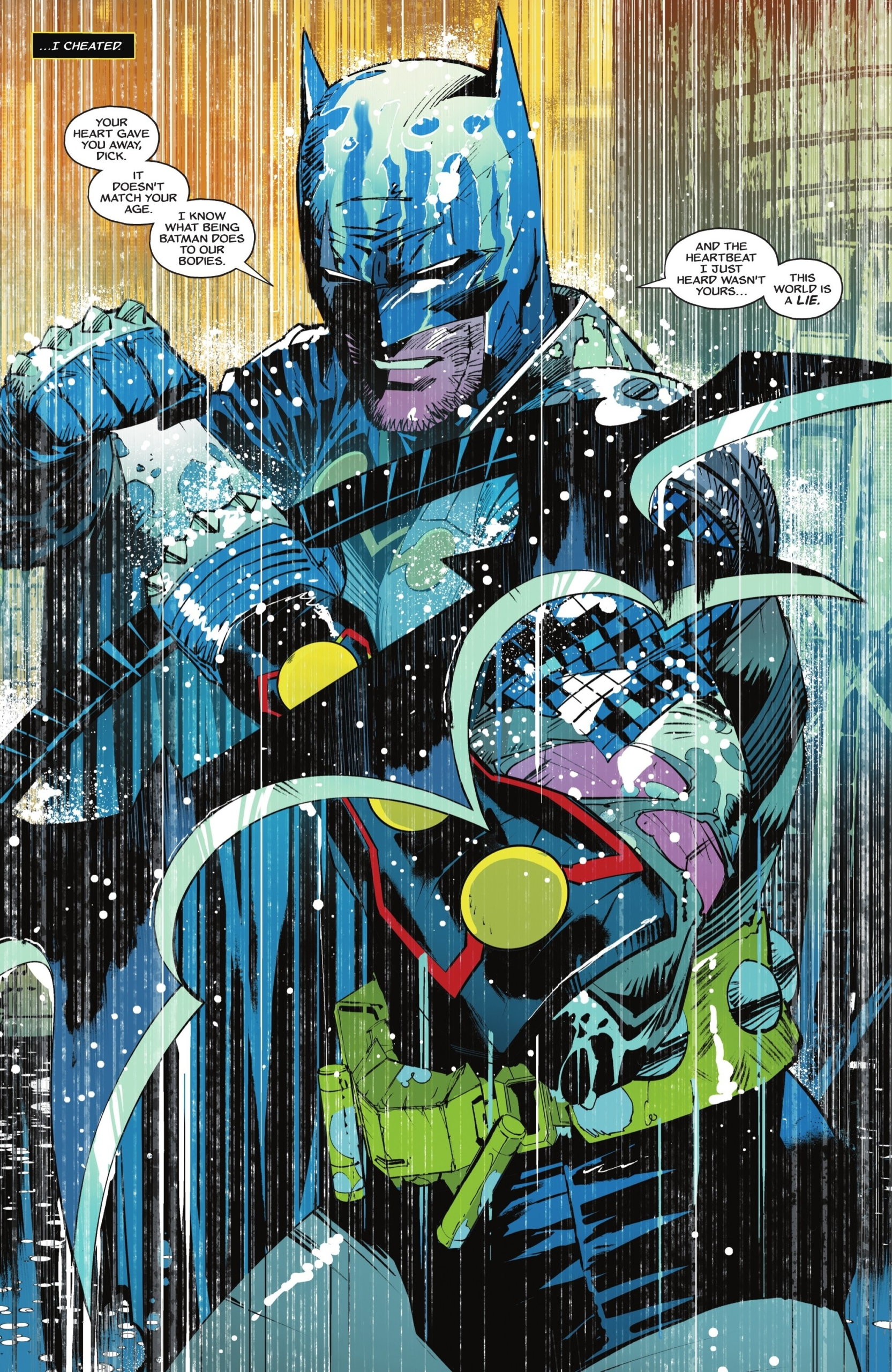
The story opens with Bruce in mid-fight against this reality’s Dick Grayson, having just learned that he’s responsible for the deaths of their Jason Todd, Tim Drake, and Damian Wayne. While the specifics remain vague, what’s clear is that Bruce’s inability to move on from the mantle caused it. It’s something he sees reflected in Dick, who has created a personal army of Robins yet doesn’t trust them enough to give up the cowl himself. It’s heartbreaking to see Dick fail in the same way as Bruce, but it’s that failure that pushes Bruce to a realization. This world is fake, a test created by the Heart of Apokolips to punish him for escaping death. He goes to strike a final blow against Dick before being transported to a different reality.
We soon see that Bruce has only hopped out of the frying pan and into the fire. He finds himself shackled in a cell, injured and trapped. We’re not used to seeing Bruce in a position of vulnerability like this, signalling something is very wrong. In this universe’s Batman, Jason Todd believes Bruce is actually Clayface. Bruce soon escapes, only to discover the tragic outcome for this world’s Gotham. It’s become a massive Arkham, poisoned by the Joker’s irradiated gas, with Jason protecting it as its singular citizen. He claims the greatest lesson he learned from Bruce was how to be alone, highlighting another one of our hero’s flaws. Seeing no other option, Bruce leans into this reality’s narrative, changing into Clayface to confront Jason in a shocking final panel.
We’ve seen Bruce at odds with his protégés before, but Williamson frames their conflict in a unique way. Rather than simply pitting Bruce against corrupted versions of his sidekicks, the writer uses Dick and Jason as a way to showcase his greatest flaws. Dick’s inability to trust his army of Robins echoes Bruce’s struggle to truly share the burden of being Batman. At the same time, Jason’s descent into cruel isolation reflects Bruce’s own long-standing loneliness. Batman is often portrayed as a consummate professional, so having him confront his shortcomings made human is a refreshing change of pace.
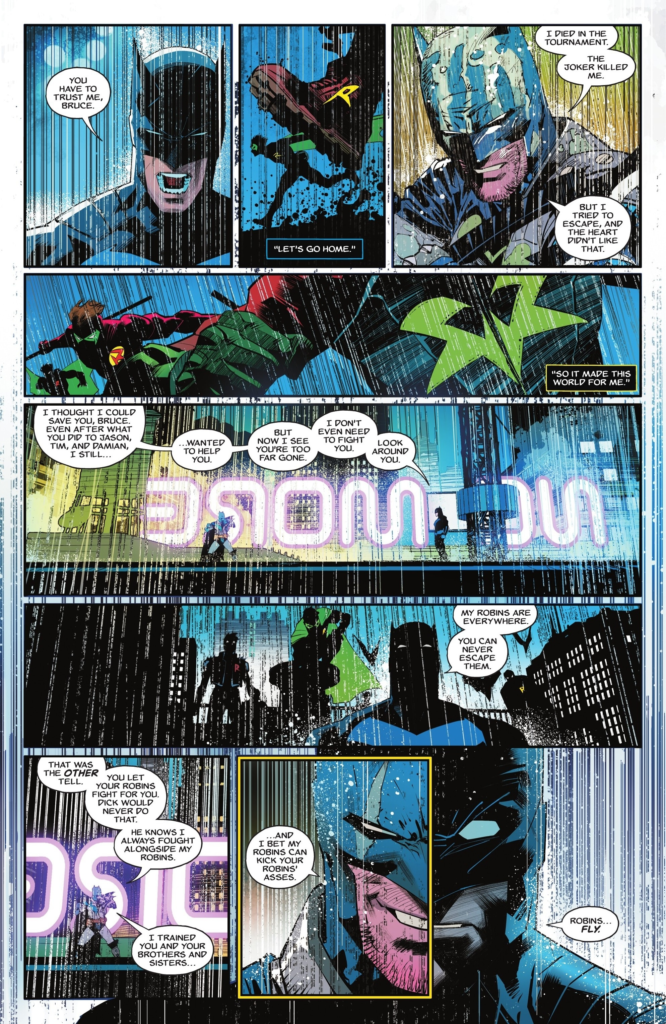
Williamson’s exploration of these alternate Bat-family members reveals just how deeply Bruce’s influence runs in them. Dick’s establishment of Robin programs in every major city shows his large-scale thinking, yet it’s poisoned by the same paranoia that haunts his mentor. He may have been able to create a literal army of successors, but he still hasn’t learned to trust them. Meanwhile, Jason’s situation is more tragic. He’s become an isolated man, fueled by Bruce’s worst impulses, standing as the lone protector of a dying Gotham. It’s a wretched fate and a damning commentary on what happens when you lean into Batman’s trauma without his moral center.
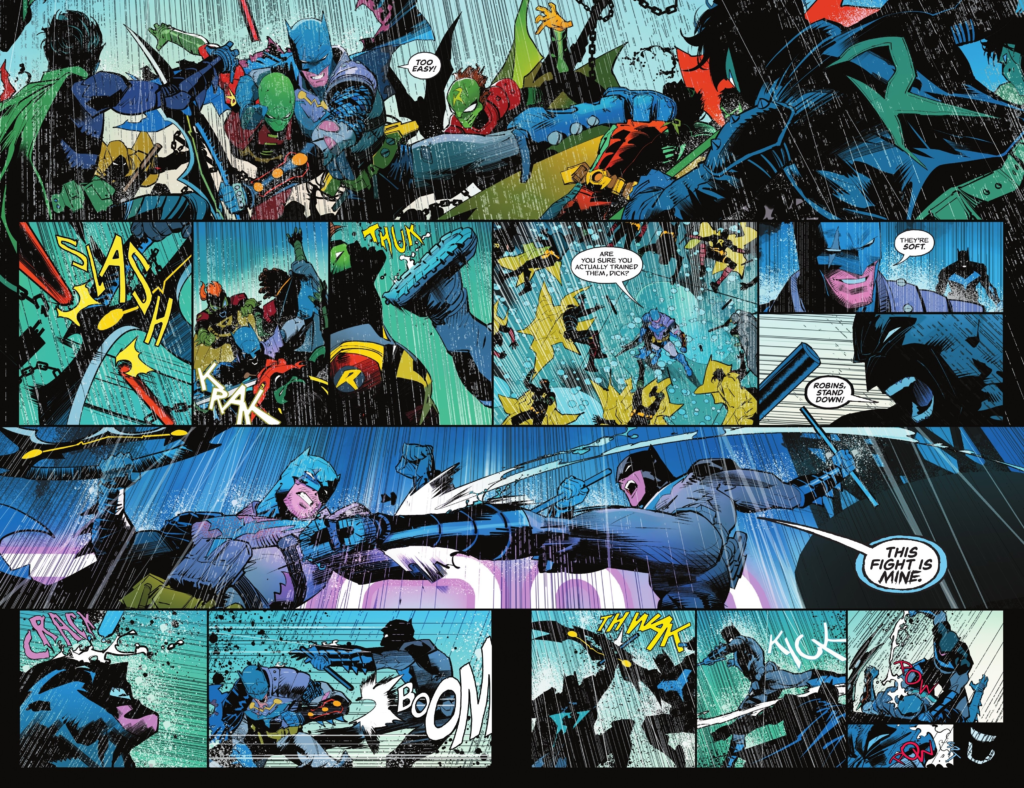
Dan Mora’s art is excellent throughout, showcasing why he’s one of DC’s go-to artists. The character and city designs are top-notch, with each Robin maintaining their own distinct elements while incorporating them into new Batman costumes. Jason’s appearance steals the show, merging bright reds with Batman’s signature horns and cape to create a terrifying new Red Hood. The fights are brutal and intense, with each blow that Bruce, Dick, and Jason exchange doing physical and emotional damage. The splash montage of Dick and Bruce fighting on page eight is a highlight, condensing an entire battle into a single chaotic scene.
Triona Farrell is spectacular on colors and nails each reality’s distinct elements. Dick’s world is murky and drenched in perpetual night, with only his blue bat logo and the Robins’ different colors popping through the gloom. Jason’s world flips this approach, rendered largely in black and white except for his signature reds, which burst out of each panel. It’s a smart choice that portrays Jason’s influence in an inescapable fashion. The image of Gotham contained within a giant red globe on page twenty-four is a treat, manifesting the Red Hood as a physical prison. Tom Napolitano’s letters alternate between dark thought boxes and white speech bubbles, taking readers on a clear journey through internal monologues and external conversations. It never detracts from Mora’s art; instead, it adds important context to each panel.
Those who were worried Bruce would be sidelined during this event can rest easy. Williamson and Mora have sent him on a journey to confront the darkness within himself. This is a problem he can’t punch his way out of, and it’s going to take everything within Bruce to come out of the other side. It may be a daunting task, but if anyone’s up to the challenge, it’s Batman.
‘DC K.O.: Knightfight’ #2 Review: Clayface, Red Hood & the Poisoned Gotham
Those who were worried Bruce would be sidelined during this event can rest easy. Williamson and Mora have sent him on a journey to confront the darkness within himself.