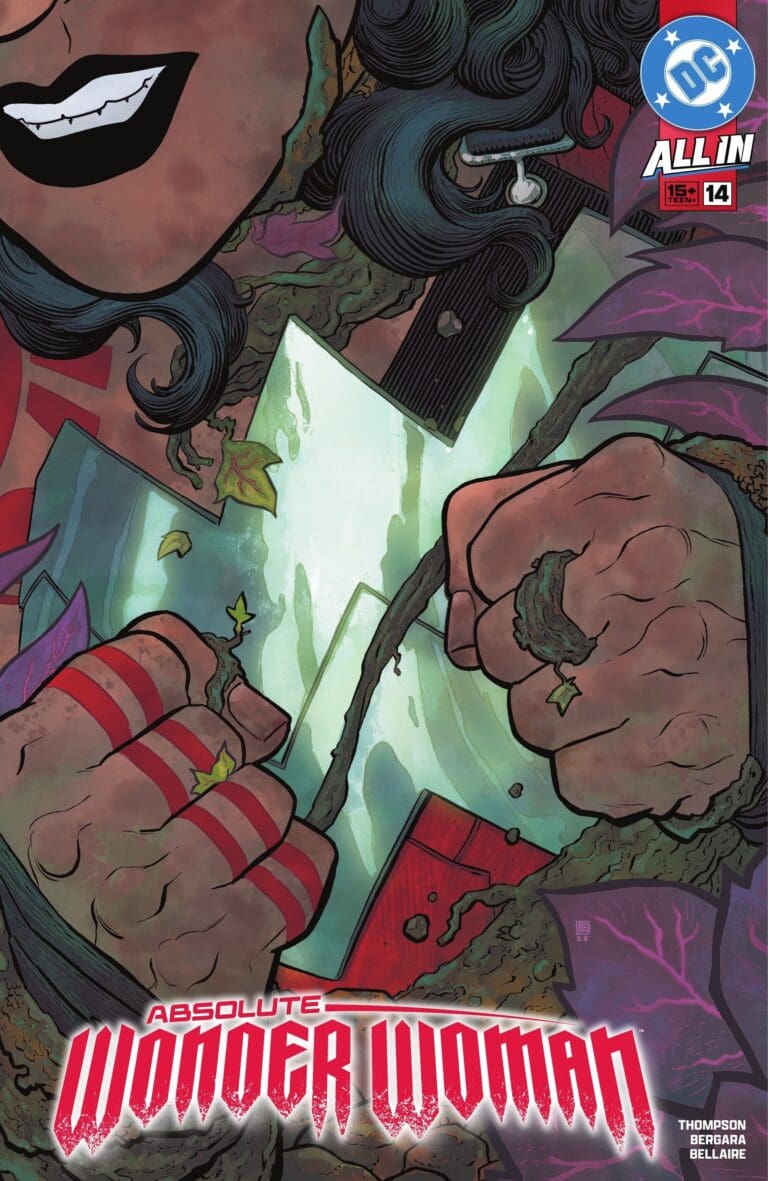
If there is one thing Kelly Thompson has nailed in her run on Absolute Wonder Woman, it’s the sheer weight of Diana’s existence. It’s not just about punching monsters; it’s about the metaphysical ripples a demigod causes just by standing in a room. Issue #14, the conclusion to the “The Price” two-parter, takes that concept and sprints with it. It’s an issue that balances high-octane action with a surprisingly deep philosophical debate about the state of the modern world, all rendered in Matías Bergara’s electric, kinetic style.
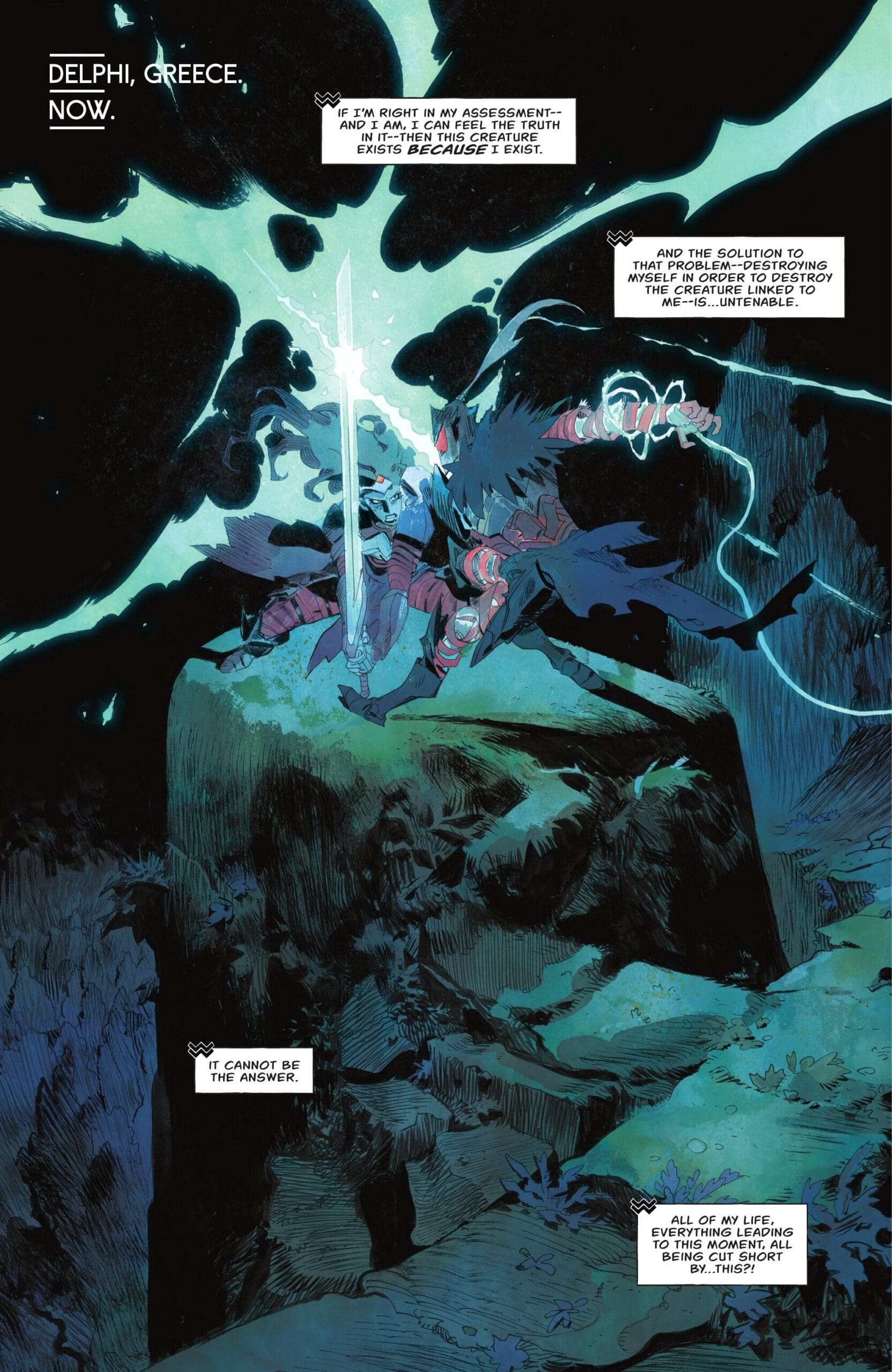
The issue opens immediately where we left off: Diana is in a desperate scrap with a creature that is essentially her “inverse.” The internal monologue here is fascinating. Diana realizes that this monster exists because she exists. Magic demands a balance. If the universe gets a Diana (a force of overwhelming good, compassion, and light), it apparently feels the need to cough up a counterweight of pure negativity.
Realizing she can’t just punch her way out of a metaphysical equation, Diana puts the creature to “sleep” temporarily and regroups at The Hieron. This leads to the issue’s strongest story beat: the planning session. Diana is resigned to the idea that her existence is the problem. She’s ready to pack it in. But Gia, acting as the voice of the audience (and perhaps the writer), calls absolute nonsense on that theory.
Gia’s argument effectively reframes the entire conflict. She points out that the world is run by billionaires stepping on the vulnerable, corporations poisoning the planet, and endless surveillance. The world is already out of balance. Diana isn’t the cause of the glitch; she’s the patch. It’s a great moment that grounds the high-fantasy concepts in gritty, modern reality.
Reinvigorated (or at least convinced she shouldn’t un-exist herself just yet), Diana heads to Samothrace, Greece. Her plan? Summon Gaia, the Earth Mother herself, to sort this out. The catch is that you don’t just ring Gaia’s doorbell; you have to bleed to get her attention. The subsequent confrontation isn’t a fight, but a negotiation with the planet itself. Gaia imprisons the creature but demands a heavy price: Diana must fight the encroaching darkness, and eventually, give her life in Gaia’s name. Diana accepts without hesitation, because of course she does.
The core theme of this issue is “Balance vs. Imbalance,” but Thompson refuses to let it be a simple black-and-white trope. Usually, in superhero comics, balance is treated as a sacred law. Here, the book argues that the natural order might already be rigged. Gaia initially refuses to help, claiming the universe is just correcting itself. Diana’s rebuttal (that the world has been tricked into darkness) is a defining character moment and a further affirmation of what readers already know: that the Absolute Universe is inherently evil.

Matías Bergara continues on art duties, and his style brings a distinct flavor to the book. If you’re used to more traditional house style superhero art, Bergara might be a shock to the system, but in the best way possible. His lines are loose, expressive, and incredibly fluid. The opening fight scene feels dangerous and fast; you can feel the impact of the “inverse” creature shredding through Diana’s defenses.
Where Bergara really shines, however, is the arrival of Gaia. He draws the Earth Mother not as a woman in a toga, but as a towering, terrifying amalgamation of roots, earth, and glowing eyes. It feels ancient and divine, and I’m kinda also hoping Gaia comes back as maybe the Absolute Universe version of the Parliament of Trees. Absolute Swamp Thing, anyone?
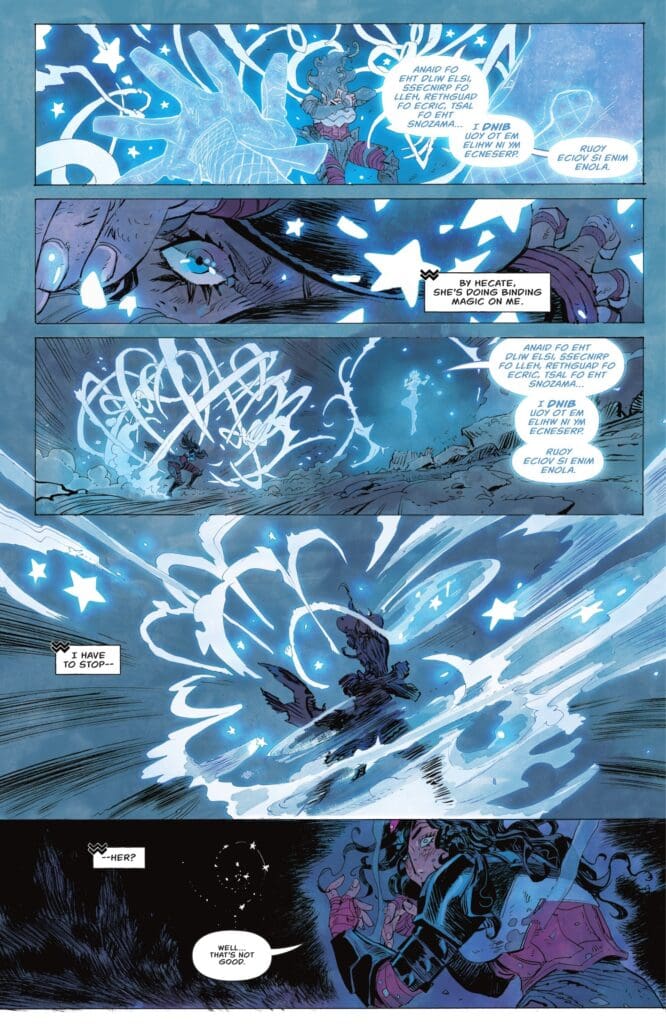
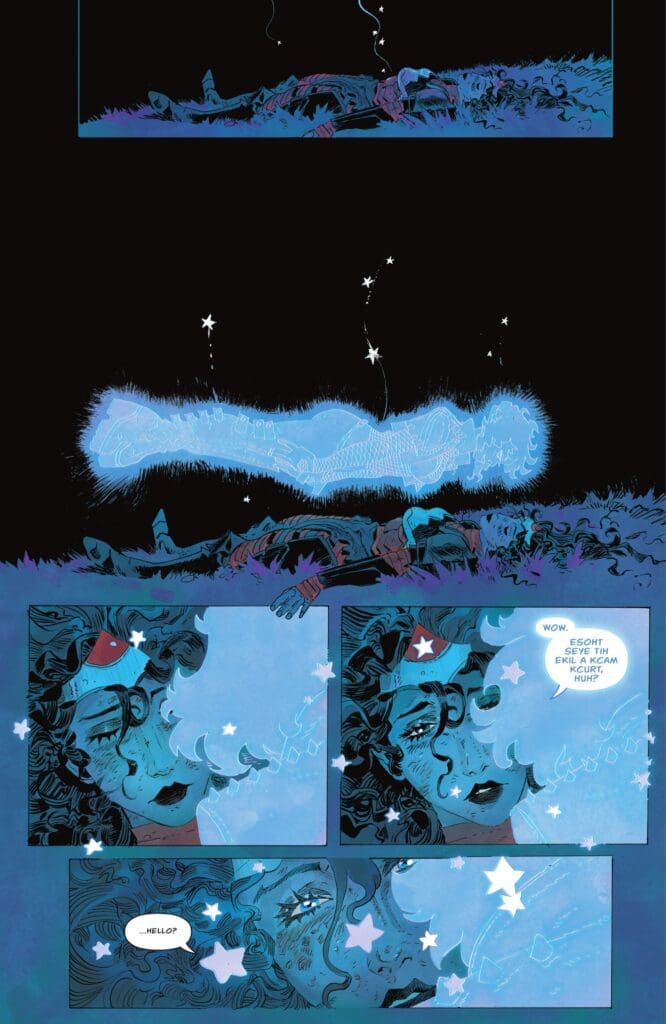
Jordie Bellaire’s colors are, as always, doing heavy lifting. She creates a distinct separation between the magical and the mortal. The inverse creature is surrounded by sick, neon greens and electric blues that feel radioactive against the earthy tones of the Greek ruins. When Gaia appears, the palette shifts to deep, overwhelming crimsons and blacks, signaling that we have left the realm of superheroes and entered the realm of horror-fantasy. Finally, a special nod goes to letterer Becca Carey. Lettering often goes unnoticed unless it’s bad, but here it adds a crucial layer to the storytelling. It forces the reader to slow down and decode what Zatanna is saying, much like Diana has to.
Absolute Wonder Woman #14 is a satisfying conclusion to “The Price” that sets up massive stakes for the future. We get a resolution to the “Inverse” problem, but it comes with a literal deadline on Diana’s life courtesy of Gaia.
‘Absolute Wonder Woman’ #14 Review: The Cost of doing Business with Gods
Absolute Wonder Woman #14 is a satisfying conclusion to “The Price” that sets up massive stakes for the future. We get a resolution to the “Inverse” problem, but it comes with a literal deadline on Diana’s life courtesy of Gaia.