
Captain Planet has stuck in our minds for generations because of his powerful message teaching us that protecting the Earth is a task requiring teamwork, diversity, and individual action. Now, after 35 years, the iconic eco-hero makes a much-anticipated return to comics in Captain Planet and The Planeteers #1 – and perhaps they’re needed more than ever.
In this new adventure from David Pepose (Cable: Love and Chrome, Space Ghost) and artist Eman Cassallos, the classic elements – Earth, Fire, Wind, Water, Heart – unite once more to summon Captain Planet. But when Gaia, the Spirit of the Earth, is captured by the villain Lucian Plunder, the Planeteers face a critical test. Even with their powers combined and Captain Planet fighting beside them, can they rescue Gaia and halt Plunder’s destructive path?
Credit: Dynamite Comics
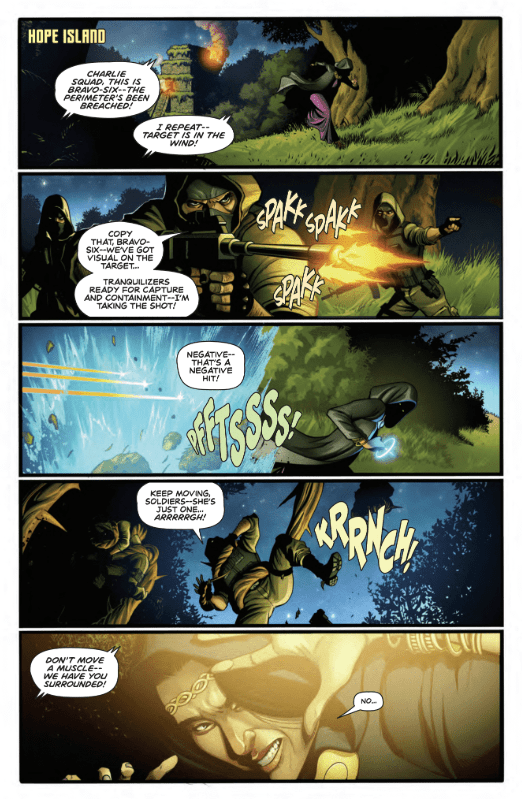
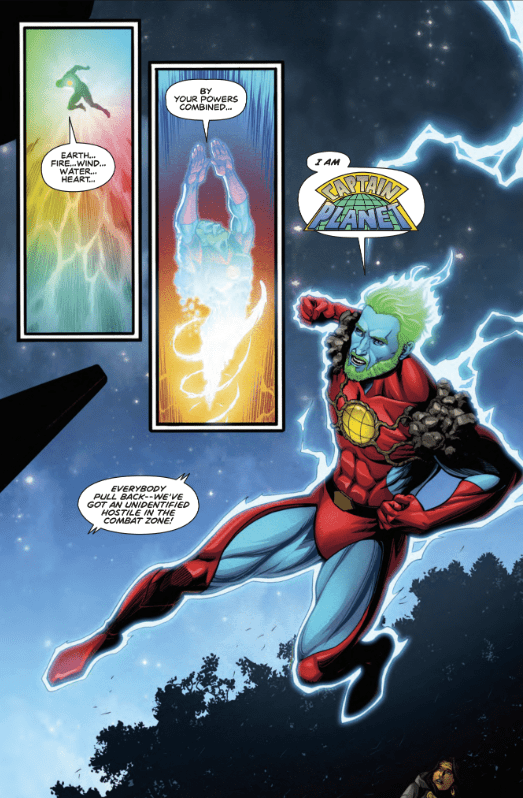
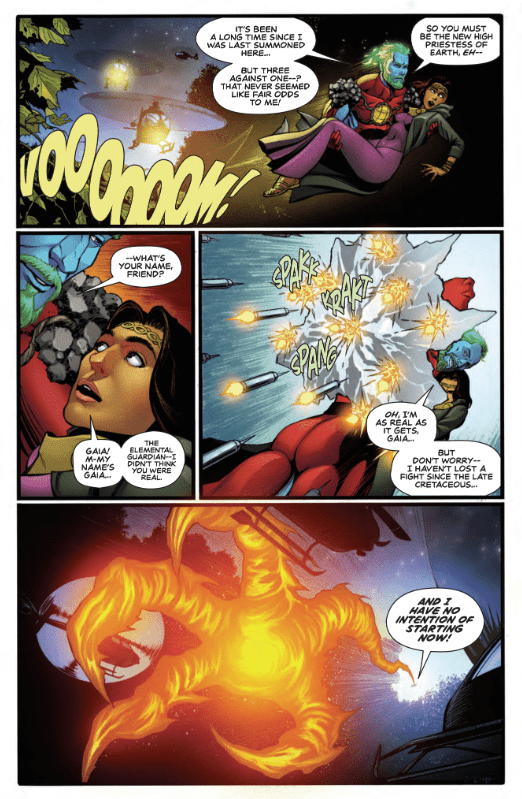
While Captain Planet #1 will bring back those warm, fuzzy memories, its story feels incredibly fresh and speaks directly to the heart of today’s issues. The story kicks off with a dramatic chase on Hope Island where Gaia, the spirit of the Earth, is being hunted by a militia. Despite using her elemental powers to defend herself, she’s outmatched by their advanced weaponry. In a last-ditch effort, Gaia summons Captain Planet using the combined powers of Earth, Fire, Wind, Water, and Heart. He makes a grand entrance and tries to fend off the attackers without causing serious harm, but this approach backfires when the militia uses heavy artillery, leaving Captain Planet badly wounded. This dire situation forces Gaia to send the power rings across the globe just before she is captured.
Following Gaia’s imprisonment, the story shifts to five different people around the world as they discover their newfound elemental abilities in moments of crisis. We meet Kwame, who wields the power of Earth; Wheeler, who controls Fire; Linka, with the power of Wind; Gi, commanding Water; and Ma-Ti, who possesses the power of Heart. The issue concludes with Gaia telepathically reaching out to these new Planeteers, urging them to action. At the same time, the villain, Lucian Plunder, unveils his plan to seize the elemental powers for his own destructive purposes, setting the stage for the Planeteers’ mission.
Credit: Dynamite Comics
Pepose and Casallos’s Captain Planet #1 delivers a nostalgic gut punch while feeling depressingly current, instantly showing why these heroes are needed now more than ever. Pepose’s fantastic script drives this urgency; action-packed and fast-paced, it smartly avoids exposition, throwing readers straight into the action and commendably trusting their intelligence.
The story effectively highlights the Planeteers’ core values: Kwame’s struggle with misfortune while moving forward, Wheeler’s fiery passion for justice, Gi’s representation of fluid wisdom, and Ma-Ti’s deep appreciation for life. These themes underscore some fundamental human endeavors: protecting one’s own and standing up for what’s right, even when facing human or natural obstacles. At its core, the message is a powerful call to action.
Artist Eman Casallos delivers the visual spectacle, crafting dynamic layouts, bombastic action, and impressive set pieces that keep the comic in constant motion. Casallos runs wild with the full elemental spectrum, showcasing it brilliantly across varied global locations that allow his creativity to truly shine. Complementing this energy is Captain Planet’s updated design, which proves to be a success. Small tweaks, like the beard adding a bit of edge and the rock/earth elements on his shoulders, subtly modernize the character while preserving the classic, vibrant ’90s color scheme.
Colorist Jorge Sutil brings it all to life with a unique palette. The colors elevate Casallos’s artwork; Captain Planet looks colorful and grand, yet integrates naturally into the world around him. Sutil’s skill truly shines in rendering the elemental energies – electric blues, blazing oranges, and Cap’s distinctive green hair all look spectacular. Together, the art and colors have a slight throwback feel, reminiscent of the gradient-heavy style of 2000s comics, managing to feel both nostalgic and polished. Finally, letterer Jeff Eckleberry does an excellent job using impactful onomatopoeias, adding an great finishing product.
The comic’s only potential downside is also a strength: it dedicates significant time to setup. However, it uses a montage structure effectively to quickly introduce the key players, their beliefs, and their current situations. It’s a familiar trope, but executed well here.
Credit: Dynamite Comics
Captain Planet #1 is a timely relaunch blending nostalgia with modern relevance. Pepose’s compelling, fast-paced script and Casallos’s dynamic art, enhanced by Sutil’s vibrant colors, make this a highly promising debut. If you are looking for a nostalgic trip with a message, pick up Captain Planet.
Advance Review: ‘Captain Planet’ #1: Returns When We Need Him Most
Captain Planet #1 is a timely relaunch blending nostalgia with modern relevance. Pepose’s compelling, fast-paced script and Casallos’s dynamic art, enhanced by Sutil’s vibrant colors, make this a highly promising debut. If you are looking for a nostalgic trip with a message, pick up Captain Planet.